

The Strategic CFO as Capital Architect: Fixing Systemic Clogs in the Actual Movie Introduction: From Observation to Architecture In most organizations, finance still operates as a historian — documenting the contrail of past EBITDA. The Strategic CFO operates differently. They step into the Actual Movie, where capital is not observed but engineered. This third installment in the CFO series moves from diagnosis to design. After exposing the Billboard Trap, this article examines how elite finance leaders eliminate systemic clogs by architecting capital systems that preserve momentum through volatility. Key Points (Executive Summary) Liquidity constraints are often coverage failures, not cash...

Why CFOs Misjudge the True Cost of Capital
CFO Series Part 2: The Billboard Trap — Why CFOs Misjudge the True Cost of Capital Introduction In Part One of the CFO Series, we challenged finance leaders to stop staring at the contrail of historical EBITDA and instead focus on the engine: Cash Velocity. But even CFOs who adopt a velocity-first mindset often fall into a second, more dangerous illusion — the Billboard Trap. The Billboard Trap occurs when capital decisions are judged primarily by the nominal rate displayed on the billboard, rather than by how effectively that capital moves through the business. This article dismantles that illusion by examining...

Cash Velocity Architecture Modern CFOs
Stop Chasing the Contrail: The Architecture of Cash Velocity for Modern CFOs For decades, CFO performance has been judged by a familiar contrail: trailing EBITDA. It is clean, auditable, and easy to explain. It is backward-looking. EBITDA records what already happened, not whether the business has the liquidity and momentum required to fund what comes next. In modern operating environments, this distinction matters. Companies can report strong EBITDA while experiencing cash strain, limited strategic flexibility, or increasing fragility beneath the surface. The disconnect is structural, not theoretical. The modern CFO must shift from managing historical earnings to managing cash velocity—the...

Capital Source Reports $63.3 Million Deployed in 2025
Capital Source Reports $63.3 Million Deployed Across Diverse Portfolio in 2025 Chicago — January 26, 2026 — Capital Source®, through its Private Credit Division, announced another strong year of execution and growth in 2025, deploying $63.3 million across a diverse portfolio of small and lower-middle market businesses throughout North America and Canada. Throughout the year, Capital Source continued to support founder-led and operator-driven businesses with flexible, growth-oriented credit solutions built around real operating needs, including expansion initiatives, acquisition activity, working capital support, and balance sheet optimization. “2025 reinforced what we focus on every day: disciplined underwriting, pragmatic structuring, and being...
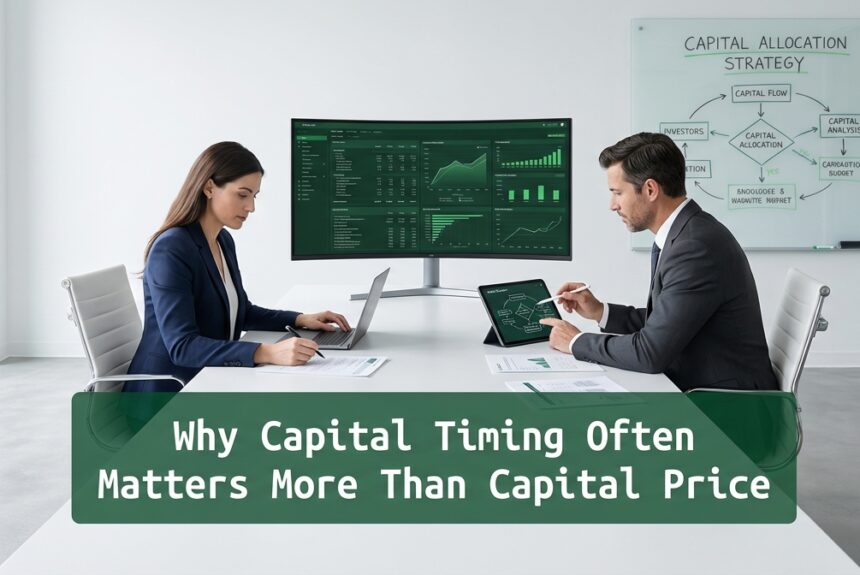
Capital Timing Often Matters More Than Capital Price
Why Capital Timing Often Matters More Than Capital Price Introduction Capital decisions often fixate on price since price is visible. It can be compared, negotiated, and defended. Timing works differently. It rarely appears on a term sheet, yet it determines whether capital accelerates growth or compensates for decay. Two capital raises at identical prices can produce dramatically different outcomes based on when they occur. This article concludes a five-part series examining capital through a structural lens—moving beyond cost discipline to consider time, motion, learning, and momentum. At the center of that framework sits a simple and often overlooked reality: timing...