

The Real Cost of Money Isn’t the Rate Introduction In business finance, few mistakes are as persistent—or as costly—as misjudging the true cost of capital. CFOs and owners routinely compare interest rates, factor rates, or headline pricing as if those figures capture the full economic impact of a financing decision. They do not. The real cost of money is not the rate attached to it. It is what happens to a business while it waits for capital to arrive—and how that waiting affects execution, momentum, and cash-flow velocity. This distinction matters more than ever in an environment where underwriting timelines...

Hidden Cost of Lost Momentum
The Hidden Cost of Lost Momentum in Growing Organizations Part 4 of a series on capital, time, and organizational velocity Introduction Most organizational damage does not arrive dramatically. It accumulates quietly. Momentum fades long before results decline—and by the time the slowdown is visible in metrics, recovery is expensive. For growing organizations, momentum is not a motivational concept. It is an operating condition that affects decision cycles, talent attraction, execution quality, and the efficiency of capital. This article builds on earlier parts of the series that examine why cost discipline can erode long-term performance, why time compresses optionality, and why...

Symmetric Liquidity Capital Alignment
The Symmetric Cure: Solving Liquidity Shocks Through Capital Alignment Introduction Liquidity shocks are commonly described as cash shortages. In practice, they are structural failures—misalignments between how capital is deployed and how cash actually moves through a business. When external friction rises, internal cash velocity slows, and working capital requirements expand horizontally. Traditional, linear bank debt is not designed to absorb that shift. For a broader strategic framing of liquidity shock responses, see our companion analysis: Strategic Solutions to Liquidity Shock. This article outlines a symmetric approach to liquidity recovery: securing the operational foundation through Asset-Based Lending (ABL) and restoring cash...

Organizations Learn Faster Through Motion
Why Organizations Learn Faster Through Motion Than Planning Introduction Planning feels productive. Motion feels risky. Most organizations default to analysis when uncertainty rises. They extend planning cycles, refine assumptions, and delay action in search of clarity. The intent is rational: reduce error before committing resources. But organizations do not learn through prolonged certainty. They learn by acting, observing results, and adjusting course. In capital strategy, this distinction matters. Learning speed is not a cultural trait—it is a structural outcome shaped by how capital, time, and motion interact. This article is Part 3 of a series examining why capital strategy fails...
Time Variable Capital Decisions
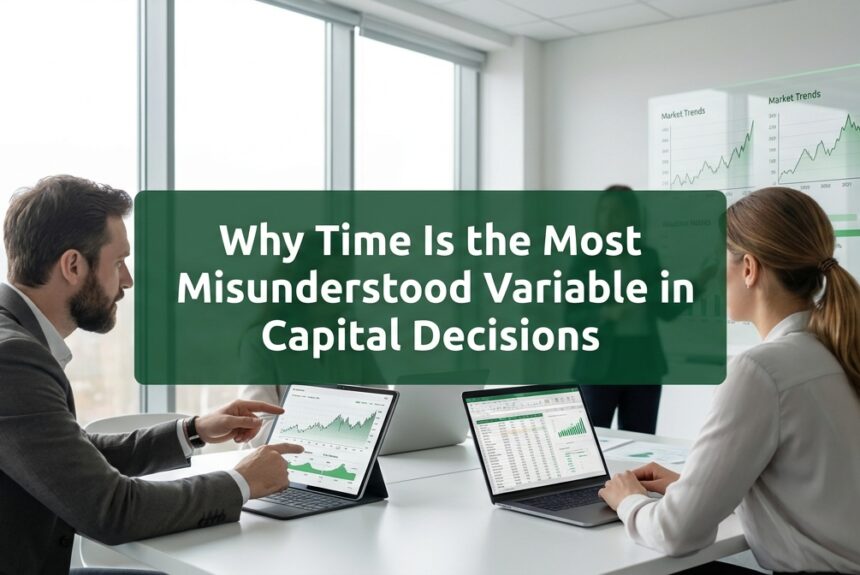
Why Time Is the Most Misunderstood Variable in Capital Decisions Introduction Time is often treated like money—something to save, delay, or deploy later. In capital decisions, this framing feels disciplined. Leaders wait for clearer signals, lower risk, or better pricing. Time does not behave like capital. It cannot be stored, refinanced, or recovered. When it is treated as a cost input rather than a structural force, organizations make decisions that appear prudent yet quietly narrow future options. This article is Part 2 of a broader series on capital strategy. It builds on the argument that cost discipline alone can undermine...