
Customer Concentration: How One Big Customer Can Shrink Your Credit Line
Landing a customer that grows into 40% of your revenue feels like the best year you have ever had. To a lender it can read as single-party risk, and it can quietly shrink the credit you qualify for. Here is the arithmetic, in plain English.

There is a paradox that catches good operators off guard: your best sales year can reduce your borrowing capacity. You land an anchor account, revenue climbs, margins hold, and then the renewal on your line of credit comes back smaller than you expected. Nothing went wrong. The business got more concentrated, and concentration is priced.
Most explanations of this stop at “lenders do not like concentration,” which is true and useless. The mechanics are specific, they are written down, and once you can see them you can plan around them. So rather than paraphrase, we will quote the clearest public source there is and walk the math.
One important note before we start. The guidance quoted throughout this article comes from the Office of the Comptroller of the Currency, and it is written for the institutions the OCC supervises: national banks and federal savings associations. It is not a universal commercial-lending standard, it does not bind every lender you might talk to, and it is emphatically not Capital Source underwriting criteria. We use it because it is the most detailed public explanation of how this arithmetic actually works, and because a great deal of the credit market takes its cues from it. Think of it as a well-lit example, not the law of the land. Your own lender may draw the lines somewhere else entirely.
What is customer concentration?
Customer concentration is the share of your revenue or your receivables that depends on a single customer, or on a small handful of them. It matters to a lender because it converts a business risk into a credit risk: if that one relationship changes, the cash flow backing the loan changes with it.
The Office of the Comptroller of the Currency, which supervises national banks, defines it this way in its Comptroller’s Handbook on Asset-Based Lending:
“A concentration exists when a few customers produce the majority of receivables or when sales are primarily to customers in one industry.”
“A receivables concentration of one account or a few large accounts is often referred to as ‘single-party’ risk; if the ‘single party’ takes its business elsewhere or its financial condition deteriorates, the borrower’s business could be compromised.”
OCC Comptroller’s Handbook, Asset-Based Lending, Version 1.1
There is a number attached to it, and it sits lower than most owners guess. The same guidance says a bank “normally considers receivables to be concentrated if there are single accounts representing 10 percent or more of the total receivables portfolio.”
Read “normally considers” exactly as written. That is the point where an examiner expects a bank to start paying attention. It is not a trapdoor that swings open at 10.01 percent. Plenty of lenders sit comfortably above it with the right customer and the right paperwork. What the number really tells you is where the conversation starts.
Here is a useful coincidence. The accounting rulebook arrives at the same figure from a completely different direction: under ASC 280-10-50-42, a public company must disclose the existence and amount of revenue from any single external customer accounting for 10 percent or more of its revenues. That is a disclosure standard for financial statements, not a lending rule. It does not govern your credit line and no lender applies it to your facility. It is worth knowing only for what it reveals: when accountants sat down to decide at what point one customer becomes material enough that outsiders deserve to hear about it, they landed on the same 10 percent. Two different professions, same instinct.
Two numbers, two different jobs. 10 percent of receivables in one name is where the guidance says a bank normally calls it a concentration. 10 to 20 percent of the borrowing base is where that same guidance says the account should then be capped. The first one flags you. The second one costs you.
Why does one big customer reduce what you can borrow?
Because a receivables line is not advanced against your receivables. It is advanced against your eligible receivables, and concentration is one of the tests that decides what qualifies. The OCC guidance is unusually direct about the remedies it points a supervised bank toward:
“A bank extending credit to a borrower with a concentrated customer base should limit concentrated accounts to no more than 10 percent to 20 percent of the receivables borrowing base. Alternatively, the bank may reduce the percentage advanced against such concentrations.”
“Exceptions to concentration limits should be rare and based on unique circumstances that mitigate the concentration risk.”
OCC Comptroller’s Handbook, Asset-Based Lending, Version 1.1
Read that carefully, because the arithmetic is not intuitive. A cap set at 20 percent of the borrowing base does not mean 20 percent of that customer’s invoices come out. It means the customer’s slice is capped against the base after the trimming. That is a circular definition, and circular definitions bite harder than they look.
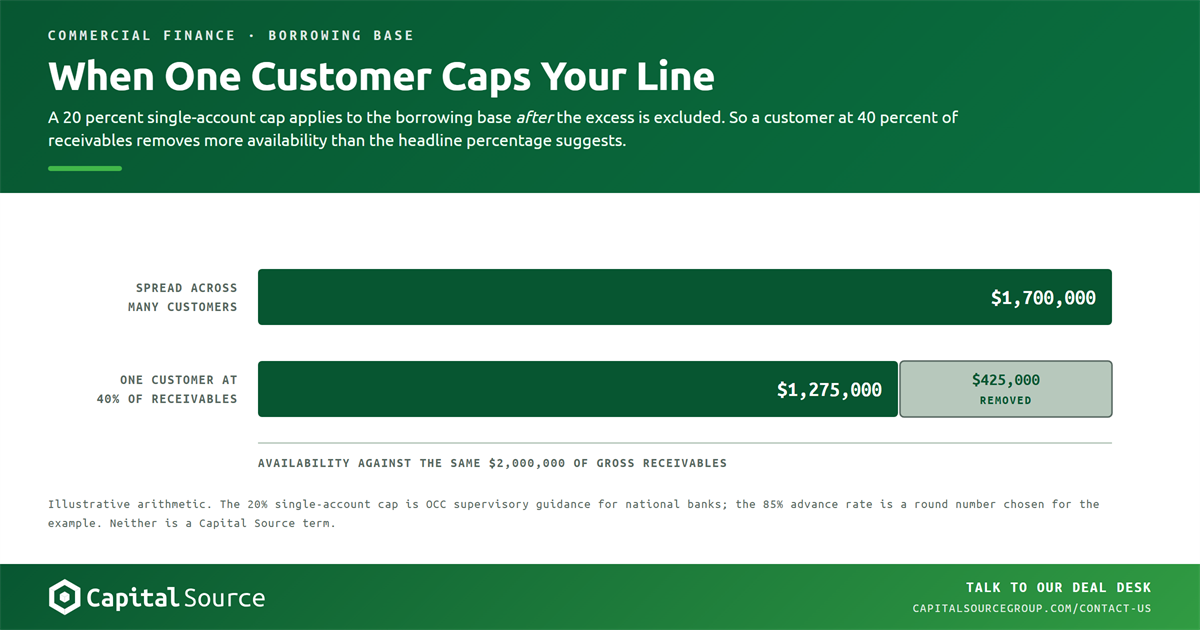
Here is the worked example. A business has $2,000,000 in gross receivables. One customer accounts for $800,000 of it, or 40 percent. Say the lender applies a 20 percent single-account cap and an 85 percent advance rate on eligible receivables.
Most people assume the anchor keeps $400,000, which is 20 percent of the original $2,000,000. It does not work that way. Call the dollars the anchor is allowed to contribute x. Everybody else is $1,200,000 and fully eligible. The cap says x can be no more than 20 percent of the finished base, and the finished base is $1,200,000 plus x. So:
x = $240,000 + 0.20x
0.80x = $240,000
x = $300,000
Three hundred thousand, not four hundred. Because every dollar you let the anchor add to the base also raises the ceiling it is measured against, the cap settles lower than the intuitive answer. That is the whole trick, and it is why the table below looks worse than owners expect.
| Line | Amount | How it gets there |
|---|---|---|
| Gross receivables | $2,000,000 | What the aging report shows. |
| All other customers | $1,200,000 | No single one large enough to trip the cap. |
| The anchor customer | $800,000 | 40 percent of gross receivables. |
| Of that, what counts | $300,000 | Solved above. The most that can sit at 20 percent of the resulting base. |
| Of that, ineligible | $500,000 | Still yours, still owed, still collateral. Just not in the base. |
| Eligible base | $1,500,000 | $1,200,000 plus the $300,000 that qualified. |
| Available at 85 percent | $1,275,000 | Against $1,700,000 if the same receivables were spread evenly. |
| Cost of the concentration | $425,000 | Availability the anchor account removed by being an anchor. |
Four hundred twenty-five thousand dollars of availability, gone. Not because anyone doubts the invoices, and not because the customer is weak. Purely because of how much of the total sits in one name. That is the number worth understanding before you plan growth around a single relationship.
Note the second option in the guidance: instead of capping the amount, a lender “may reduce the percentage advanced against such concentrations.” Same destination, different route. If you are comparing facilities, ask which lever is being used, because the two behave differently as your concentration moves.
What else quietly shrinks the base?
Concentration rarely arrives alone. Several other eligibility tests interact with it, and each one hits harder when a large share of the total sits with one payer.
Cross-aging. The handbook’s glossary defines it as “the practice of making all of the accounts receivable from a single account party … ineligible to be included in the borrowing base if a specified proportion of the total accounts receivable from that party is delinquent.” On a diversified book that is a nuisance. When one customer is 40 percent of your receivables and a slice of their balance goes past due, cross-aging can remove the entire relationship from your base at once.
Past-due exclusions. The guidance notes that “normally, an account is considered ineligible collateral when it is past due by three times the terms, e.g., 90 days for 30-day terms and 21 days for seven-day terms.” Your large customer’s payment habits therefore become a borrowing-capacity issue and not merely a collections annoyance.
Contra-accounts. Defined as “situations in which an entity is both a customer and a supplier, creating accounts receivable and accounts payable that may offset each other.” If your anchor customer also sells you something, the guidance flags that the customer “can ‘set off’ the debt it owes against the debt owed to it and pay only the net amount.” Concentration plus a contra relationship is a combination worth surfacing early.
Dilution. The gap between what you invoice and what you actually collect, from “discounts, returns, allowances, and credit losses.” The handbook notes dilution “varies by industry but is usually expected to be 5 percent or less of receivables.” A single customer with a habit of deductions can move your whole dilution rate, and dilution feeds advance rates directly.
One point of reassurance in all of this: ineligible does not mean worthless. The guidance is explicit that “ineligible collateral remains part of the ABL lender’s collateral pool but does not qualify for inclusion in the borrowing base.” The asset still supports the relationship. It just does not generate availability.
Does the identity of the customer change anything?
Yes, and this is the part most treatments leave out. Concentration is not scored as a single number. The same guidance instructs that “in analyzing concentrations, the bank should consider the underlying credit quality of a concentrated customer base,” and that a lender “should consider the amount of risk posed by concentrations and structure the loan agreement to moderate such risk.”
That is a meaningful opening. Forty percent of revenue from an investment-grade buyer on a multi-year contract is a different proposition from 40 percent from a thinly capitalized reseller on handshake terms, even though both show up as 40 percent on the aging report. If your concentration is in a strong, well-documented payer, that is an argument to make with evidence rather than a fact to hope nobody notices.
The practical version: bring the customer’s credit story with you. Their payment history with you, the contract or standing purchase orders, their public filings or credit rating if they have one, and the length and depth of the relationship. Concentration you can document is underwritable in a way concentration you merely disclose is not.
What can you actually do about it?
Diversifying revenue is the real answer and the slow one. It is worth doing and it will not help you this quarter. These are the levers that work on a shorter clock.
- Raise it before they find it. An operator who opens with “our top customer is 38 percent of receivables, here is their payment history and the contract” is a materially different credit conversation from one where the aging report reveals it. It also lets you frame the mitigants rather than answer accusations.
- Get the concentration underwritten on the customer’s credit. Factoring generally puts more weight on the account debtor and less on your balance sheet, which can turn a strong anchor customer from a constraint back into the asset it always was. Be clear-eyed, though: that shifts the emphasis, it does not remove the limits. Factors set concentration caps of their own, assign credit limits to each debtor, hold reserves, and decline invoices they do not like the look of. Ask where those lines sit before you assume the problem is solved.
- Negotiate the sublimit, not just the rate. The single-account cap is a term like any other. If your concentration is documented and high quality, the cap and the exceptions language are worth as much attention as pricing.
- Tighten the paper. Contracts, standing purchase orders, and clear terms all reduce the “takes its business elsewhere” scenario the guidance is written around.
- Watch dilution on that account specifically. Deductions and returns from your largest customer move your whole dilution rate and therefore your advance rate.
- Know your own numbers first. If a lender computes your concentration before you do, you have already lost the initiative. Our guide to the red flags lenders see in your financials covers the rest of the pre-application picture.
Where does financing fit?
The structure that fits depends on whether your concentration is a quality problem or purely an arithmetic one. If the anchor customer is strong and simply large, the goal is a structure that reads their credit rather than penalizing your shape.
Can you finance the receivables the borrowing base excluded?
Not by making them eligible, but sometimes yes, and it is a different question from whether your lender will raise the cap. The $500,000 that the cap pushed out of the base in our example did not become bad paper on the way out. It stopped being countable under one facility’s eligibility criteria. Those are two different problems, and only one of them is about credit quality.
The distinction is worth slowing down on, because it is where most operators give up too early. A credit agreement does two separate jobs. It decides what counts, through the borrowing base and its eligibility criteria. It also decides what you are permitted to do, through the covenants. A concentration exclusion is a question of the first kind. Whether you can place a second facility behind the first is a question of the second kind. Treating the first answer as though it settled the second is how a business with real collateral and real revenue talks itself out of options it actually has.
On that second question, the guidance is more accommodating than its reputation suggests:
“ABL facilities often include a covenant in the loan agreement that prevents borrowing at another institution without the original banks’ knowledge and consent. Prudent banks specifically prohibit ABL facilities at other institutions because of the control issues associated with shared collateral. An ABL lender may not object to other types of borrowing, however, and may be comfortable with another lender providing specialized financing, equipment leasing, or a mortgage.”
OCC Comptroller’s Handbook, Asset-Based Lending, Version 1.1
Read the shape of that carefully. What prudent banks rule out is a competing ABL facility, and the stated reason is control of shared collateral. Specialized financing from another lender is treated as a different matter entirely, one the senior lender may well be comfortable with. The test is not whether new capital exists. It is whether the new capital contests the senior lender’s collateral and control.
The same handbook describes the junior structures that already exist for this, which is worth knowing because it means none of this is exotic:
“A revolving ABL facility may also be structured using a second-lien loan to provide additional leverage. A second-lien loan is similar to a last-out tranche in that it is subordinate with respect to repayment, but does not share a senior lien.”
“A second-lien lender’s interest is typically governed by an inter-creditor agreement that gives the first-lien lender greater control with respect to the collateral.”
OCC Comptroller’s Handbook, Asset-Based Lending, Version 1.1
Where our Stretch programs fit
This is the gap Capital Source’s Stretch Financing programs were built for: businesses with an established facility that are capped out and cannot reach additional liquidity because of collateral constraints, covenant limitations, or debtor concentration risk. We started developing them in 2021 to work alongside factoring facilities, taking a junior position behind a factor’s priority claim on B2B receivables. Factoring firms and asset-based lenders refer clients to us for the same reason, which is that the structure is designed to bolster a senior position rather than replace it.
Coupled with a concentration-capped ABL line, and where it is available, it works like this. The senior facility keeps doing what it does well: a revolving line against the eligible base, with its lien, its lockbox and its advance rate untouched. A Stretch Loan or Stretch Piece sits behind it in a subordinate position, underwritten on the business rather than on the slice of receivables the base excluded, and repaid on a revenue-based or performance-based schedule that tracks the cash cycle instead of fighting it.
Be precise about what that does and does not do, because the difference matters. It does not make the ineligible receivables eligible. Nothing can, inside someone else’s credit agreement, and any lender who implies otherwise is describing a product that does not exist. What it does is recognize that the $500,000 sitting outside the base is evidence of something real: a customer who buys at volume and pays. The senior facility cannot count that. A lender whose criteria are written differently can still underwrite the business it represents.
In the worked example the anchor contributes $300,000 to the base while $500,000 of good invoices sit outside it. Those invoices are not written off, disputed, or past due. They are simply more of one name than one formula is built to count.
What has to be true for it to work
This is conditional, and the conditions are not formalities. Before layering a second facility behind an ABL line, an operator should be able to work through all six of these with their lender and their counsel.
- Your senior lender has to know, and where that covenant is in your agreement, has to agree. The covenant quoted above is explicit about knowledge and consent. That consent belongs to the senior lender, it is theirs to withhold, and nobody can promise you in advance that it will be given. Raising it early is a far better conversation than raising it after the fact.
- Junior has to be documented as junior. An intercreditor or subordination agreement is the instrument that fixes lien priority, payment blockage and enforcement standstill between the two lenders. Informal subordination is not subordination, and a standstill is not simply a waiting period after which the junior lender is free to act.
- The collection path stays exactly where it is. In most ABL transactions the bank controls, or reserves the right to control, the borrower’s cash receipts through a lockbox and cash dominion. That includes collections on the excluded receivables, which still reach the senior lender first. A junior facility has to be built around that arrangement rather than through it.
- Permission to borrow is not permission to repay. ABL agreements commonly gate payments on junior debt behind conditions such as minimum excess availability and a fixed charge coverage test, as practitioners writing for the Secured Finance Network have set out in detail. A facility can be fully permitted and still be unpayable in the month you most want to pay it. Read those conditions before signing rather than after.
- The senior line can react to the junior one. Consent is not the end of it. A lender that agrees can still impose a reserve against the borrowing base, and the new facility’s fixed charges feed the same coverage test the senior line measures you against. Model your senior availability after the junior facility is in place, not before.
- Cross-default runs in both directions. The same OCC glossary defines it as “the right to declare a loan in default if an event of default occurs in another loan provided to the borrower.” A stumble on a junior facility can therefore put your largest and most operationally important facility in default. That is the strongest argument there is for documenting the two together instead of bolting one onto the side of the other.
One more thing, said plainly. The concentration cap exists for a reason, and a junior lender reaching past it is taking on the same single-party risk the cap was written to control. Cross-aging, as covered above, means one partial delinquency from that same customer can move the entire relationship at once. That risk does not evaporate because a second lender is willing to look at it. It gets underwritten and structured, which is a different thing. Anyone describing the cap as a formula quirk to be worked around is not being straight with you.
Capital Source structures financing through our affiliate, Stretch Finance, and through our network of banks, lending partners and private credit funds. Availability, structure and terms are subject to review and underwriting. As flagged at the top, the OCC thresholds quoted here are supervisory guidance for the institutions the OCC regulates, not our criteria.
Bring us the concentration question
Every receivables book has a shape. If yours leans on one or two relationships, the useful conversation is about how a facility gets structured around that, not whether the number is too high. That is what our Deal Desk is for.
Key takeaways
- Ten percent is where the questions start. Bank guidance normally treats a single account at 10 percent or more of total receivables as concentrated. Low, but a benchmark rather than a cliff.
- A 20 percent cap removes more than 20 percent. The cap applies to the base after trimming, so the ceiling rises with every dollar you add to it. Solve it before you assume the number.
- Ineligible is not worthless. Excluded receivables stay in the collateral pool. They just stop generating availability.
- Cross-aging is the sharp edge. One partial delinquency can pull an entire customer relationship out of the base, which stings most when that relationship is the big one.
- Who the customer is genuinely matters. Guidance tells lenders to weigh the credit quality behind a concentration, so a documented, high-quality anchor is an argument you get to make.
- Excluded is not the end of the conversation. A credit agreement decides what counts and, separately, what you are permitted to do. Junior capital placed behind the senior line, with that lender’s knowledge and consent and a proper intercreditor agreement, can sometimes reach liquidity the borrowing base cannot.
- Some structures read the customer instead of your shape. Factoring and negotiated receivables facilities lean more on the account debtor, though factors set concentration caps and per-debtor limits of their own.
Frequently asked questions
What counts as customer concentration for a business loan?
Bank examination guidance normally treats a single account representing 10 percent or more of total receivables as a concentration. Read that as the level where a lender starts asking questions rather than a hard cutoff, and note it is written for OCC-supervised institutions rather than for every lender. Concentration also exists where a few customers produce the majority of receivables, or where sales go primarily to one industry. A similar 10 percent figure appears in accounting standards, but ASC 280-10-50-42 is a financial-statement disclosure rule for public companies, not a lending rule.
How much does customer concentration reduce my borrowing base?
More than the headline percentage suggests, because a single-account cap applies to the borrowing base after the excess is excluded. Take $2,000,000 of gross receivables with one customer at $800,000, or 40 percent. Under a 20 percent single-account cap, solving x = 20% of ($1,200,000 + x) gives x = $300,000, so only $300,000 of that balance sits in the base and the eligible base is $1,500,000 rather than $2,000,000. These figures are illustrative arithmetic, not anyone’s terms.
Does it help if my biggest customer has strong credit?
It can. Bank guidance directs lenders analyzing concentrations to consider the underlying credit quality of the concentrated customer base, and to structure the loan agreement to moderate the risk. Forty percent of revenue from a well-documented, financially strong buyer on a multi-year contract is a different proposition from the same percentage owed by a thinly capitalized customer on informal terms. Bring the payment history and the contract.
Can you get financing against receivables your borrowing base treats as ineligible?
Not by making them eligible, because eligibility is defined by your senior lender’s credit agreement and no outside lender can rewrite it. A concentration exclusion is an exclusion from an advance formula rather than a finding that the invoices are uncollectible, and bank guidance is explicit that ineligible collateral remains part of the lender’s collateral pool. A junior or subordinated facility placed behind the senior line can sometimes provide liquidity the borrowing base cannot, provided the senior lender knows and consents, the junior position is documented in an intercreditor or subordination agreement, and the senior lender’s collection path is left intact. Whether any of that is available depends on your actual credit agreement and on underwriting.
What is cross-aging and why does it matter with a large customer?
Cross-aging is the practice of making all of the receivables from a single customer ineligible for the borrowing base when a specified proportion of that customer’s balance is delinquent. On a diversified receivables book it is a minor irritation. When one customer represents a large share of the total, a partial delinquency can remove the whole relationship from your base at once, which is why payment behavior on a concentrated account deserves close attention.
Sources
- Office of the Comptroller of the Currency, Comptroller’s Handbook: Asset-Based Lending (Version 1.0 March 2014; Version 1.1 January 27, 2017). Concentration, dilution, cross-aging, contra-account and ineligible-collateral guidance and definitions.
- Wade Kennedy (McGuireWoods LLP), Pitfalls of Incorporating Term Loan Provisions into ABL Credit Agreements, The Secured Lender, Secured Finance Network (November 1, 2021). Payment conditions on junior debt (excess availability and fixed charge coverage).
- Deloitte, Roadmap: Segment Reporting, Information About Major Customers (ASC 280-10-50-42).
- National Credit Union Administration, Concentration Risk, supervisory guidance on managing concentrations.
This article is for informational and educational purposes only and does not constitute financial, investment, accounting, tax, or legal advice. The concentration thresholds, caps, advance rates, and worked examples described here are drawn from published supervisory guidance for national banks and from illustrative arithmetic; they are not Capital Source criteria, offers, or terms, and no approval, rate, or outcome is implied. The concepts discussed are general in nature and should be reviewed with qualified professionals based on your specific circumstances. Capital Source provides access to commercial financing solutions through its affiliates, syndicates, network of banks, lending partners, and private credit funds/groups. Availability, approval, funding amount, structure, and terms are subject to business review, underwriting, and lender approval.
Leave a Reply