

The Borrowing Base Governance Gap in Multi-Instrument Capital Structures Why lender-level compliance can miss combined utilization across the full balance sheet Every lender in a multi-instrument capital stack is watching the right thing. They are watching their facility. They are monitoring their advance rates, borrowing base requirements, covenant compliance, and collateral position against the specific instrument they govern. They are doing exactly what their credit policy requires. And none of them — not one — is watching whether the combined utilization across every instrument the business is running is consistent with what the balance sheet can actually sustain. That is...

Governed Capital Stack Operating Cycle
The Governed Capital Stack: Why Capital Structure Must Start With the Operating Cycle How Instrument Phase Discipline, Stack True Cost Assessment, the Forensic ABL Ceiling, and the Deployment Efficiency Ratio turn PO financing, ABL, inventory financing, and RBF into one governed capital architecture. The capital structure conversation most SMB businesses have had is the wrong conversation. It starts from the product: what instruments are available, what the business qualifies for, and what the lender will offer. It works backward from the lender’s capability to the business’s requirement rather than forward from the operating cycle to the capital structure that serves...

Inventory Financing Governed Facility
Inventory Financing and the Governed Facility Why the Asset Class Most Lenders Avoid Determines Whether the Capital Stack Works How the Integrated Inventory Borrowing Base, WIP Cost to Complete Discipline, and the NWC-CCC-WCC Governance Trinity Become the foundation every inventory-intensive capital stack requires Most lenders avoid inventory financing not from borrower weakness. They avoid it from analytical cost. Inventory is expensive to evaluate correctly, expensive to monitor correctly, and expensive to govern after origination. That gap produces one of the most important failures in SMB commercial lending: the most capital-intensive asset class is often the most poorly governed. Inventory is...
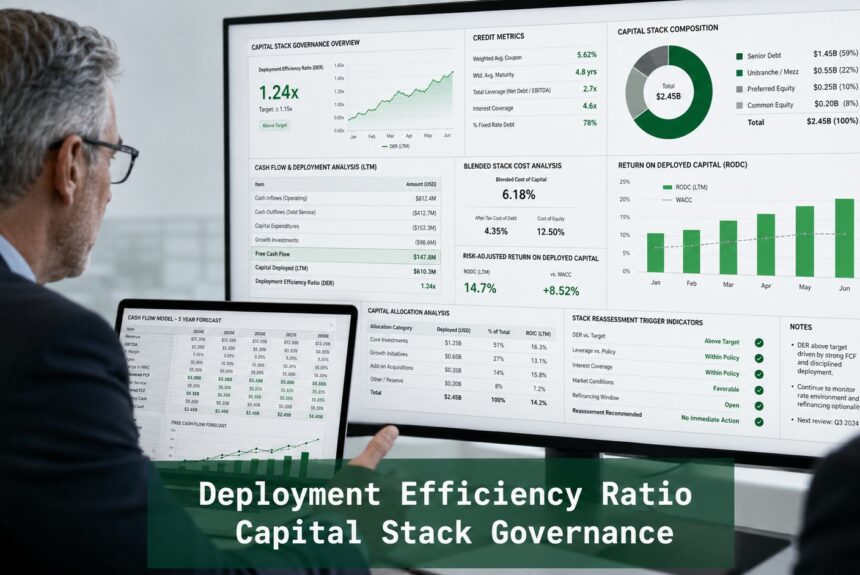
Deployment Efficiency Ratio Capital Stack Governance
Stack Governance and the Deployment Efficiency Ratio: Why APR Is the Wrong Measure for a Capital Stack How the Deployment Efficiency Ratio Replaces Rate Comparison as the Governing Standard for Whether a Capital Stack Is Producing Value or Eroding It Most businesses evaluate their capital stack by asking what each instrument costs. That is the wrong question. The right question is whether the capital the stack deploys is generating more return than it costs to carry. A 48 percent annualized RBF advance funding a seasonal inventory build that generates 65 percent gross margin on the deployed capital is not expensive....

ABL Ceiling Governance
ABL Ceiling Governance: How the Borrowing Base Controls RBF Deployment in the Capital Stack How the Integrated Inventory Borrowing Base Sets the ABL Ceiling, Defines the RBF Trigger, and Determines Stack Cost The ABL ceiling is not an arbitrary facility limit. It is the forensically governed maximum the Integrated Inventory Borrowing Base can support against eligible assets at current advance rates under current market conditions. That ceiling determines the boundary between Phase Two and Phase Three. Get the ceiling wrong and every instrument above it in the stack is mispositioned: RBF gets deployed against a requirement ABL should have covered,...