
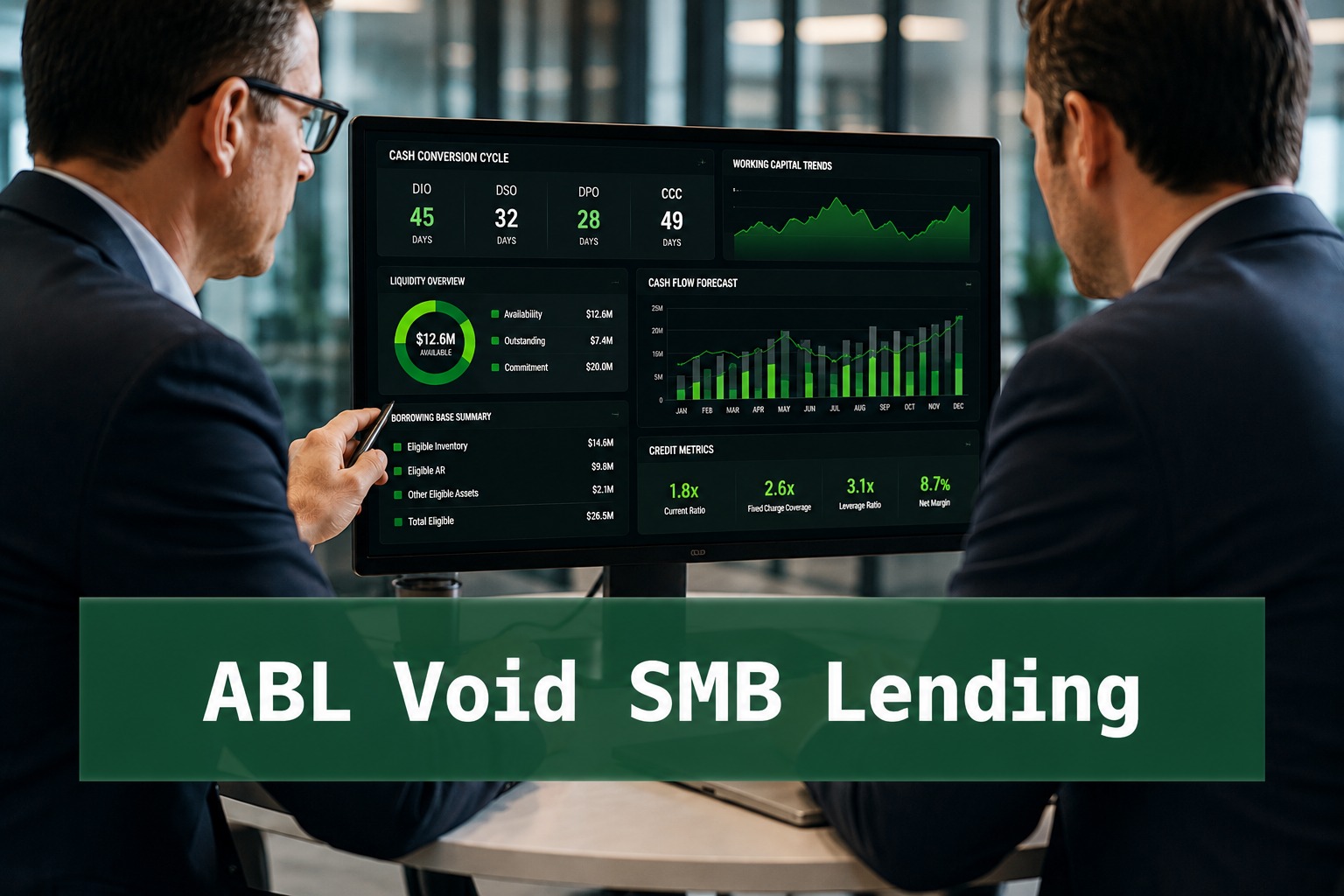
Capital Structure and the ABL Void: Why Regional Banks Are Exiting Complex SMB Borrowers
How the ABL Void, the NWC-CCC-WCC Governance Trinity, and the Forensic ABL Framework Form a Unified Capital Governance Architecture
SERIES CONTEXT
This article serves as the capstone of Book Three of the Capital Governance Stack series — the structural prescription volume built around the capital structure failures now reshaping the lower middle market. Book One established the forensic diagnostic framework. Book Two established the capital governance framework. Book Three applied both systems directly to facility design — establishing the ABL Void diagnosis, the NWC-CCC-WCC Governance Trinity, and the Forensic ABL Framework as a unified capital governance architecture for complex SMB borrowers operating inside the modern commercial lending market.
This capstone integrates the three Book Three series into a single analytical structure and clarifies what the combined architecture produces when applied as one operating system rather than as isolated lending concepts.
KEY POINTS
- Book Three was built around a single governing claim: the businesses the regional bank market is exiting are not fundamentally uncreditworthy. They are structurally unmeasured. The underwriting failure originates inside the economics of modern bank regulation, where the analytical cost of interpreting SMB operating-cycle complexity exceeded the economics of maintaining those relationships at scale.
- The three Book Three series are not parallel arguments aimed at the same issue. They are sequential layers inside one capital governance architecture: diagnosis, measurement discipline, and structural prescription.
- The ABL Void Series established why the market gap exists and which borrower profiles concentrate inside it most heavily.
- The NWC-CCC-WCC Governance Trinity Series established the three operating-cycle variables that must be measured simultaneously to evaluate those borrowers correctly.
- The Forensic ABL Framework and ABL-RBF Stack Series established the facility design system that applies those measurements to a governable capital structure.
- Across all three books of the Capital Governance Stack, the distinction between a conventional lender and a capital governance partner is not flexibility, speed, relationship language, or product count. The distinction is analytical discipline — whether the capital provider can determine if the structure actually works for the borrower’s operating cycle across the full cycle range.
THE DIAGNOSIS: WHAT THE ABL VOID SERIES ESTABLISHED
The regional bank market did not retreat from complex SMB commercial lending because the borrower base weakened. The retreat occurred because the economics of post-crisis commercial banking changed the relationship between underwriting effort and regulatory return.
Working-capital-intensive businesses, inventory-heavy distributors, seasonal operators, and growth-phase companies require interpretive underwriting. Their repayment capacity cannot be measured through static ratio analysis alone. Their operating-cycle behavior must be interpreted dynamically across timing compression, liquidity asymmetry, inventory concentration, counterparty payment behavior, and cycle-level recovery capacity.
That level of underwriting became economically unattractive for much of the regional banking market.
The result was not a random reduction in credit appetite. It was a structural withdrawal from complexity.
The businesses most exposed to that withdrawal are frequently misunderstood inside conventional credit discussions. Many of these borrowers continue generating strong operating cash flow. Many continue holding healthy demand profiles, stable customer relationships, and meaningful enterprise value. The problem is measurement visibility.
Their cash generation occurs at the operating-cycle level rather than at the reporting-period level.
The income statement frequently masks that reality.
A borrower may appear compressed inside a reporting window while simultaneously strengthening across the operating cycle itself. A trailing average borrowing-base model may appear mathematically stable while the actual working-capital cycle underneath it has already shifted materially.
The conventional framework often cannot detect those changes with sufficient precision.
That structural gap is the ABL Void.
The ABL Void is not a conventional market failure. The regional banking market made a rational economic decision within the regulatory system governing modern commercial banking. The gap exists because the market chose standardization over interpretive complexity.
That decision created a structural opportunity for capital providers willing to perform the analytical work conventional underwriting models increasingly avoid.
Four borrower profiles occupy the ABL Void most heavily.
Working-Capital-Intensive Operators
These businesses generate legitimate operating-cycle cash flow, though their liquidity profile becomes distorted when evaluated through static period reporting. Their operating minimum frequently sits well above what conventional underwriting assumptions recognize.
Seasonally Asymmetric Businesses
These operators require forward-looking working-capital analysis rather than trailing-average assumptions. Their borrowing pressure concentrates at predictable seasonal peaks that conventional midpoint formulas frequently underestimate.
Growth-Phase Borrowers
Rapid growth compresses liquidity before revenue expansion fully stabilizes. Conventional underwriting frequently interprets this compression as weakness even when forward operating-cycle repayment capacity is strengthening.
Inventory-Heavy Distributors
These borrowers face widening gaps between forced-liquidation assumptions and real inventory economics. The farther inventory values drift from origination assumptions, the more vulnerable the borrowing structure becomes.
The ABL Void Series established that these profiles are not random exceptions. They represent a structurally identifiable borrower category produced by the interaction between operating-cycle complexity and modern bank underwriting economics.
THE MEASUREMENT FRAMEWORK: WHAT THE NWC-CCC-WCC GOVERNANCE TRINITY ESTABLISHED
Identifying the borrower profiles inside the ABL Void is only the diagnostic layer.
The second layer is measurement discipline.
The NWC-CCC-WCC Governance Trinity established that three operating-cycle variables must be measured simultaneously for the capital structure to remain governable:
- NWC Velocity and NWC Floor Stress Testing
- CCC Forensic Assessment
- WCC Shape Analysis
Individually, each variable produces partial operating-cycle visibility.
Applied together, they produce the complete cycle-level measurement system required for forensic facility design.
NWC Velocity and the NWC Floor Stress Test
The balance-sheet NWC figure does not identify the operating minimum required to sustain the business.
It identifies a reporting-state recovery position.
The operating cycle itself may require materially more liquidity than the balance sheet appears to imply.
The NWC Floor Stress Test establishes the minimum liquidity floor required across:
- normal operating conditions
- seasonal peak demand
- stressed operating conditions
That floor becomes the governing liquidity threshold below which the operating cycle begins destabilizing.
This distinction matters enormously inside working-capital lending.
A borrowing structure that compresses the business beneath its operating NWC floor may appear mathematically compliant while simultaneously impairing repayment capacity through operational strain.
The forensic framework treats the operating minimum as a governing variable rather than as a residual outcome.
CCC Forensic Assessment
The Cash Conversion Cycle determines how long capital remains deployed before repayment recovery occurs.
The conventional advance-rate model frequently treats the origination-period CCC as structurally stable.
That assumption becomes dangerous when payment timing, inventory turns, or payables behavior begin shifting.
A borrowing base calibrated against a 45-day CCC produces materially different economics once the actual operating cycle has migrated toward 60 or 65 days.
The additional capital deployment period compounds silently against the borrower’s operating liquidity every cycle the misalignment persists.
The CCC Forensic Assessment recalibrates the facility against current operating timing rather than against static origination assumptions.
That converts the underwriting model from collateral-only governance into timing-sensitive governance.
WCC Shape Analysis
Working Capital Cycle Shape Analysis establishes three operating variables conventional trailing-average formulas cannot measure accurately:
- peak working-capital demand
- trough recovery capacity
- peak-to-trough duration
A trailing borrowing-base average becomes structurally unreliable inside highly asymmetric operating cycles.
The midpoint is too low at peak and too high at trough simultaneously.
The WCC framework measures the actual shape of the operating cycle:
- how high demand rises
- how long peak pressure persists
- how recovery behaves after compression
- whether the structure can survive the full cycle range
This becomes especially important inside seasonal operators, inventory-heavy businesses, and growth-phase companies where repayment timing matters more than static collateral appearance.
The Governance Trinity as a Unified System
The Trinity matters because the three variables constrain each other.
NWC floor requirements influence cycle tolerance. CCC timing influences advance-rate exposure. WCC shape determines duration pressure and recovery sequencing.
Measured independently, each variable produces only partial visibility.
Measured simultaneously, they produce the full operating-cycle map required for governable commercial lending.
The Trinity established the measurement discipline the conventional market increasingly stopped performing at scale.
THE PRESCRIPTION: WHAT THE FORENSIC ABL FRAMEWORK ESTABLISHED
The Trinity established the measurement system.
The Forensic ABL Framework established the structural prescription.
The framework applies the Trinity directly to facility construction through three simultaneous operating inputs:
- Forensic Borrowing Base
- CCC-Adjusted Advance Rate
- Maximum Availability Sized Against Peak Working-Capital Demand
This is not a different collateral category.
It is a different facility-design methodology.
The conventional structure frequently begins with the formula.
The forensic structure begins with the operating cycle.
The Forensic Borrowing Base
The borrowing base must reflect current asset behavior rather than static origination assumptions.
Inventory composition, receivable timing, customer concentration, seasonality pressure, and operational volatility all influence whether the collateral behaves as the original underwriting model expected.
The forensic borrowing base evaluates current operating conditions rather than assuming historical alignment remains intact.
The CCC-Adjusted Advance Rate
Conventional advance rates govern collateral exposure.
They frequently fail to govern timing exposure.
The CCC-Adjusted Advance Rate introduces timing discipline directly into facility economics by calibrating deployment against the period capital is actually outstanding.
That distinction changes facility risk materially.
A structure designed around an outdated repayment cycle can remain technically compliant while steadily eroding liquidity underneath the borrower.
The CCC-adjusted framework prevents that erosion from remaining invisible.
The ABL-RBF Stack
Some borrowers require working-capital support above what the forensic collateral ceiling alone can sustain.
The ABL-RBF Stack addresses that requirement through disciplined sequencing.
Inside the stack:
- ABL governs the collateral base
- RBF bridges the peak increment
- repayment sequencing retires the higher-cost layer first
- Deployment Return Threshold governs whether the combined structure should exist at all
This is not product stacking for yield expansion.
It is governed sequencing tied directly to the operating cycle.
The structure exists only when the combined deployment improves operating-cycle sustainability rather than weakening it.
THE THREE BOOK THREE SERIES AS A SINGLE GOVERNANCE ARCHITECTURE
The three Book Three series function as one argument expressed across three layers.
The ABL Void Series identified who the conventional market is failing and why.
The NWC-CCC-WCC Governance Trinity Series established the operating-cycle measurement system required to evaluate those businesses correctly.
The Forensic ABL Framework and ABL-RBF Stack Series established the capital structure architecture that applies those measurements to a governable facility design.
No layer is complete without the others.
Diagnosis without measurement remains observation. Measurement without prescription remains analysis. Prescription without diagnosis becomes product-forward lending.
That distinction matters.
The Capital Governance Stack was built specifically to replace product-forward commercial lending with operating-cycle-governed capital structure design.
The architecture only works when diagnosis, measurement discipline, and structural prescription operate together.
WHAT BOOK THREE ADDS TO THE CAPITAL GOVERNANCE STACK
Book One established the forensic diagnostic framework.
It established the analytical disciplines required to identify what is actually happening inside a borrower’s operating cycle rather than relying on static financial reporting proxies.
Book Two established the capital governance framework.
It established the standards required to determine whether a capital deployment improves borrower sustainability or accelerates operational erosion. That included the Deployment Return Threshold — the governance standard determining whether a capital structure deserves deployment at all.
Book Three established the structural prescription layer.
It translated the diagnostic and governance frameworks into facility design itself.
Together, the three books establish a complete capital governance architecture.
Not a product suite. Not a marketing framework. Not a lending-language refresh.
A full analytical governance system for evaluating:
- what the operating cycle actually requires
- whether the capital deployment serves that requirement
- whether the structure can sustain the borrower across the full operating-cycle range
The strategic consequence is substantial.
A borrower entering a capital discussion after working through the Capital Governance Stack enters from a fundamentally different position.
The borrower arrives with:
- the forensic diagnostic already performed
- the operating-cycle variables already identified
- the governance standards already established
- the facility-design inputs already assembled
At that point, the conversation stops being a conventional lender evaluation.
It becomes a collaborative capital-structure design discussion between:
- a borrower who understands the operating cycle
- a capital provider capable of structuring around it
That is the Governance Premium.
The premium is earned before deployment begins.
CONCLUSION
The regional bank market has already made its structural decision.
The businesses now exiting that market are unlikely to regain those relationships under the current economics governing commercial banking.
The gap between operating-cycle quality and underwriting visibility has become structural.
The Capital Governance Stack was built to close that gap.
Not by lowering underwriting standards.
By applying more accurate ones.
The framework measures:
- operating-cycle reality rather than static income-statement proxies
- current conditions rather than origination assumptions
- working-capital demand across the full cycle range rather than through midpoint approximations
That is what the three books established.
That is what the three Book Three series delivered.
That is what the forensic capital governance architecture produces when diagnosis, measurement discipline, and facility design operate together.
And that remains the governance standard almost no competitor in the SMB commercial lending market is currently applying at scale.
If your business fits one of the four borrower profiles identified inside the ABL Void Series — working-capital-intensive, seasonally asymmetric, growth-phase, or inventory-heavy — the first question is not whether capital is available.
The first question is whether the structure was designed around the operating cycle your business actually carries.
Capital Source performs forensic operating-cycle assessment across the complete framework:
- ABL Void diagnosis
- NWC-CCC-WCC Governance Trinity analysis
- Forensic ABL facility design
- CCC-Adjusted Advance Rate calibration
- ABL-RBF Stack sequencing discipline
The objective is not product placement.
The objective is determining the capital structure the operating cycle can sustain.
THE ABL VOID SERIES
Article One: Your Regional Bank Did Not Pull Back Because Your Business Weakened
Article Two: The Businesses the Regional Bank Market Is Leaving Are Not Random
Article Three: The Regional Bank Could Not See Your Credit
THE NWC-CCC-WCC GOVERNANCE TRINITY SERIES
Article One: Your NWC Is Not What Your Balance Sheet Says It Is
Article Two: Cash Conversion Cycle and ABL Advance Rates
Article Three: Working Capital Cycle Analysis
THE FORENSIC ABL FRAMEWORK AND ABL-RBF STACK SERIES
Article One: Forensic ABL Facility Design
Article Two: CCC-Adjusted Advance Rate
Article Three: The ABL-RBF Stack
STRATEGIC DISCLOSURE
Capital Source is a commercial capital advisory firm. This article is provided for informational purposes and reflects the firm’s analytical perspective regarding current commercial credit conditions and operating-cycle-based facility design. It does not constitute financial, legal, or investment advice. Businesses evaluating commercial capital structures should engage qualified advisors familiar with their specific operating conditions and liquidity requirements.
Proud to be ranked on the 2024 and 2025 Inc. 5000 list of America’s fastest-growing private companies.