
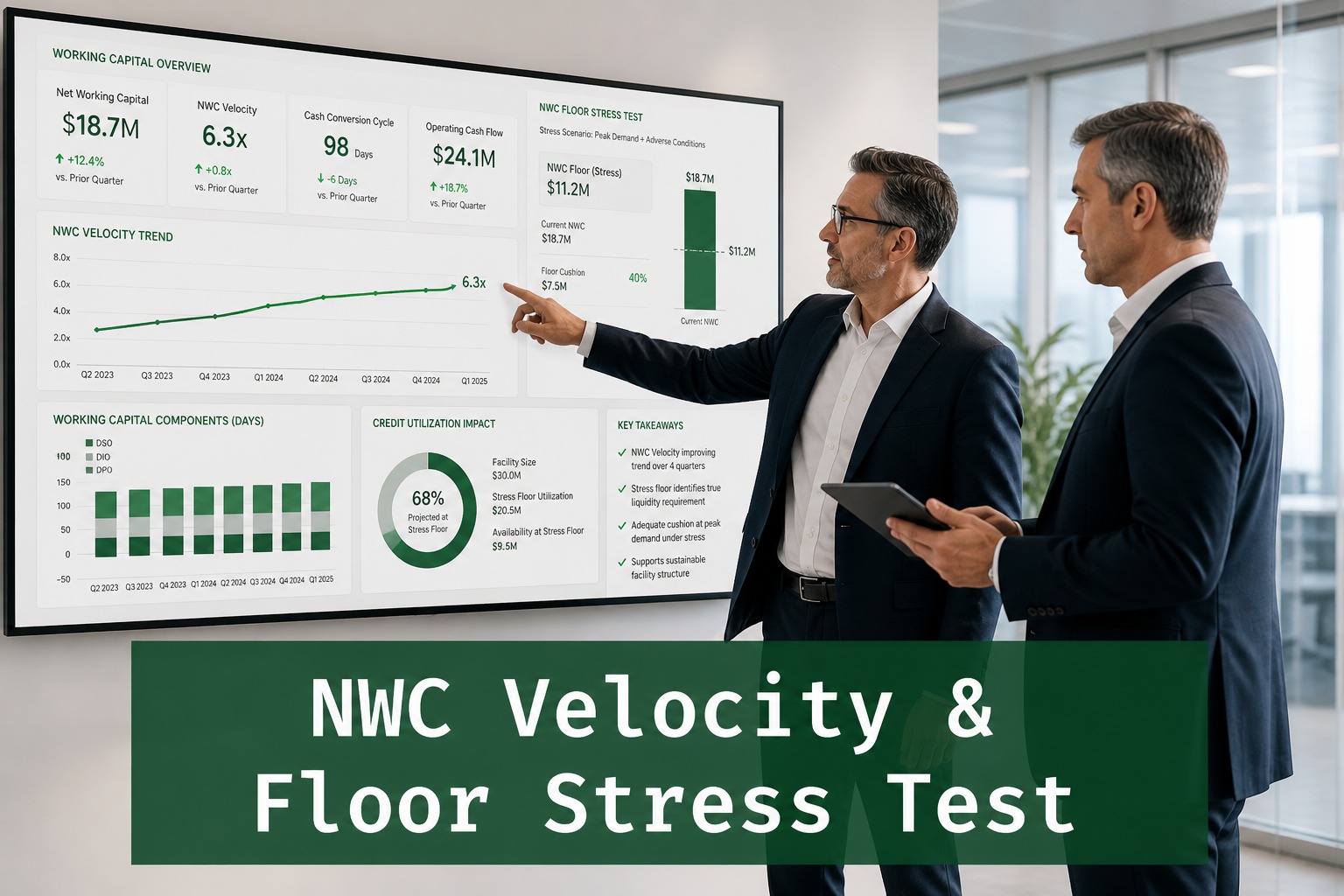
What Is Net Working Capital Really? NWC Velocity and the NWC Floor Stress Test Explained
Why Net Working Capital Is a Dynamic Operating Variable, Not a Static Balance Sheet Figure
SERIES CONTEXT
This article is the first in the NWC-CCC-WCC Governance Trinity Series — a three-part series developing the operating cycle variables that determine ABL facility sizing, advance rate calibration, and draw management discipline. It is published on the Capital Source Group thought-leadership platform for financially literate SMB operators, CFOs, and business owners. This series builds directly on the ABL Void Series, which established that the businesses regional banks are exiting are not uncreditworthy — they are unmeasured. This series delivers the measurement framework that reads them correctly. Readers arriving here directly will find this article stands alone as a complete diagnostic.
KEY POINTS
- Net Working Capital (NWC) as a balance sheet figure tells you the liquidity position at a single point in time. It does not tell you whether that position is adequate through the full operating cycle, whether it can sustain peak demand without compression, or whether the capital structure drawing against it is sized correctly for the cycle that actually exists.
- NWC Velocity is the rate at which the NWC floor regenerates through the operating cycle after peak demand draws it down. A business with high NWC Velocity recovers its liquidity floor quickly and can sustain higher facility utilization. A business with low NWC Velocity takes multiple cycles to recover after compression events and requires more conservative facility sizing.
- The NWC Floor Stress Test establishes the minimum NWC floor required through three scenarios simultaneously — normal operating conditions, peak demand compression, and stress conditions where both AR collection slows and inventory turns extend at the same time. A facility whose draw service compresses the NWC floor below the stress threshold is not sized correctly regardless of what the borrowing base calculation supports at origination.
- Federal Reserve research on ABL facility performance and academic literature on working capital management in tightening credit environments consistently indicate that NWC floor compression events are the most common precursor to liquidity stress in otherwise sound SMB commercial borrowers — and that those events are almost universally not anticipated in the original facility sizing.
- The income statement cannot reveal NWC floor compression. The NWC Velocity assessment and the NWC Floor Stress Test can. That is the analytical gap this series was built to close.
DEFINITIONS
NWC Velocity — the rate at which the Net Working Capital (working capital) floor regenerates through the operating cycle after peak demand draws it down. NWC Velocity is determined by the speed of three simultaneous variables: AR collection rate, inventory turn rate, and payables extension capacity. High NWC Velocity means the floor recovers quickly. Low NWC Velocity means the floor recovers slowly and requires more conservative facility sizing to protect it through adverse operating conditions.
NWC Floor Stress Test — the governance discipline of calculating the minimum NWC floor required to sustain the operating cycle through three scenarios simultaneously: normal operating conditions at current CCC and WCC parameters, peak demand compression at maximum working capital draw, and stress conditions where AR collection slows and inventory turns extend simultaneously. The stress test establishes the floor below which ABL draw service cannot compress the NWC position without impairing the operating cycle.
THE BALANCE SHEET GIVES YOU A NUMBER. IT DOES NOT GIVE YOU THE ANSWER.
Every balance sheet shows a Net Working Capital figure — current assets minus current liabilities. For most businesses reviewing their own financial position, it is one of the first numbers they check. For most lenders evaluating a credit, it is one of the first ratios they calculate.
The problem is not that the number is wrong. The problem is that it answers the wrong question.
The balance sheet NWC figure tells you the liquidity position on the day the balance sheet was prepared. It does not tell you whether that position is adequate three months from now when your seasonal peak demands maximum working capital. It does not tell you whether a new ABL facility drawing against that position will compress it below the threshold required to sustain your operating cycle. It does not tell you how quickly the position recovers after peak demand has passed. And it does not tell you what happens to the position when your customers start paying fifteen days slower than they did at origination.
Those are the questions that determine whether your capital structure is working or eroding. None of them are visible on the balance sheet.
Section One: Why NWC Is a Dynamic Variable, Not a Static Figure
The conventional treatment of Net Working Capital as a balance sheet metric reflects how it is reported, not how it actually behaves. A business’s NWC position is not static between reporting periods. It moves continuously through the operating cycle — expanding as receivables accumulate, compressing as inventory is purchased and payables come due, and recovering as collections arrive and the cycle completes.
The shape of that movement is what determines whether a business’s NWC position is genuinely adequate or whether it only appears adequate at the specific moment the balance sheet captures it.
Consider a distributor whose balance sheet shows $850,000 in Net Working Capital at fiscal year end. That figure reflects the position after the peak season has passed, receivables have been collected, and inventory has been drawn down. It is a trough figure — the strongest point in the operating cycle from a liquidity perspective. The same business at peak demand six months earlier may have carried $200,000 in NWC while simultaneously drawing its ABL facility to maximum utilization to fund the inventory build the season required.
The balance sheet at year end says the business has $850,000 in working capital. The operating cycle at peak demand says the business needed $200,000 to survive the most capital-intensive period of the year. Both numbers are accurate. Neither one alone tells you whether the business’s capital structure is sized correctly.
What closes that gap is NWC Velocity — the rate at which the floor regenerates from the trough to the recovery position through each operating cycle. A business that moves from $200,000 at peak to $850,000 at trough within a single seasonal cycle has high NWC Velocity. Its floor recovers fully before the next peak demand arrives. The capital structure can be sized more aggressively because the regeneration rate supports it.
A business that moves from $200,000 at peak to $400,000 at trough and then stalls — because AR collection has slowed, because inventory is turning more slowly, or because payables terms have tightened — has low NWC Velocity. Its floor does not fully recover before the next cycle begins. Each successive peak draws the floor down slightly further than the prior one. The capital structure appears adequate on the balance sheet while the operating cycle is quietly losing ground cycle by cycle.
The balance sheet NWC figure is a lagging indicator of a dynamic process. By the time a deteriorating NWC Velocity shows up on the balance sheet as a materially lower NWC figure, the operating cycle has already been under pressure for multiple periods. The NWC Velocity assessment identifies the deterioration while it is still a trajectory problem rather than a balance sheet crisis.
The strategic consequence of treating NWC as a static figure: a facility sized against balance sheet NWC at a strong point in the operating cycle may be structurally oversized for what the NWC floor can actually sustain at the weakest point. That oversizing does not produce excess availability. It produces NWC floor compression that the income statement cannot detect and the borrower cannot feel until the compression has already impaired the operating cycle.
Section Two: The NWC Floor Stress Test
Knowing the NWC Velocity is the diagnostic. Knowing the NWC floor under adverse conditions is the governance standard. The NWC Floor Stress Test produces that standard by running three scenarios against the operating cycle simultaneously rather than assessing the floor at a single point or against a single assumption.
Scenario One — Normal Conditions
The baseline floor establishes the NWC position the operating cycle requires under average operating performance at current CCC and WCC parameters. This is not the balance sheet figure. It is the calculated minimum required to fund the operating cycle through its full duration, including the peak demand period, calibrated against current AR collection rates, inventory turn rates, and payables extension capacity.
The normal conditions floor is the starting point. For many businesses, it is materially lower than the balance sheet NWC figure because the balance sheet captures the recovery position rather than the operating minimum.
Scenario Two — Peak Demand Compression
The peak demand floor establishes the NWC position when the operating cycle is at maximum working capital draw — the moment when inventory has been fully funded, receivables have not yet converted, and the facility is at or near maximum utilization. This is the most capital-intensive moment in the operating cycle and the moment at which the NWC floor is under the greatest pressure from the simultaneous demands of operating cycle funding and facility draw service.
Federal Reserve research on commercial lending behavior and academic literature on working capital-intensive credit structures consistently indicate that peak demand compression events are the most common origin of NWC floor stress in SMB ABL borrowers. The facility was sized against the normal conditions floor. The peak demand floor turned out to be lower than the facility draw service could sustain. The gap between the two is where the stress event originates.
Scenario Three — Stress Conditions
The stress floor establishes the NWC position when two adverse conditions occur simultaneously — AR collection slows beyond the normal conditions assumption and inventory turns extend beyond the origination rate. This is the scenario that produces the most severe simultaneous pressure on both sides of the working capital cycle. Receivables remain outstanding longer. Inventory is held longer. The NWC floor is compressed from both sides at the same time while the facility continues to accrue carrying cost against the slower-converting asset base.
The stress floor is not a worst-case scenario designed to fail the credit. It is a plausible adverse scenario that establishes whether the facility can survive a reasonable combination of operating deterioration without producing a liquidity event. A facility that cannot sustain its draw service above the stress floor under plausible adverse conditions is not a sound facility regardless of what the normal conditions analysis supports.
The NWC Floor Stress Test is not a more conservative version of the conventional borrowing base calculation. It is a different analytical discipline entirely. The conventional borrowing base calculates what the assets support at face value against a standard formula. The NWC Floor Stress Test calculates what the operating cycle can sustain across the full range of conditions it will actually encounter. Those are different questions, and they produce different answers.
The strategic consequence of the three-scenario approach: a facility that clears the normal conditions floor but fails the peak demand floor or the stress floor is not adequately sized for the operating cycle it is supposed to support. Discovering that failure at origination through the stress test is a governance discipline. Discovering it during peak demand or under adverse conditions is a liquidity event.
FORENSIC STRESS TEST: DO YOU KNOW YOUR NWC FLOOR?
NWC Velocity Assessment
- Have you calculated your NWC floor at the most capital-intensive point in your operating cycle rather than at the balance sheet date?
- Do you know the rate at which your NWC floor regenerates from peak demand to recovery position within a single operating cycle?
- Has your NWC Velocity changed over the past four operating cycles as AR collection rates, inventory turn rates, or payables terms have shifted under current market conditions?
NWC Floor Stress Test
- Has the minimum NWC floor been established under normal operating conditions at current CCC and WCC parameters rather than at origination assumptions?
- Has the peak demand floor been calculated against the maximum working capital draw your operating cycle produces and tested against current facility draw service requirements?
- Has the stress floor been calculated against a simultaneous AR collection slowdown and inventory turn extension to establish whether the operating cycle can sustain facility draw service under plausible adverse conditions?
Facility Sizing Alignment
- Is your current ABL facility sized against the stress floor or against the balance sheet NWC figure at a favorable point in your operating cycle?
- Has your NWC Velocity been assessed since your facility was originated to determine whether the regeneration rate has changed in ways that affect the adequacy of the current facility structure?
- Does your lender understand your NWC Velocity and the three-scenario floor, or are facility conversations still anchored to balance sheet NWC figures?
FREQUENTLY ASKED QUESTIONS
What is the difference between balance sheet NWC and the NWC floor the stress test establishes? (working capital definition)
Balance sheet NWC is the liquidity position on a specific date. The NWC floor is the minimum liquidity position required to sustain the operating cycle through its full duration under adverse but plausible conditions. For most businesses, the balance sheet NWC at a favorable reporting date substantially overstates the NWC floor because the balance sheet captures the recovery position after peak demand has passed and collections have arrived. The stress test establishes what the floor actually is at the worst point in the cycle under the worst combination of conditions the operating environment makes plausible.
Why does NWC Velocity matter for ABL facility sizing? (working capital cycle analysis)
Because ABL facility draw service is a fixed obligation that continues regardless of where the business is in its operating cycle. A facility sized against a high NWC position at the balance sheet date may produce draw service that the NWC floor at peak demand cannot absorb. NWC Velocity determines how quickly the floor recovers after peak demand compresses it. Low NWC Velocity means the floor recovers slowly and the facility draw service compounds against a compressed floor for multiple periods before the recovery position is reached. That compounding is where NWC floor stress originates in otherwise sound businesses.
How has demand-channel transmission affected NWC Velocity across the SMB segment? (working capital trends SMB)
Federal Reserve senior loan officer survey data and academic research on working capital behavior in inflationary environments consistently indicate that NWC Velocity has deteriorated across the SMB segment over the past two years through three simultaneous channels. AR collection cycles have extended as counterparties manage their own cash positions under inflationary pressure. Inventory turns have slowed as demand patterns have shifted. Payables extension capacity has compressed as suppliers have tightened terms in response to their own working capital pressure. All three channels reduce NWC Velocity simultaneously, and the combination produces a materially different floor than facilities sized at prior NWC Velocity assumptions were built to support.
What triggers the stress floor and how is it calculated? (working capital stress test method)
The stress floor is triggered by the simultaneous occurrence of two adverse conditions — AR collection slowing beyond the normal conditions assumption by a defined percentage and inventory turns extending beyond the origination rate by a defined period. The specific parameters are calibrated to the business’s operating cycle characteristics rather than to industry averages. A business with a 90-day normal CCC might stress against a 120-day collection period and a 30-day inventory turn extension. A seasonal business might stress the peak demand floor against a revenue delay scenario where the seasonal collections arrive later than the WCC shape assumes. The stress floor is the NWC position that results from running those parameters against the full operating cycle simultaneously.
How does the NWC Floor Stress Test connect to the broader NWC-CCC-WCC Governance Trinity? (working capital framework explanation)
The NWC Floor Stress Test is the NWC dimension of the trinity. It establishes the minimum liquidity floor the operating cycle requires under adverse conditions. Article Two of this series develops the CCC Forensic Assessment — the dynamic timing variable that determines how quickly working capital converts to cash and whether the advance rate is calibrated to actual collection cycle reality. Article Three develops the WCC Shape Analysis — the structural framework that sizes the facility for the full operating cycle shape including peak and trough rather than the trailing average. All three variables must be assessed simultaneously for an ABL facility to be sized correctly.
CONCLUSION
The Net Working Capital figure on your balance sheet is accurate. It is also incomplete. It tells you where you were on a specific date. It does not tell you whether your capital structure is sized correctly for the operating cycle you are actually running through.
NWC Velocity tells you how quickly the floor regenerates. The NWC Floor Stress Test tells you whether the floor can sustain your facility draw service under the conditions your operating cycle will actually encounter. Together, they produce the working capital governance discipline that no regional bank applied with forensic precision to the businesses it is now exiting — and that no commodity alternative lender is applying to the businesses it is now replacing them.
Article Two of this series develops the CCC Forensic Assessment. Article Three develops the WCC Shape Analysis. The series capstone integrates all three into the unified governance framework for forensic ABL facility sizing.
If your ABL facility was sized against a balance sheet NWC figure rather than against the NWC floor your operating cycle actually requires under current conditions, the first step is establishing what that floor actually is.
Capital Source performs that assessment. We calculate your NWC Velocity against current AR collection rates, inventory turn rates, and payables extension capacity. We run the NWC Floor Stress Test across normal, peak demand, and stress scenarios calibrated to your specific operating cycle. And we establish whether your current facility structure is sized against the floor that actually exists or the one that appeared on the balance sheet at a favorable moment in your cycle.
STRATEGIC DISCLOSURE
Capital Source is a commercial capital advisory firm. This article is produced for informational purposes and represents the firm’s analytical perspective on current credit market conditions. It does not constitute financial, legal, or investment advice. Businesses evaluating capital structure decisions should engage qualified advisors with direct knowledge of their specific operating circumstances.
Proud to be ranked on the 2024 and 2025 Inc. 5000 list of America’s fastest-growing private companies.