
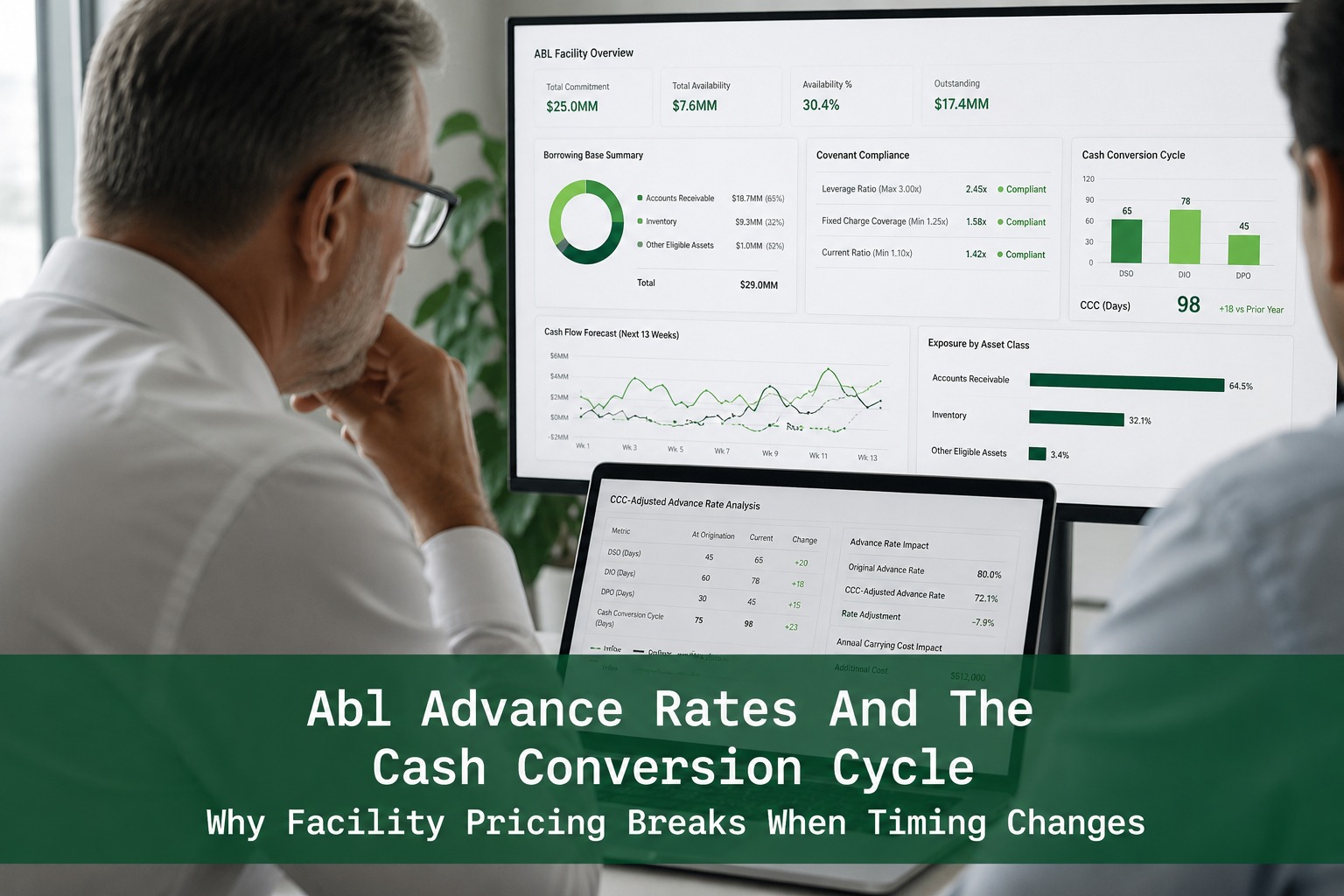
ABL Advance Rates and the Cash Conversion Cycle: Why Facility Pricing Breaks When Timing Changes
How Advance Rate Recalibration Against Current Cash Conversion Timing Corrects the Hidden Pricing Misalignment in Most ABL Facilities
SERIES CONTEXT
This article is the second in the Forensic ABL Framework and ABL-RBF Stack Series — a three-part series delivering the complete capital structure solution for the businesses the regional bank market is exiting. It is published on the Capital Source thought-leadership platform for financially literate SMB operators, CFOs, and business owners.
Article One established the Forensic ABL Facility as a design discipline built on three simultaneous inputs. This article develops the CCC-Adjusted Advance Rate — the pricing mechanism that ensures an ABL advance rate reflects the period the capital is actually outstanding rather than the period the origination formula assumed.
Readers arriving here directly will find this article stands alone as a complete diagnostic of how the cash conversion cycle changes the real carrying cost of an asset-based lending facility.
KEY POINTS
- The advance rate on an ABL facility is a collateral question and a timing question simultaneously. Most facilities answer the first well and leave the second unaddressed. That gap — between what the advance rate implies about conversion timing and what the current Cash Conversion Cycle delivers — is where facility pricing silently diverges from facility economics.
- The CCC-Adjusted Advance Rate recalibrates the advance against the Cash Conversion Cycle the operating cycle is running at today. It is not a lower advance rate. It is an accurate one — reflecting the period the capital is genuinely outstanding rather than the period the origination assumed.
- When the Cash Conversion Cycle extends beyond the origination assumption, every advance outstanding against the eligible asset base accrues carrying cost against cash that arrives later than the formula anticipated. The borrower pays that extended carrying cost whether the advance rate acknowledges it or not.
- CCC extension is one of the most common sources of advance rate misalignment in ABL facilities originated before the current demand environment. The extension rarely appears as a direct credit quality issue. It appears as margin compression, tighter liquidity, and working capital strain without a clear single cause.
- The CCC-Adjusted Advance Rate is the pricing complement to the Forensic ABL Facility design Article One established. The Forensic Borrowing Base determines what the assets support. The CCC-Adjusted Advance Rate determines what it costs to use them at current timing reality.
DEFINITIONS
CCC-Adjusted Advance Rate
The advance rate on eligible ABL assets recalibrated against the actual Cash Conversion Cycle the operating cycle is running at currently rather than against the CCC assumption embedded in the origination advance rate.
The CCC-Adjusted Advance Rate reflects the carrying cost of the advance across the period the underlying assets actually take to convert to cash. For receivables, it is derived from the weighted average collection period in the current receivables aging. For inventory, it reflects the actual turn rate producing the current Days Inventory Outstanding.
The CCC-Adjusted Advance Rate is not a penalty rate. It is the rate at which the advance is priced correctly against actual conversion timing.
THE ADVANCE RATE HAS TWO JOBS. MOST ABL FACILITIES ONLY DO ONE.
Every ABL advance rate performs two functions.
The first is collateral governance — ensuring the advance does not exceed a defined percentage of eligible asset value, protecting the lender against collateral deterioration. That function is well understood and consistently applied.
The second function is timing governance — ensuring the advance is priced against the period the capital will actually be outstanding before the underlying assets convert to cash.
That timing function is almost never explicitly addressed in conventional ABL facility design. The advance rate is set at origination based on asset type and eligibility criteria. The Cash Conversion Cycle assumption embedded in that rate is implicit, derived from historical averages, and rarely revisited regardless of how operating conditions have shifted.
The result is an asset-based lending facility whose collateral governance is current and whose timing governance is outdated. The advance rate reflects what the assets are worth at a standard collection assumption. It does not reflect what they cost to carry at the collection cycle the business is running.
Section One: How the Cash Conversion Cycle Gets Embedded in the Advance Rate
The conventional ABL advance rate on eligible receivables — typically 80 percent — was developed against historical data on collection performance across industries and facility types. Embedded in that rate is an implicit assumption about how quickly receivables convert to cash.
An 80 percent advance rate on a 45-day receivable carries different economics than an 80 percent advance rate on a 65-day receivable. The same nominal rate against a longer collection period means the capital is outstanding for more days, accruing carrying cost against cash that has not yet arrived.
At origination, the advance rate is calibrated to the historical collection performance the underwriting analysis captured. If the historical DSO was 45 days, the advance rate reflects 45-day conversion economics. The lender is comfortable advancing 80 percent because the receivable is expected to convert within a period that makes the economics sound.
When the DSO extends — as it has across much of the SMB segment under current counterparty payment pressure — the economics embedded in the origination advance rate no longer reflect reality.
The receivable now converts in 65 days. The lender is still advancing 80 percent. The carrying cost of that advance has increased because the capital is outstanding for 20 additional days before it returns. The nominal rate is unchanged. The actual cost has risen.
The Cash Conversion Cycle extension problem is not a lender problem or a borrower problem. It is a facility design problem.
The advance rate was set correctly for the CCC at origination. The CCC has since moved. The advance rate has not moved with it.
That mismatch is not a credit quality signal. It is a timing signal — and the two require fundamentally different responses.
The strategic consequence of embedded Cash Conversion Cycle assumptions: every cycle the advance rate remains calibrated to an origination CCC that no longer reflects current collection behavior, the borrower pays a carrying cost the facility pricing does not acknowledge.
That gap accumulates silently — in compressed margins, tighter liquidity, and a Net Working Capital floor that erodes slightly each cycle rather than holding at the stress threshold the Forensic ABL Facility requires.
Section Two: The CCC-Adjusted Advance Rate
The CCC-Adjusted Advance Rate corrects the timing governance function the conventional advance rate fails to perform.
It recalibrates the advance against the Cash Conversion Cycle the operating cycle is actually running at — producing a rate that reflects current conversion timing rather than origination assumptions.
The Receivables Component
For eligible receivables, the CCC-Adjusted Advance Rate begins with the weighted average collection period derived from current receivables aging rather than from contractual terms or historical averages.
If the current weighted average collection period is 65 days and the origination advance rate was calibrated against a 45-day assumption, the CCC-Adjusted Advance Rate recalibrates against the 65-day period.
The recalibration does not mechanically reduce the advance rate by the ratio of CCC extension.
It establishes the rate at which the carrying cost of the advance reflects the actual period of outstanding exposure.
For some facilities, the recalibrated rate is close to the origination rate — the Cash Conversion Cycle has not materially extended. For facilities where the CCC has extended by 15 to 25 days, the recalibrated rate reflects a meaningfully different carrying cost structure.
The practical effect is direct.
A borrower whose facility advance rate has been recalibrated against the current Cash Conversion Cycle understands what the facility actually costs per cycle at current conversion timing.
A borrower whose advance rate has not been recalibrated is paying an effective cost that differs from the nominal rate — and that difference accumulates against the Net Working Capital floor without a visible signal.
The Inventory Component
For eligible inventory, the CCC-Adjusted Advance Rate connects the advance rate to current inventory turn performance rather than to origination turn assumptions.
Inventory turning in 50 days rather than the 35-day origination assumption is outstanding in the operating cycle for 15 additional days before it generates the receivable that eventually converts to cash.
The carrying cost of the advance against that inventory is higher than the origination rate captured.
The inventory component incorporates the forced liquidation gap the Forensic Advance Rate from Article One established — the divergence between the advance rate’s implied liquidation value and the value the inventory would yield under current market conditions.
The CCC-Adjusted Advance Rate for inventory addresses both dimensions: the timing extension that increases carrying cost and the value divergence that overstates collateral support.
The Combined CCC Assessment
The full CCC-Adjusted Advance Rate assessment produces a complete picture of how the facility is priced against current conversion timing across both eligible asset classes.
It identifies:
- the receivables timing gap
- the inventory timing gap
- the combined carrying cost impact of both
- the difference between what the facility costs at origination assumptions and what it costs at current Cash Conversion Cycle reality
That difference is the invisible cost the facility has been generating since the CCC extended beyond origination assumptions.
Making it visible is the first step toward governing it.
The CCC-Adjusted Advance Rate does not change the facility’s collateral adequacy.
The Forensic Borrowing Base from Article One governs collateral adequacy.
The CCC-Adjusted Advance Rate governs pricing adequacy — whether the advance rate reflects the actual period of outstanding exposure.
Both are necessary.
Neither substitutes for the other.
The strategic consequence of the CCC-Adjusted Advance Rate: a facility priced at the CCC-Adjusted rate carries no hidden timing gap between nominal cost and actual cost.
The borrower’s Net Working Capital floor modeling, deployment return calculations, and full-stack cost governance all operate against a carrying cost that reflects conversion timing reality.
A facility priced at origination assumptions carries a gap that erodes the Net Working Capital floor silently every cycle the Cash Conversion Cycle remains extended.
FORENSIC STRESS TEST: IS YOUR ADVANCE RATE CCC-ADJUSTED?
Receivables Timing
- Has the weighted average collection period in your current receivables aging been calculated and compared against the collection assumption embedded in your origination advance rate?
- Has your DSO changed materially since your facility was originated and, if so, has your advance rate been reviewed against current conversion timing?
- Do you know what your asset-based lending facility actually costs per cycle at your current weighted average collection period versus what the nominal advance rate implies?
Inventory Timing
- Has your current inventory turn rate been compared against the turn assumption embedded in your origination advance rate?
- Does the Days Inventory Outstanding in your current operating cycle materially exceed the turn assumption the facility was underwritten against?
- Has the forced liquidation value of your inventory been assessed against current market conditions and incorporated into the inventory advance rate?
Combined CCC Assessment
- Has the full CCC-Adjusted Advance Rate been calculated across both receivables and inventory to establish the complete timing gap between origination assumptions and current conversion reality?
- Do you know the cumulative carrying cost difference between what your facility costs at origination Cash Conversion Cycle assumptions and what it costs at your current CCC?
- Has this timing gap assessment been incorporated into your Net Working Capital floor modeling and your Deployment Return Threshold calculations?
FREQUENTLY ASKED QUESTIONS
What is the CCC-Adjusted Advance Rate and how does it differ from the standard advance rate?
The standard advance rate is set at origination based on asset type, eligibility criteria, and historical collection and turn performance. It embeds an implicit Cash Conversion Cycle assumption that is rarely revisited.
The CCC-Adjusted Advance Rate recalibrates against the Cash Conversion Cycle the operating cycle is running at currently — the weighted average collection period from current receivables aging and the actual inventory turn rate from current sales velocity.
The two rates may be identical for facilities whose CCC has not materially changed since origination.
For facilities where the CCC has extended, the CCC-Adjusted rate reflects a materially different carrying cost structure.
Does the CCC-Adjusted Advance Rate mean I borrow less against my assets?
Not necessarily.
The CCC-Adjusted Advance Rate is a pricing discipline, not a collateral discipline.
It addresses what the advance costs per cycle, not what percentage of eligible assets the facility supports.
An ABL facility can carry the same advance rate percentage against eligible assets while still applying the CCC-Adjusted rate to understand and govern the actual carrying cost per cycle.
Where the origination advance rate overstated the collateral support — because the forced liquidation gap has widened — the Forensic Advance Rate from Article One addresses the collateral component.
The CCC-Adjusted Advance Rate addresses the timing component.
How does Cash Conversion Cycle extension translate into Net Working Capital floor compression?
When the Cash Conversion Cycle extends, capital is deployed in the operating cycle for longer before it returns as cash.
During that extended period, the Net Working Capital floor absorbs the carrying cost of the outstanding advance rather than the operating cycle generating the cash that would otherwise sustain it.
A 20-day CCC extension means the Net Working Capital floor must sustain 20 additional days of carrying cost before receivables convert.
That sustained compression appears as gradually tighter liquidity and a floor that holds lower than the stress threshold requires.
The CCC-Adjusted Advance Rate makes the compression mechanism visible so it can be governed rather than accumulated.
When should a borrower initiate a CCC-Adjusted Advance Rate assessment?
The primary trigger is any material change in DSO or DIO since facility origination.
For most SMB borrowers with ABL facilities originated before the current demand environment, DSO has extended and DIO has slowed enough that the CCC-Adjusted assessment will identify a meaningful timing gap.
Secondary triggers include:
- Net Working Capital floor compression without a visible income statement cause
- advance rate pressure from the lender without a clear collateral deterioration signal
- covenant pressure on metrics that appeared adequate at origination
How does the CCC-Adjusted Advance Rate connect to the ABL-RBF Stack Article Three develops?
The CCC-Adjusted Advance Rate is the pricing input that determines how much of the operating cycle’s capital requirement the ABL facility can cost-effectively support.
For businesses whose forensic facility — correctly priced at the CCC-Adjusted rate — can fully support peak working capital demand, the ABL facility alone is the complete solution.
For businesses where the CCC-Adjusted pricing reveals a cost structure that makes full ABL utilization inefficient at peak demand, the ABL-RBF Stack may provide the incremental capital at terms better suited to the peak demand window.
Article Three develops that analysis in full.
CONCLUSION
The advance rate on your ABL facility is a collateral question and a timing question.
Most facilities answer the first well and leave the second unaddressed.
That gap — between what the advance rate implies about conversion timing and what the current Cash Conversion Cycle delivers — is where facility pricing silently diverges from facility economics.
The CCC-Adjusted Advance Rate closes that gap.
It is not a different instrument or a different facility structure.
It is the same advance rate, correctly calibrated against the conversion cycle that exists rather than the one assumed at origination.
Combined with the Forensic Borrowing Base and the NWC-CCC-WCC Governance Trinity, it completes the pricing layer of the Forensic ABL Facility design.
Article Three develops the ABL-RBF Stack — the capital structure solution for businesses whose operating cycle requirements exceed what the forensic asset base can support alone.
CTA
If your ABL advance rate has not been assessed against your current Cash Conversion Cycle since origination — and for most SMB borrowers with facilities originated before the current demand environment it has not — the CCC-Adjusted Advance Rate assessment is the starting point for understanding what your facility actually costs against the conversion cycle running today.
Capital Source performs that assessment.
We calculate:
- your current weighted average collection period from receivables aging
- your current DIO from inventory turn data
- the combined CCC-Adjusted Advance Rate that reflects current conversion timing across both asset classes
That assessment identifies the gap between what your facility costs at origination assumptions and what it costs at current Cash Conversion Cycle reality.
Series articles
Article One: Forensic ABL Facility Design
Article Three: The ABL-RBF Stack [Upcoming]
STRATEGIC DISCLOSURE
Capital Source is a commercial capital advisory firm. This article is produced for informational purposes and represents the firm’s analytical perspective on current credit market conditions. It does not constitute financial, legal, or investment advice. Businesses evaluating capital structure decisions should engage qualified advisors with direct knowledge of their specific operating circumstances.
Proud to be ranked on the 2024 and 2025 Inc. 5000 list of America’s fastest-growing private companies.