
Cash Conversion Cycle and ABL Advance Rates: Why Your Borrowing Base May Be Outdated
The CCC Forensic Assessment — How to Measure the Cash Conversion Cycle Against Current Operating Reality Rather Than Origination Assumptions
SERIES CONTEXT
This article is the second in the NWC-CCC-WCC Governance Trinity Series — a three-part series developing the operating cycle variables that determine asset-based lending (ABL) facility sizing, advance rate calibration, borrowing base accuracy, and draw management discipline. It is published on the Capital Source thought-leadership platform for financially literate SMB operators, CFOs, and business owners. Article One established that NWC is a dynamic operating variable that must be assessed through NWC Velocity and the NWC Floor Stress Test rather than read from the balance sheet. This article develops the Cash Conversion Cycle as the timing variable that determines advance rate calibration and carrying cost reality. Readers arriving here directly will find this article stands alone as a complete diagnostic.
KEY POINTS
- The advance rate on your ABL facility was calibrated against a Cash Conversion Cycle that reflected how quickly your receivables converted at the time the facility was originated. If your CCC has extended since origination the advance rate is overstated relative to the operating cycle and borrowing base reality that actually exists.
- The CCC Forensic Assessment measures the Cash Conversion Cycle against current counterparty payment behavior, current inventory turn rates, and current payables extension capacity rather than against historical averages or origination assumptions.
- Every additional day of CCC extension compounds the True Cost per Cycle of every outstanding advance and extends the period over which assets must be held before they convert to cash. A facility originated at a 60-day CCC assumption and now operating against an 80-day CCC is carrying an advance rate that overstates what the underlying assets will actually return within the period the formula assumed.
- Federal Reserve senior loan officer survey data and academic research on working capital behavior in tightening credit environments consistently indicate that CCC extension across the SMB segment has been the primary driver of advance rate and borrowing base misalignment in ABL facilities originated before the current rate and demand environment.
- The CCC Forensic Assessment is the second variable in the NWC-CCC-WCC Governance Trinity. It operates alongside the NWC Floor Stress Test from Article One and the WCC Shape Analysis from Article Three. All three must be assessed simultaneously for an ABL facility to be correctly sized against the operating cycle that actually exists.
DEFINITIONS
CCC Forensic Assessment — the discipline of measuring the Cash Conversion Cycle against current counterparty payment behavior, current inventory turn rates, and current payables extension capacity rather than against historical averages or origination assumptions. The CCC Forensic Assessment produces the actual cycle timing the operating cycle is running at today and uses it to recalibrate advance rates, True Cost per Cycle calculations, borrowing base assumptions, and NWC floor projections against current operating reality rather than the conditions that existed when the facility was originated.
YOUR ADVANCE RATE WAS BUILT FOR A DIFFERENT BUSINESS
Not a worse business. Not a better business. A business that collected receivables on a different timeline, turned inventory on a different schedule, and operated in a demand environment that no longer applies to the cycle running today.
Most ABL advance rates are set at origination and reviewed infrequently if at all. The 80 percent advance rate on eligible receivables that made sense when your average collection period was 45 days makes a structurally different claim about the underlying assets when your average collection period is now 62 days. The receivables are not lower quality. They take longer to convert. And every additional day of conversion time is a day on which the advance outstanding against those receivables is accruing carrying cost against cash that has not yet arrived.
That is not a rate problem. It is a timing problem. And timing problems in ABL facilities do not show up on the income statement until they have already produced an over-advance condition, borrowing base shortfall, or covenant breach.
Section One: What the CCC Actually Measures and Why Current Conditions Have Changed It
The Cash Conversion Cycle measures the time it takes for cash to move out of the business through inventory purchase and vendor payment and return to the business through receivables collection. It is expressed as Days Sales Outstanding plus Days Inventory Outstanding minus Days Payables Outstanding. The result is the number of days the business has capital deployed in the operating cycle before it converts back to cash.
At origination most ABL facilities calibrate the advance rate against a CCC derived from trailing twelve-month historical data. That historical CCC reflects what the cycle was running at over the prior year. It does not reflect what the cycle is running at today. And in the current environment the gap between the historical CCC and the current CCC is material for most SMB borrowers across three simultaneous channels.
The AR Collection Channel
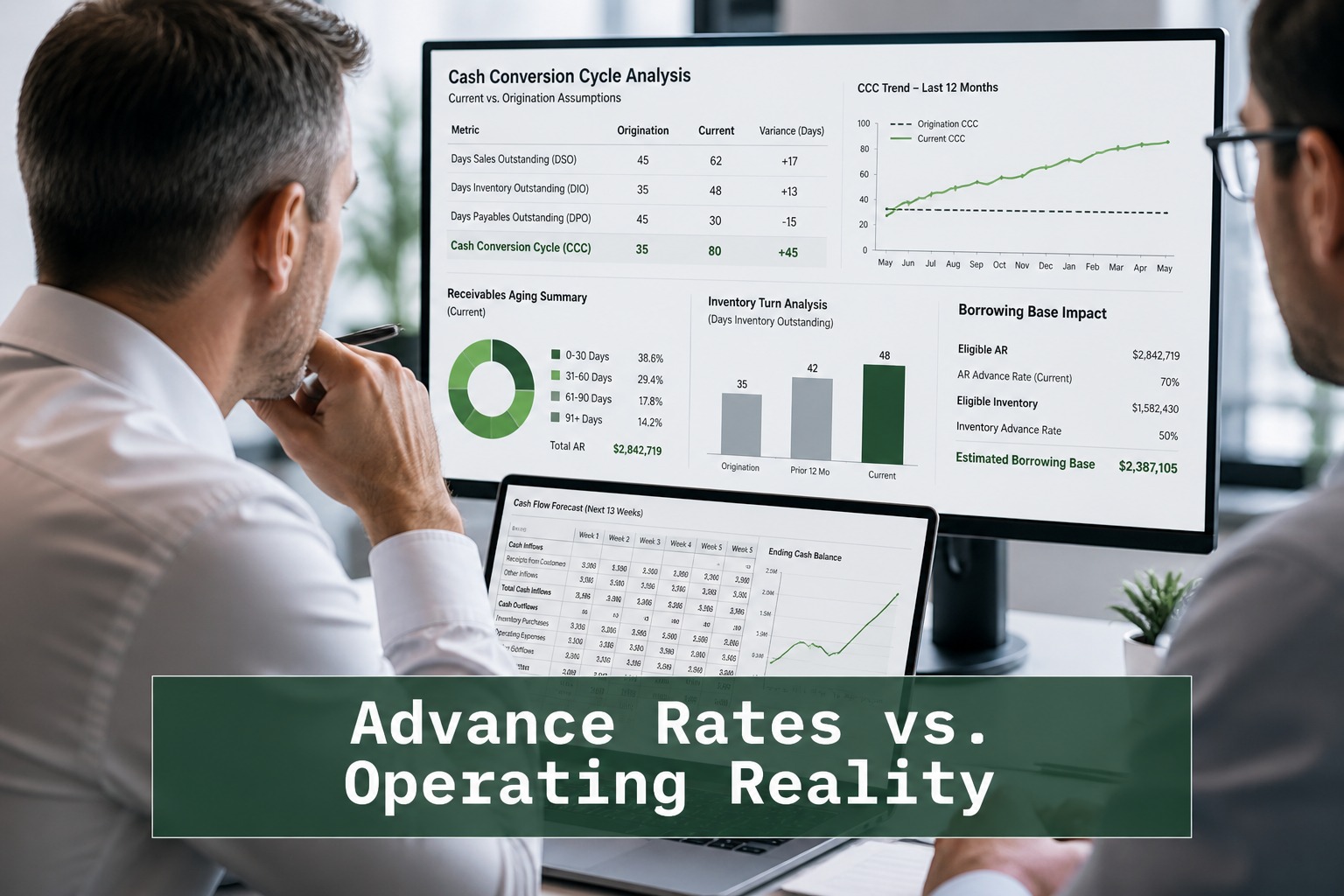
Counterparties managing their own working capital under inflationary pressure have extended payment cycles across the SMB segment. A customer who historically paid on net 30 terms may now be effectively paying on net 45 or net 52 terms without formally renegotiating the terms of sale. The aging bucket data shows the extension. The DSO calculation confirms it. But the advance rate on the facility may still reflect the historical payment behavior rather than the current one.
The Inventory Turn Channel
Demand-channel transmission has slowed inventory turns for businesses across multiple sectors. Inventory that was turning in 35 days at origination may now be turning in 48 days as buyer caution, order pattern shifts, and supply chain realignment have extended the time between purchase and sale. Slower turns mean the same inventory dollar is outstanding in the operating cycle for longer before it generates the receivable that eventually converts to cash.
The Payables Extension Channel
Suppliers tightening their own working capital positions have compressed the payables extension capacity that historically offset the DSO and DIO components of the CCC. A business that historically stretched payables to 45 days may now be managing against 30-day supplier terms. That compression adds directly to the effective CCC because it reduces the offset that payables extension provides against the cash deployed in receivables and inventory.
Federal Reserve senior loan officer survey data and academic research on supply chain financing behavior in inflationary environments consistently indicate that all three channels have operated simultaneously across the SMB segment over the past two years. The combined effect has extended the effective CCC for most SMB ABL borrowers beyond the assumptions their facilities and borrowing bases were originated against.
A 20-day CCC extension on a $1.5 million ABL advance at a 10.5 percent annual carrying cost adds approximately $8,600 in carrying cost per cycle. That additional cost does not appear as a line item on the income statement. It appears as compressed operating margins, tighter NWC, and eventually as an advance rate that the underlying assets can no longer fully support within the period the facility assumed.
The strategic consequence of the three-channel CCC extension: an ABL facility originated at a 60-day CCC that is now operating against an 80-day CCC is not the same facility. The advance rate is overstated, the carrying cost per cycle is understated, and the NWC Floor Stress Test from Article One is running against a more compressed floor than the origination analysis assumed. The CCC Forensic Assessment is what makes the extension visible before it has already produced a structural borrowing base problem.
Section Two: The CCC Forensic Assessment
The CCC Forensic Assessment replaces the historical average with a current operating measurement calibrated to the specific conditions the business is actually running against. It has three components.
Component One — DSO at Current Payment Behavior
Days Sales Outstanding is calculated against current receivables aging rather than against the historical collection rate. The assessment identifies the weighted average collection period across the current receivables book, distinguishing between the contractual terms and the actual collection behavior. Where contractual terms are net 30 and actual collection behavior is producing a 52-day weighted average the CCC Forensic Assessment uses 52 days in the DSO component, not 30.
This distinction matters because advance rates calibrated to contractual terms assume the receivables will convert within the contractual period. When actual collection behavior diverges from contractual terms the advance outstanding against those receivables is extended beyond the period the advance rate assumed. The receivables are not ineligible. They are slower. And slower receivables produce a higher carrying cost and a lower effective advance rate than the contractual-terms calculation implies.
Component Two — DIO at Current Turn Rate
Days Inventory Outstanding is calculated against current inventory turn data rather than against the historical turn rate at origination. The assessment identifies the actual turn rate the inventory is achieving in the current demand environment, distinguishing between the origination assumption and the current performance.
For businesses carrying inventory that has experienced demand-channel slowdown, the actual DIO may be materially higher than the origination assumption. A business that originated with a 35-day DIO running at a 45-day DIO today is carrying working capital in inventory for ten additional days per cycle. Those ten days compound the carrying cost, extend the NWC floor compression period, and reduce the effective advance rate because the inventory takes longer to generate the receivable that eventually converts to cash.
Component Three — DPO at Current Payables Terms
Days Payables Outstanding is calculated against current supplier terms and current payment behavior rather than against the historical payables extension capacity. Where payables terms have compressed the DPO calculation reflects the actual extension capacity available, not the historical capacity that may no longer be offered by suppliers managing their own working capital positions.
The DPO component is the offset in the CCC formula. Longer payables extension reduces the CCC by delaying the cash outflow side of the cycle. When payables compression reduces the DPO, the effective CCC increases even if DSO and DIO remain constant. The CCC Forensic Assessment captures this compression and incorporates it into the current CCC calculation alongside the DSO and DIO components.
The CCC Forensic Assessment does not produce a more conservative CCC than the historical calculation. It produces an accurate one. A business whose current CCC is longer than its historical average is not a weaker business. It is a business operating in a different timing environment than the one its facility was built around. The forensic assessment makes that difference visible and governable rather than invisible and accumulating.
The strategic consequence of the three-component assessment: the CCC Forensic Assessment produces the advance rate recalibration the current operating cycle actually requires. A facility with an advance rate calibrated to a 60-day CCC running against an 80-day CCC should carry an advance rate that reflects the 80-day conversion period. That recalibration is what the CCC-Adjusted Advance Rate delivers, which Article Three develops in full as part of the complete forensic facility sizing framework.
FORENSIC STRESS TEST: DO YOU KNOW YOUR CURRENT CCC?
DSO Assessment
- Have you calculated your weighted average collection period against current receivables aging data rather than against contractual terms or historical averages?
- Has your DSO changed materially over the past four operating cycles and if so has your advance rate been recalibrated to reflect the current collection timeline?
- Are you aware of the specific counterparties driving collection extension in your current AR book and whether that extension is structural or temporary?
DIO Assessment
- Have you calculated your current inventory turn rate against actual sales velocity rather than against the origination assumption or the prior year average?
- Has your DIO extended since your facility was originated and if so by how many days relative to the advance rate assumption?
- Does your current inventory position include categories turning materially slower than your overall DIO average that may require a separate advance rate assessment?
DPO Assessment
- Has your effective payables extension capacity changed since origination as supplier terms have compressed?
- Do you know the DPO offset your current supplier terms actually provide relative to the historical capacity your facility assumed?
- Have any key supplier relationships shifted from extended payables to tighter terms in ways that have increased your effective CCC without a corresponding change in your DSO or DIO?
Advance Rate Alignment
- Has your current advance rate been assessed against the CCC Forensic Assessment rather than against the historical CCC at origination?
- Do you know the carrying cost per cycle at your current CCC relative to the carrying cost the facility was originated to support?
- Has your lender recalibrated the advance rate since origination in response to demonstrated CCC extension or has the rate remained at the origination assumption despite changed timing conditions?
FREQUENTLY ASKED QUESTIONS
What is the CCC Forensic Assessment and how does it differ from a standard CCC calculation?
A standard CCC calculation uses trailing twelve-month historical averages for DSO, DIO, and DPO. The CCC Forensic Assessment uses current operating data — weighted average collection periods from the current receivables aging, actual inventory turn rates from current sales velocity, and effective payables extension from current supplier terms. In stable operating environments the difference between the two is small. In the current environment where collection cycles have extended, inventory turns have slowed, and payables terms have compressed simultaneously, the difference can be 15 to 25 days or more. That difference determines whether the advance rate on the facility is calibrated to the operating cycle that actually exists or the one that existed at origination.
Why does a longer CCC mean the advance rate is overstated?
The advance rate on eligible receivables is calibrated against the assumption that those receivables will convert to cash within a specific period. When the actual collection period extends beyond that assumption the advance outstanding against the receivables accrues carrying cost against cash that arrives later than the formula assumed. The receivables are not ineligible. They are slower. An advance rate calibrated to a 45-day collection period is overstated when applied to receivables actually converting in 62 days because it assumes a return of capital within a period that the current operating cycle cannot deliver.
How does CCC extension affect the NWC floor established in Article One?
CCC extension and NWC floor compression are connected through the same operating cycle mechanics. When the CCC extends, capital is deployed in the cycle for longer before it returns as cash. The NWC floor must absorb that extended deployment period. A 20-day CCC extension means the NWC floor must sustain 20 additional days of working capital deployment before the receivables convert and the floor regenerates. That additional deployment period reduces the NWC Velocity calculated in Article One and lowers the stress floor the NWC Floor Stress Test produces. All three variables in the trinity move together when the CCC changes. That is why all three must be assessed simultaneously.
What is the CCC-Adjusted Advance Rate and when does it apply?
The CCC-Adjusted Advance Rate is the advance rate recalibrated against the actual CCC the CCC Forensic Assessment produces. It replaces the origination advance rate when the current CCC has materially diverged from the origination assumption. A business with a CCC Forensic Assessment showing an 80-day current CCC against a 60-day origination assumption should carry an advance rate that reflects the 80-day conversion reality — because the carrying cost, the NWC floor impact, and the True Cost per Cycle all reflect the longer outstanding period whether the advance rate acknowledges it or not. Article Three of this series develops the CCC-Adjusted Advance Rate as part of the complete Forensic ABL Framework.
How does the CCC Forensic Assessment connect to facility conversations with lenders?
A borrower who arrives at a lender conversation with a completed CCC Forensic Assessment has already done the analytical work the lender would perform during underwriting. The assessment demonstrates that the borrower understands the current timing reality of its operating cycle, has quantified the divergence from origination assumptions, and is prepared to discuss advance rate recalibration from an informed analytical position rather than from a reactive one. That preparation is the Governance Premium the Credit Tightening Series established — earned before the lender conversation, not assembled in response to it.
CONCLUSION
The advance rate on your ABL facility is not wrong. It is outdated. It was calibrated against a CCC that reflected how your operating cycle ran at origination. If your DSO has extended, your inventory turns have slowed, or your payables extension capacity has compressed since origination — and for most SMB borrowers at least one of those three conditions applies — your CCC has changed and your advance rate has not caught up with it.
The CCC Forensic Assessment closes that gap. It measures the cycle as it actually runs today and produces the recalibration the facility requires to reflect current operating reality rather than origination assumptions. Combined with the NWC Floor Stress Test from Article One it produces a two-dimensional picture of the operating cycle that no balance sheet figure and no historical average can provide.
Article Three develops the WCC Shape Analysis — the third variable in the trinity and the one that sizes the facility for the full operating cycle shape including peak demand and seasonal trough rather than the trailing average. The series capstone integrates all three into the unified governance framework for forensic ABL facility sizing.
If your ABL facility advance rate has not been recalibrated since origination and your operating cycle has changed — in collection timing, inventory velocity, or payables capacity — the CCC Forensic Assessment is the starting point for understanding what your facility should actually look like against the cycle running today.
Capital Source performs that assessment. We calculate your current DSO against actual receivables aging, your current DIO against actual inventory turn rates, and your effective DPO against current supplier terms. We produce the CCC Forensic Assessment that tells you where your current CCC sits relative to your origination assumption and what the advance rate recalibration that reflects current operating reality looks like for your specific facility.
Article One: Your NWC Is Not What Your Balance Sheet Says It Is
Article Three: WCC Shape Analysis
STRATEGIC DISCLOSURE
Capital Source is a commercial capital advisory firm. This article is produced for informational purposes and represents the firm’s analytical perspective on current credit market conditions. It does not constitute financial, legal, or investment advice. Businesses evaluating capital structure decisions should engage qualified advisors with direct knowledge of their specific operating circumstances.
Proud to be ranked on the 2024 and 2025 Inc. 5000 list of America’s fastest-growing private companies.