
REFERRAL PARTNER SERIES
Intercreditor Agreements: Making Room for Multiple Sources of Capital
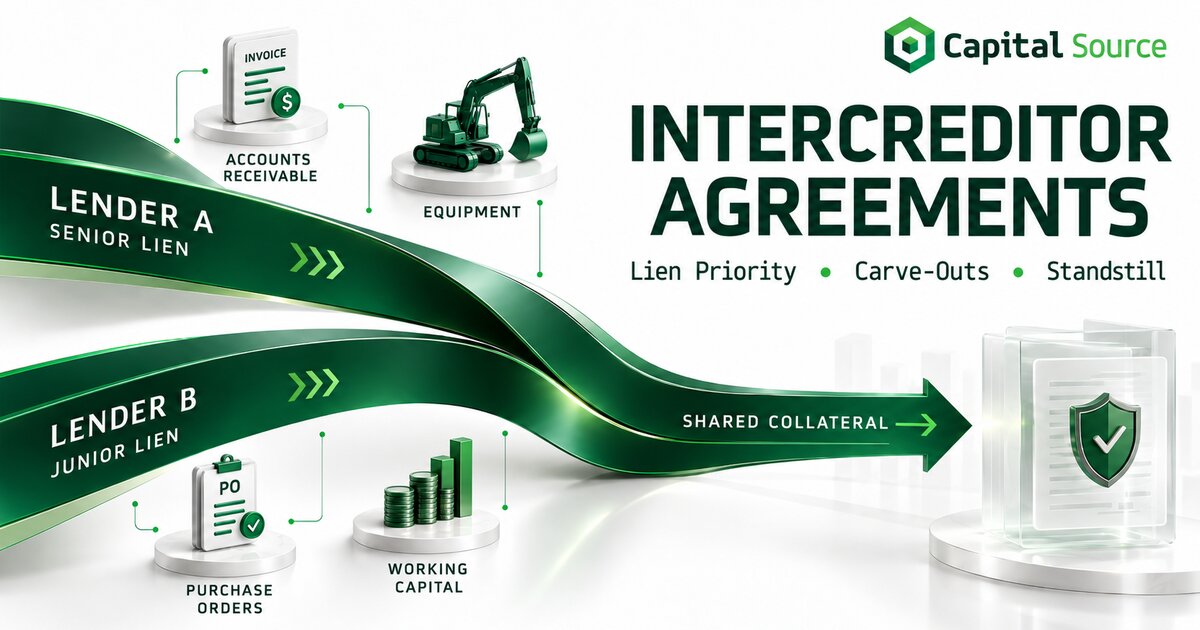
Two lenders, one borrower, one pool of collateral. Before either of them funds, somebody has to decide who gets paid first, who waits, and who controls enforcement. That decision lives in a single document, and the owners caught between two lenders rarely get it explained in plain terms.
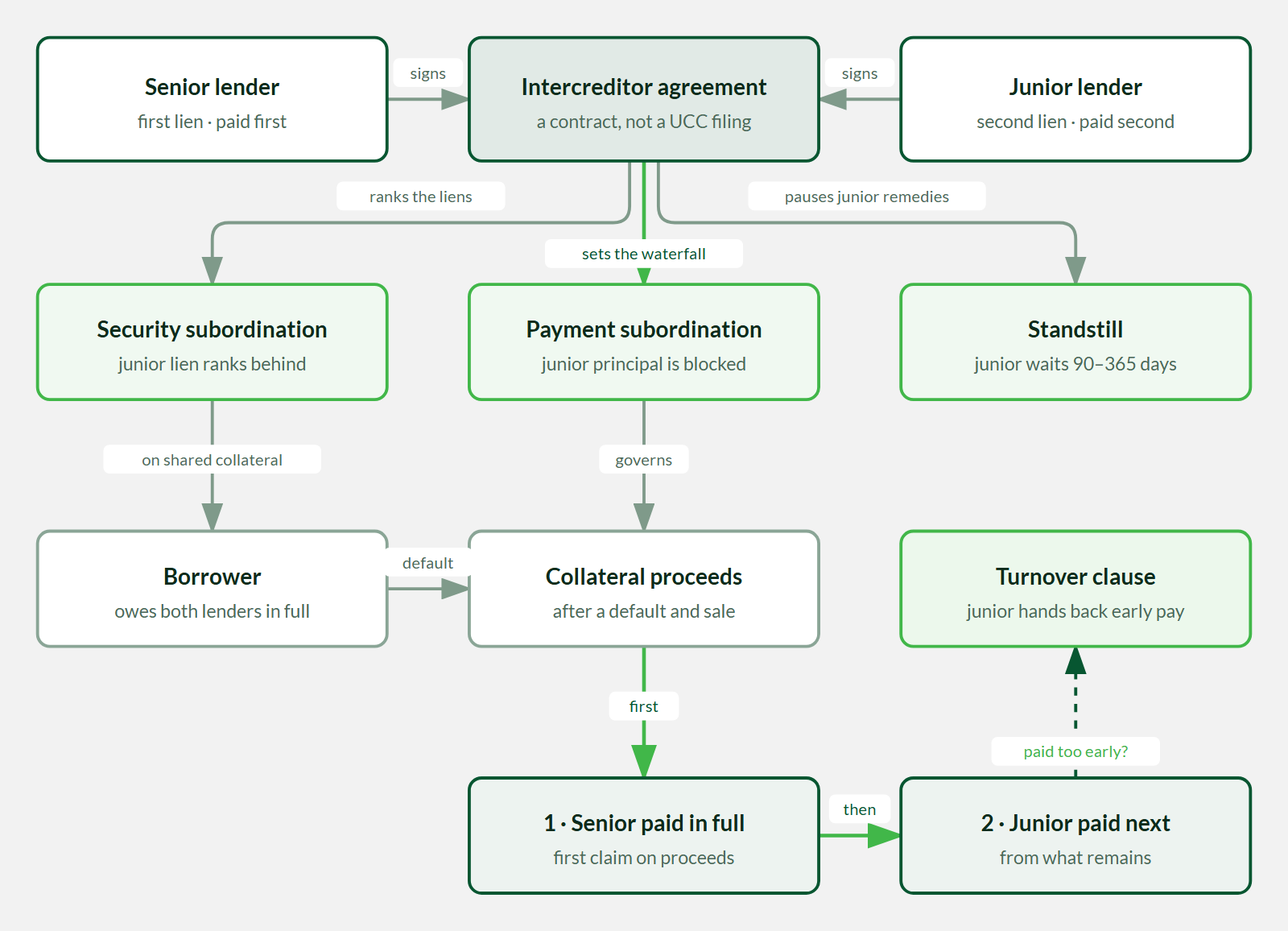
An intercreditor agreement is a contract between two or more lenders to the same borrower that fixes lien priority, payment rights, and enforcement control before anything goes wrong. It is signed at closing, it sits behind every loan in the stack, and it does most of its work on the worst day of the credit. For the factoring, purchase order finance, and asset-based lending firms we work with, and for the credit officers who paper these deals, the document is routine. For the founder whose receivables lender and whose term lender have just met for the first time, it can read like a land mine.
What is an intercreditor agreement?
An intercreditor agreement is a contract among lenders to the same borrower that sets their relative rights and priorities against shared collateral. Thomson Reuters Practical Law names the three provisions that carry the weight: payment subordination, security subordination, and standstill. Blakes adds the commercial reason the document exists at all: companies routinely secure financing from more than one lender, and two lenders sharing a borrower need their relative rights written down before a default writes them for everyone.
Why two lenders end up sharing one borrower
Split collateral is the common shape. A working-capital lender funds against receivables and inventory while a fixed-asset lender holds equipment or real estate. Blakes notes that collateral-access rights matter most in exactly these split deals, where a working-capital lender realizing on inventory occupying the fixed-asset lender’s property may owe compensation for the occupation and for any damage. A factor buying receivables from a company that also carries a bank term loan is the classic case, and the questions a factor should be asking before the borrowing base moves are covered in our guide to the factoring borrowing base gap.
The other shape is the unitranche facility, where one loan agreement papers what is economically senior and junior money at a blended rate. Mayer Brown’s September 2026 legal update describes the agreement among lenders (AAL) that sits behind the credit agreement and governs the sharing and allocation of interest and fees, the right to direct enforcement, caps on protective advances, voting on amendments, and the trigger events that shift the payment waterfall from pro rata to first-out, then last-out. Some unitranche borrowers, the update observes, never learn an AAL is sitting behind their credit agreement at all.
Lien priority: who gets paid first from the collateral
Lien priority determines the order in which lenders are paid from the proceeds of shared collateral. Absent any agreement, Uniform Commercial Code Article 9 ranks conflicting perfected security interests by priority in time of filing or perfection, the first-to-file-or-perfect rule of U.C.C. 9-322. The code then allows the parties to contract out of that order: U.C.C. 9-339 provides that Article 9 does not preclude subordination by agreement. Security subordination is that agreement in action. The junior lender’s lien remains perfected, but it is contractually ranked behind the senior lien on the shared collateral.
Filings show the structure at scale. A subordination and intercreditor agreement filed with the SEC in a 2014 cosmetics holding-company financing pairs a $125 million first-lien senior facility with a $40 million second-lien junior term loan, and subordinates the junior liens to the senior liens across all collateral, now owned or later acquired.
Where the UCC lien search fits
A UCC lien search is a diligence step that reveals the financing statements already filed against a borrower before a new lender closes. It tells a lender who has perfected, in what order, and against which collateral. What it cannot tell you is what those lenders agreed between themselves, because intercreditor agreements are contracts, not filings, and they never reach the filing office. Two positions can look correctly ordered on a search report and still be re-ranked by a subordination agreement under U.C.C. 9-339. Credit officers run the search to map the stack, then ask for the intercreditor documents to learn who actually controls it.
Payment blockage: when the junior lender stops getting paid
A payment blockage provision stops payments to the junior lender while senior debt remains outstanding. Per Blakes, most intercreditor agreements prohibit payments toward the junior lender’s principal while senior debt is outstanding, and the treatment of interest is where the negotiation actually happens: restrictions on interest payments are commonly negotiated rather than assumed. Blockage is typically triggered by a default, and it does one thing to the junior lender’s model that every junior underwriter prices in advance: cash can stop while the obligation keeps accruing. For the borrower, blockage pauses a payment stream without reducing a single dollar of the underlying debt.
Standstill: who controls enforcement, and for how long
A standstill provision gives the senior lender control of enforcement by barring the junior lender from acting against the collateral for a defined period. Blakes reports the market range and the give-and-take inside it.
Standstill periods typically run 90 to 365 days, depending on the type of debt and the lenders’ relative negotiating strength, per Blakes. Junior lenders commonly negotiate the right to take basic protective steps during the period, such as accelerating their debt and demanding repayment.
The logic is orderly realization: one lender directs the sale of the collateral instead of two racing it to the bottom. A junior lender that understands this going in underwrites the wait rather than discovering it.
Turnover, DIP financing, and the bankruptcy provisions
The provisions that matter most in a restructuring are the ones signed on the happiest day of the credit. Turnover clauses require a junior creditor that receives payments it was not entitled to receive, typically after notice of a default, to hand those payments over to the senior side. In the SEC-filed agreement cited above, the junior liens are also subordinated to liens securing debtor-in-possession financing granted in an insolvency proceeding, which means new bankruptcy-court-approved money can prime the junior position that already thought it was second. Mayer Brown’s 2026 update flags the live question in this area: how unitranche-style agreements among lenders hold up when they are tested in bankruptcy, which is one more reason the document gets negotiated carefully while everyone is still friendly.
What the stack means for the owner in the middle
An intercreditor agreement orders obligations; it does not reduce them. The owner still owes both lenders, on both sets of terms, with a contract in between that was negotiated by people who expect to enforce it. Two practical habits follow. First, know your own stack: ask which of your facilities are senior, which are junior, and whether an AAL or intercreditor agreement exists that you have never seen. Second, treat the agreement as part of every refinancing decision, because a new lender inherits the negotiation, not just the balance. Our post on the customer concentration business loan walks through a case where concentration pressure and an existing senior lender met in the same collateral pool.
Before approaching any lender about new capital, put the existing agreement through a structured review. If you use an AI assistant for document work, the prompt below checks a current financing agreement for consent triggers and cites the contractual language behind each one. Treat the output as preparation for a conversation with counsel and the existing lender, not as legal advice.
• negative pledges
• restrictions on additional indebtedness
• limitations on additional liens or security interests
• lender consent requirements
• subordination or intercreditor requirements
• events of default that could be triggered by additional financing
Based solely on the agreement, determine whether [Business Name] appears to need the existing lender or lienholder’s consent before accepting additional financing from [New Lender Name]. Cite the specific section, paragraph, covenant, or contractual language supporting your conclusion. If the agreement is ambiguous, incomplete, or does not clearly address the issue, say so and identify what should be confirmed with legal counsel or the existing lender. Do not assume consent is required or permitted unless the agreement supports that conclusion.
How Capital Source works within multi-lender capital structures
Capital Source approaches an intercreditor agreement as a coordination exercise rather than a contest for collateral. The starting point is that a growing business rarely needs one form of financing at a time. An A/R facility funds receivables, equipment financing or a sale-leaseback funds machinery, purchase order finance funds a specific large order, and Stretch working capital through our affiliate fills timing gaps the others do not cover. Each facility is underwritten against different assets and different cash flows, and the documentation should reflect that.
Three drafting tools allow complementary lenders to coexist. A collateral carve-out excludes specific assets from one lender’s collateral package so that a complementary lender can take a security interest in them. Subordination ranks one lender’s lien or payment rights behind another’s on agreed terms. The intercreditor agreement then sets the operating rules across the stack: lien priority, payment blockage, standstill, and turnover. Used together, these tools preserve the protections each lender underwrote while giving the business a more diversified capital stack that does not unnecessarily restrict liquidity.
We design capital around the deal, and in shared-collateral structures that frequently means the junior seat: gap capital behind a bank revolver, purchase order finance behind an ABL facility, growth money that the senior lender’s box cannot hold. The working claim on our factoring partnerships page is that our junior debt does not endanger senior collateral, and the intercreditor negotiation is where that claim is either real or marketing. We work regularly with banks, factors, ABL lenders, equipment lenders, PO finance companies, and their counsel, and we treat the senior lender’s protections as the fixed point the structure is built around. Familiarity with the standard forms shortens the negotiation, because most senior lenders’ core concerns (priority of payment, control of enforcement, DIP consent, turnover) can be addressed with language their credit officers and counsel have seen before.
For approved partners, Capital Source also maintains a library of turnkey intercreditor, subordination, collateral carve-out, and related templates, so recurring transactions can start from documentation the partner has already worked with. Any use of those templates remains subject to deal-specific underwriting, documentation, lender approval, and legal review.
When two facilities need one set of rules between them, the drafting starts from the documents themselves. The prompt below turns two uploaded financing agreements into a first-pass intercreditor or subordination draft for the parties and their counsel to work from. It is a starting point for negotiation and legal review, not a substitute for either.
• collateral and lien rights
• lien priority
• restrictions on additional debt or liens
• payment restrictions
• defaults and enforcement rights
• standstill, turnover, and subordination
• collateral carve-outs
• notice requirements
• any provisions that conflict or require coordination between the two agreements
Then prepare a draft intercreditor or subordination agreement, whichever is more appropriate based on the uploaded documents, for review by the parties and their legal counsel. Base the draft only on the uploaded agreements. Do not invent unsupported terms. If a required business or legal point is unclear, missing, or requires negotiation, insert [TO BE CONFIRMED]. After the draft, briefly summarize the key negotiated points and any conflicts or open items that should be resolved before execution.
Talk to Our Deal Desk
If your company or your customer carries two lenders and one pool of collateral, bring us the stack. We will tell you where we fit in it.
Key takeaways
- The definition: an intercreditor agreement is a contract between two or more lenders to the same borrower that fixes lien priority, payment rights, and enforcement control before any default.
- Three provisions do the work: Practical Law names payment subordination, security subordination, and standstill as the provisions that matter most.
- Filings are not the deal: a UCC lien search shows who has perfected and in what order, but U.C.C. 9-339 lets lenders re-rank priorities by agreement, and those agreements never reach the filing office.
- The market ranges are known: payment blockage on junior principal is standard while senior debt is outstanding, and standstill periods typically run 90 to 365 days, both per Blakes.
- Coordination, not contest: carve-outs, subordination, and intercreditor rules allow complementary lenders to coexist, so a business can carry a more diversified capital stack without unnecessarily restricting liquidity.
- The junior seat is a discipline: a junior lender that reads and signs senior-friendly blockage, standstill, and turnover terms is a junior lender senior credit officers will let into the stack.
Frequently asked questions
What is an intercreditor agreement in simple terms?
It is a contract between two or more lenders to the same borrower that decides, in advance, who is paid first from shared collateral, when the junior lender must pause payments, and who controls enforcement after a default. The borrower typically signs to acknowledge it, but the agreement mainly governs the lenders’ relationship with each other.
How long does a standstill period typically last?
Standstill periods commonly run from 90 to 365 days, depending on the type of debt and the lenders’ relative negotiating strength, according to Blakes. During the period the junior lender cannot enforce against the collateral, though it often negotiates the right to take protective steps such as accelerating its own loan.
Does an intercreditor agreement change UCC lien priority?
It changes priority by contract rather than by filing. U.C.C. 9-322 ranks conflicting perfected security interests by priority in time of filing or perfection, and U.C.C. 9-339 expressly allows subordination by agreement, so lenders can agree that a later-filed position is paid ahead of an earlier one.
Do factoring companies sign intercreditor agreements?
Frequently. When a factor and a bank or term lender share one borrower, the senior lender usually requires an intercreditor or subordination agreement covering rights to receivables, proceeds, and enforcement. Blakes notes that agreements between working-capital and fixed-asset lenders often include collateral-access and compensation terms for occupying shared property.
What is a collateral carve-out?
A collateral carve-out excludes specific assets from one lender’s collateral package so that a complementary lender can take a security interest in them. In a multi-lender stack, carve-outs let each facility be secured by the assets it actually underwrites, such as receivables for an A/R line and equipment for a term loan or sale-leaseback.
Sources
- Rachel Lehman, Blakes, Intercreditor Agreements: Key Areas of Negotiation (March 6, 2024).
- Thomson Reuters Practical Law, Intercreditor Agreements Toolkit.
- Jason S. Friedman, Sean T. Scott, and Benjamin D. Snyder, Mayer Brown, Agreements Among Lenders and Unitranche Facilities: A Fresh Look at a Trending Product (September 21, 2026).
- U.S. Securities and Exchange Commission (EDGAR), Subordination and Intercreditor Agreement, Exhibit 10.10(a) (January 31, 2014).
- Cornell Law School Legal Information Institute, U.C.C. 9-322 and U.C.C. 9-339.
This article is for informational and educational purposes only and does not constitute financial, investment, accounting, tax, or legal advice. The concepts discussed are general in nature and should be reviewed with qualified professionals based on your specific circumstances. Capital Source provides access to commercial financing solutions through its affiliates, syndicates, network of banks, lending partners, and private credit funds/groups. Availability, approval, funding amount, structure, and terms are subject to business review, underwriting, and lender approval.
Leave a Reply