
AI Consumption Is Now a Line Item: How to Control Your Business’ Token Spend
Your AI bill grows with usage rather than headcount, which makes it behave unlike any other software line on your income statement. The reassuring part is that what drives it is mechanical, visible, and controllable once you know where to look.
Somewhere in the last two years, AI stopped being a pilot and became an operating expense. The invoice arrives monthly, it moves around, and in most companies nobody can explain why it was higher than last month.
That is not a governance failure. It is a measurement failure. AI is priced per unit of work in a unit nobody can see, and until you can see the unit you cannot manage the cost. Here is what is actually driving the number.
Why is an AI bill so hard to predict?
Because it is metered, not seated. Traditional software is a subscription: you buy a number of seats and the bill is the same whether your team logs in twice or two hundred times. AI is billed per token, a chunk of text roughly the size of a short word or a fragment of a longer one. Every question you send and every answer you get back is counted and priced.
The first structural fact worth internalizing: output costs several times more than input. On Anthropic’s published pricing, Claude Opus 5 is $5 per million input tokens against $25 per million output tokens, a five-to-one ratio, and the same asymmetry holds across the tiers. Reading a long document is comparatively cheap. Writing a long answer is not.
Output tokens are priced at roughly five times input tokens. A verbose assistant is more expensive than a well-read one.
That single ratio reframes a lot of advice. “Give it less context” is worth something. “Stop it writing three paragraphs where one will do” is usually worth more.
What actually drives the number?
Four mechanics account for most of the variance, and the first one is the one almost nobody knows about.
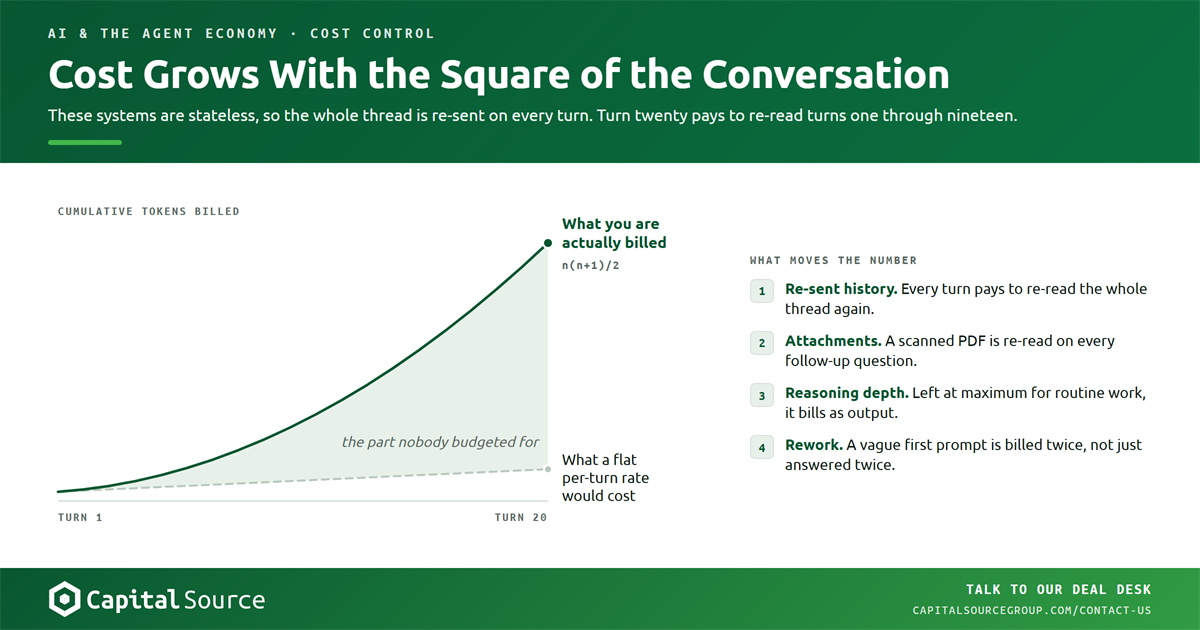
1. The whole conversation is re-sent on every turn. These systems are stateless: the model has no memory of your last message, so the application quietly resends the entire conversation each time you hit enter. Turn twenty pays to re-read turns one through nineteen. Cost does not grow with the length of a conversation, it grows with the square of it. A long-running chat window left open all afternoon is the single most common source of a surprise bill.
2. Attachments are much larger than they look. A scanned PDF or a screenshot can be worth thousands of tokens, and under the re-sending rule above, it is re-read on every subsequent turn of that conversation. Attaching a fifty-page document and then asking twelve follow-up questions means paying for that document twelve times.
3. Reasoning modes multiply output. Most current models offer a setting that controls how much internal deliberation the model does before answering. Deeper reasoning improves hard tasks and is billed as output, at output prices. Left at maximum for routine work, it is the most expensive default in the product.
4. Rework. Every “no, I meant” re-sends everything that came before it. Vague first prompts are not just slower, they are billed twice.
Which levers actually reduce the bill?
Four, roughly in order of how much they return for the effort. The first two are pricing mechanisms most business users have never been told exist.
| Lever | What it does | What to know |
|---|---|---|
| Caching | Bills repeated context at a fraction of the normal rate instead of full price every time. | On Anthropic’s API, cache reads run about a tenth of the base input price. Writing to cache costs slightly more than a normal request, so it pays off from roughly the second reuse. |
| Batch tier | Trades speed for price on work that does not need an answer this second. | Roughly half price, with results typically back within the hour and guaranteed inside a day. Anthropic, OpenAI and Google all offer a comparable tier. |
| Model tiering | Sends each task to the cheapest model that can actually do it. | The gap between tiers is several-fold. Classification and extraction rarely need the flagship model that drafting and analysis do. |
| Shorter contexts | Attacks the re-sending problem directly. | Start a fresh conversation when the topic changes. Extract the relevant pages rather than attaching the whole document. |
Two caveats worth having before you ask your team about any of this.
Caching is a prefix match, and it is fragile. The saving applies only to the unchanged opening stretch of a request, and any change anywhere in that stretch invalidates everything after it. The classic own-goal is stamping the current date and time into the top of a standing instruction: it changes every single request, so nothing ever matches and the discount silently never applies. If someone tells you caching is switched on, the follow-up question is whether anyone has confirmed it is actually being hit.
The discounts stack. Batch pricing and caching are independent mechanisms, so high-volume repetitive work that can tolerate a delay, such as overnight document processing, can claim both at once. That is the profile of a lot of back-office work.
Does paying for the top-ranked model actually buy you much?
Usually less than the ranking implies, which matters because model choice is the lever with the widest cost range. Arena.ai’s Text Arena ranks models on blind head-to-head votes rather than a fixed exam, and as of its update on August 21, 2026 the top ten stood as follows.
| Rank | Model | Provider | Arena score |
|---|---|---|---|
| 1 | claude-fable-5 | Anthropic | 1508 ± 5 |
| 2 | claude-opus-4-6-high | Anthropic | 1504 ± 4 |
| 3 | claude-opus-4-7-high | Anthropic | 1502 ± 4 |
| 4 | muse-spark-1.2 (xHigh) | Meta | 1498 ± 10 |
| 5 | claude-opus-4-6 | Anthropic | 1497 ± 3 |
| 6 | claude-opus-4-7 | Anthropic | 1494 ± 4 |
| 7 | claude-opus-5-high | Anthropic | 1493 ± 5 |
| 8 | muse-spark-1.1 | Meta | 1491 ± 5 |
| 9 | gemini-3.7-flash-high | 1490 ± 8 | |
| 10 | kimi-k3-max | Moonshot | 1489 ± 6 |
Two features of that table are worth more than the running order. The first is compression: rank one and rank twenty are separated by 27 points, on a board whose own published confidence intervals run from ±3 to ±10. A large share of these placements therefore overlap and are not cleanly distinguishable from one another. The second is that the board lists the same model at different reasoning settings as separate entries, and the distance between them is small. Claude Opus 4.6 at a high setting places second at 1504; the identical model at its default setting places fifth at 1497, seven points behind. Under driver three above, that higher setting is billed as output, at output prices.
When the measured capability gap between two models sits inside the margin of error and the price gap is several-fold, the leaderboard is not the thing that should decide your routing.
None of which is an argument for always buying the cheapest model. It is an argument for testing the tier below your default on your own routine work, because no public leaderboard can tell you whether the difference matters for classifying an invoice or extracting a date from a remittance advice. That test takes an afternoon and it is the only evidence that applies to your workload.
How do you measure it in a way a CFO can use?
Not in tokens. Tokens are the billing unit, not the management unit. The number that belongs in a budget is cost per task: per invoice processed, per document reviewed, per report drafted, per application summarized.
That reframing does two things at once. It makes AI spend comparable to the labor it augments, which is the only comparison anyone actually cares about. And it turns a scary aggregate into a unit economic that either improves or does not as volume grows, which is exactly how you already evaluate every other variable cost in the business.
Two measurement traps to avoid on the way there:
- Do not estimate tokens with a generic counter. Different model families tokenize text differently, and a mismatched estimator can be off by a fifth or more on ordinary prose and considerably worse on code or non-English text. Vendors publish their own token counting endpoints; use the one that matches the model you actually run.
- Read the usage report carefully. Providers report cached and uncached usage in separate fields. Anthropic’s, for example, splits fresh input from cache writes and cache reads, so glancing at the headline input figure alone can drastically understate the volume actually processed. Add the fields.
Is any of this spend recoverable?
Possibly, and this is the part of the story that has genuinely improved. None of what follows is tax advice, and the qualification analysis is fact-specific enough that it belongs with your CPA, not with an article. But it is worth knowing the shape of it before your next planning conversation, because the answer changed in 2025 and most owners have not caught up.
Two separate provisions matter, and they are often confused.
The deduction: research costs are immediately expensable again, if they are domestic. Between 2022 and 2024, US tax law required research and experimental costs to be capitalized and amortized rather than deducted in the year incurred, which was a real cash-flow penalty for anyone building software. The One Big Beautiful Bill Act reversed that for domestic research by adding Section 174A, restoring immediate expensing of domestic research costs for tax years beginning after December 31, 2024. Grant Thornton notes the change is permanent with no sunset, and taxpayers may alternatively elect to capitalize and amortize over a minimum of 60 months. The domestic qualifier is doing real work: foreign research did not get the same treatment.
The credit: some AI compute may count as a qualified research expense. Separately from the deduction, Section 41 provides a credit for increasing research activities, and one of its expense categories is amounts paid to another person for the right to use computers in the conduct of qualified research. That provision was written for the mainframe-leasing era and is now the main statutory route by which cloud compute is captured.
Here is the part that connects directly to everything above, and it is counterintuitive. In Aprio’s analysis of AI spend and the R&D credit, metered API and token usage is best “positioned as computer use when it is access to the provider’s computing resources tied to development,” while a flat-fee SaaS subscription is “generally, a software license and therefore excluded,” with a qualified portion “defensible only where usage data supports a computer-use characterization.”
The metered billing that makes your AI spend hard to forecast is the same thing that makes a portion of it potentially capturable. A flat monthly subscription generates no usage data. A token meter generates nothing but usage data.
That is the silver lining, and it is a narrow one. Three constraints keep it honest:
- Only research qualifies. Spend has to be consumed in activities that clear Section 41’s four-part test. Using an assistant to draft marketing copy or summarize a meeting is ordinary business use, not research, however large the bill.
- You have to be able to split the bill. Aprio’s guidance calls for an objective allocation driver, “such as instance-hours, GPU-hours, environment tags, or project codes, that splits qualified experimentation from production, maintenance, and general business use.” A single undifferentiated invoice will not survive scrutiny. This is the same tagging discipline that gives you cost per task, which is a pleasant coincidence: the work you do to understand the spend is largely the work you would need to substantiate it.
- Documentation has to show causation, not just payment. The standard is contemporaneous evidence that the tools “drove the research, not just that they were paid for.”
Two footnotes worth raising with your accountant rather than deciding yourself. Owned hardware is treated differently from rented compute: property that is depreciable in your hands is neither a supply nor a computer rental for these purposes. And if you are pre-profit, the credit is not necessarily stranded. Under Section 41(h), a qualified small business may elect to apply the credit against employer payroll taxes rather than income tax, up to $500,000 a year since the Inflation Reduction Act doubled the prior $250,000 cap for tax years beginning after December 31, 2022, split so that no more than $250,000 applies against each of the Social Security and Medicare portions (BDO). Eligibility is narrow and the election has to be made on a timely filed original return.
The practical takeaway is not “your AI bill is a tax credit.” For most companies the larger credit-eligible number is the payroll of the people doing the qualified work, not the compute they ran. The takeaway is that if you are building something rather than just using something, the spend is worth tagging before year end, because the analysis is far easier to do prospectively than to reconstruct in March. Take the categories above to your CPA and ask which, if any, apply to you.
Who should own this?
Somebody, by name, which is the part most companies skip. AI spend usually starts on a credit card belonging to whoever ran the first pilot and then quietly scales past the threshold at which that was appropriate.
The governance is not elaborate, and it is the same governance you would apply to any other metered utility:
- A named owner with the vendor console access to see usage by workload rather than one aggregate number.
- Spend caps and alerts configured at the provider, not a monthly reconciliation that discovers the problem three weeks late.
- A quarterly review of the unit cost, not the total. Total spend rising while cost per task falls is a business scaling successfully; both rising together is the signal worth acting on.
- A default model tier chosen deliberately, with exceptions justified rather than assumed.
None of that requires technical expertise. It requires treating the line the way you already treat freight, utilities, or payment processing.
Where does this sit in the bigger picture?
AI spend is one of the newer variable costs on a small or mid-sized company’s income statement, and like most new costs it arrives before the controls do. That is worth getting ahead of, but it is worth keeping in proportion: for most businesses the amounts are still modest next to payroll, inventory, or debt service.
The reason to build the discipline now is that the workloads are growing, and a unit cost you understand at today’s volume is one you can still steer at ten times the volume. We have written about the wider shift in what AI is doing to the finance function, about how we use it in our own underwriting, and about financing the infrastructure behind it.
If AI spend is growing because the business is growing, that is the good version of this problem, and it is a working capital question as much as a technology one. Capital Source structures financing through our affiliate, Stretch Finance, and through our network of banks, lending partners and private credit funds. Availability, structure and terms are subject to review and underwriting.
Growing faster than your operating cash allows?
Rising tooling costs are usually a symptom of rising volume. Tell us what the growth looks like and we will talk through what capital fits the shape of it.
Key takeaways
- AI is metered, not seated. It is billed per token of text processed, so the bill tracks usage rather than headcount and moves month to month.
- Output costs several times input. Roughly five to one on published pricing, so curbing verbose answers usually saves more than trimming the question.
- The conversation is re-sent every turn. Cost grows with the square of a conversation’s length, which makes long-running chat windows and re-read attachments the most common source of a surprise bill.
- Caching and batch pricing are real and they stack. Cached content bills at a fraction of full price, batch tiers run about half, and repetitive overnight work can claim both.
- Caching breaks silently. It matches only an unchanged opening stretch, so a timestamp at the top of a standing instruction can disable the discount without anyone noticing.
- Manage cost per task, not per token. Cost per invoice or per document is the number that belongs in a budget and can be compared against the labor it augments.
- Some of it may be recoverable, and the rules improved in 2025. Section 174A restored immediate expensing of domestic research costs, and metered AI compute consumed in qualified research may fall inside the Section 41 credit. It requires an objective allocation and real documentation, and the analysis belongs with your CPA.
Frequently asked questions
What is a token, and why is my AI billed in them?
A token is a chunk of text roughly the size of a short word or part of a longer one. AI providers price per token because that is the unit of work the system actually processes, covering both what you send and what comes back. Output tokens typically cost several times more than input tokens, so long answers are more expensive than long questions.
Why did my AI bill jump without our usage obviously changing?
The most common cause is conversation length. These systems are stateless, so the application re-sends the entire conversation history with every new message. Cost therefore grows with the square of a conversation’s length rather than in proportion to it, and a long chat window with a large attachment in it re-reads that attachment on every turn.
What is prompt caching and how much does it actually save?
Caching bills repeated opening context at a reduced rate rather than full price each time. On Anthropic’s API, cache reads cost roughly a tenth of the base input price, while writing to cache costs slightly more than a standard request, so it pays off from around the second reuse. The important caveat is that it matches only an unchanged opening stretch of the request: any change within that stretch, such as an embedded timestamp, silently prevents the discount from applying.
What is a batch tier and when should we use one?
A batch or asynchronous tier processes work at roughly half price in exchange for not returning results immediately, typically within the hour and guaranteed inside a day. Anthropic, OpenAI and Google all offer a comparable tier. It suits high-volume repetitive work with no live user waiting, such as overnight document processing, and it stacks with caching on the same request.
Can AI spending qualify for the R&D tax credit?
Potentially, where the spend is consumed in activities that meet Section 41’s four-part test for qualified research. Metered API and token usage is generally better positioned than a flat-fee software subscription, because usage data supports characterizing it as paying for the right to use another party’s computers. Ordinary business use does not qualify, an objective allocation between research and non-research use is required, and documentation must show the tools drove the research rather than merely that they were paid for. This is not tax advice and the analysis is fact-specific: discuss it with your CPA.
Sources
- Anthropic, Models overview and pricing. Per-million-token input and output rates by model tier.
- Anthropic, Prompt caching. Cache read and write pricing, prefix-match behavior, and cache-hit reporting fields.
- Anthropic, Batch processing. Batch tier pricing and turnaround.
- Anthropic, Token counting. Model-specific token counting and the risk of mismatched estimators.
- Arena.ai, Text Arena leaderboard. Model rankings, Elo-style scores and published confidence intervals, vote totals and model count, as of the August 21, 2026 update. Formerly LMArena / LMSYS Chatbot Arena; lmarena.ai now resolves to arena.ai.
- 26 U.S.C. § 41, Credit for increasing research activities (Cornell Legal Information Institute). Qualified research expense categories, including amounts paid for the right to use computers, and the four-part test. Statutory text also available from the IRS.
- Grant Thornton, Permanent full expensing for U.S. research in OBBBA. Section 174A, effective for tax years beginning after December 31, 2024, and the 60-month amortization election.
- Aprio, AI Spend and the R&D Credit: What Qualifies and When. Treatment of compute, metered API and token usage, and SaaS subscriptions; allocation and documentation standards.
- BDO, Inflation Reduction Act Doubles R&D Credit Payroll Tax Offset for Qualified Small Businesses. The Section 41(h) election, the $500,000 cap effective for tax years beginning after December 31, 2022, and its split across payroll tax prongs.
Tax note. Nothing in this article is tax advice, and it is not a tax opinion, a substantiation position, or a determination that any expense of yours qualifies for any credit or deduction. The research credit under Internal Revenue Code Section 41 and the treatment of research and experimental expenditures under Sections 174 and 174A are highly fact-specific: whether a given activity constitutes qualified research, whether a particular cost falls within a qualified research expense category, how costs must be allocated between research and non-research use, what documentation is sufficient, and how state law treats any of it all depend on circumstances this article cannot assess. Statutory provisions, IRS guidance, and effective dates also change. Capital Source is not a CPA firm, a tax advisor, or a law firm, and does not prepare returns or render tax opinions. Consult your own CPA or qualified tax advisor about the Internal Revenue Code before claiming, relying on, or planning around any credit or deduction described here.
This article is otherwise for informational and educational purposes only and does not constitute financial, investment, accounting, or legal advice, and it is not technology procurement advice. AI vendor pricing, discount structures, and product terms change frequently and vary by provider, plan, and region; every figure here reflects publicly documented pricing as of August 2026 and should be confirmed against your provider’s current documentation before you budget or contract against it. Public model leaderboards are recomputed continuously as votes accumulate and new models are added, so the standings reproduced here are a snapshot of one board on one date and should not be read as a current or durable ranking. Capital Source is not affiliated with, and does not resell or endorse, any AI vendor named in this article. Capital Source provides access to commercial financing solutions through its affiliates, syndicates, network of banks, lending partners, and private credit funds/groups. Availability, approval, funding amount, structure, and terms are subject to business review, underwriting, and lender approval.