

AI Is Rebuilding Professional Services: What It Means for Your Finance Function
Artificial intelligence is quietly rewiring professional services from the inside, and the finance function is near the center of it. Here is what the shift means for how your business runs its numbers, and why the capital partner you choose now matters more than it did a year ago.
For most of the last two decades, the businesses that served you, your accountant, your lawyer, your insurance broker, your lender, sold you a tool or a process and billed for the hours around it. That model is being rebuilt. AI is moving knowledge work from selling effort to selling outcomes, and the change is reaching the finance function fastest because finance runs on exactly the kind of structured, repeatable, document-heavy work that machines now handle well. If you are a founder or CFO trying to decide who to trust with your reporting, your forecasting, and your working capital, it helps to understand what is actually changing and what is not.
At Capital Source, we sit inside this shift rather than watching it. We build credit decisions where technology accelerates the read and people make the call. So this is not an abstract trend report. It is a map of where professional services are headed and a frank account of how we think a finance partner should be built for it.
What does “services are the new software” mean for finance?
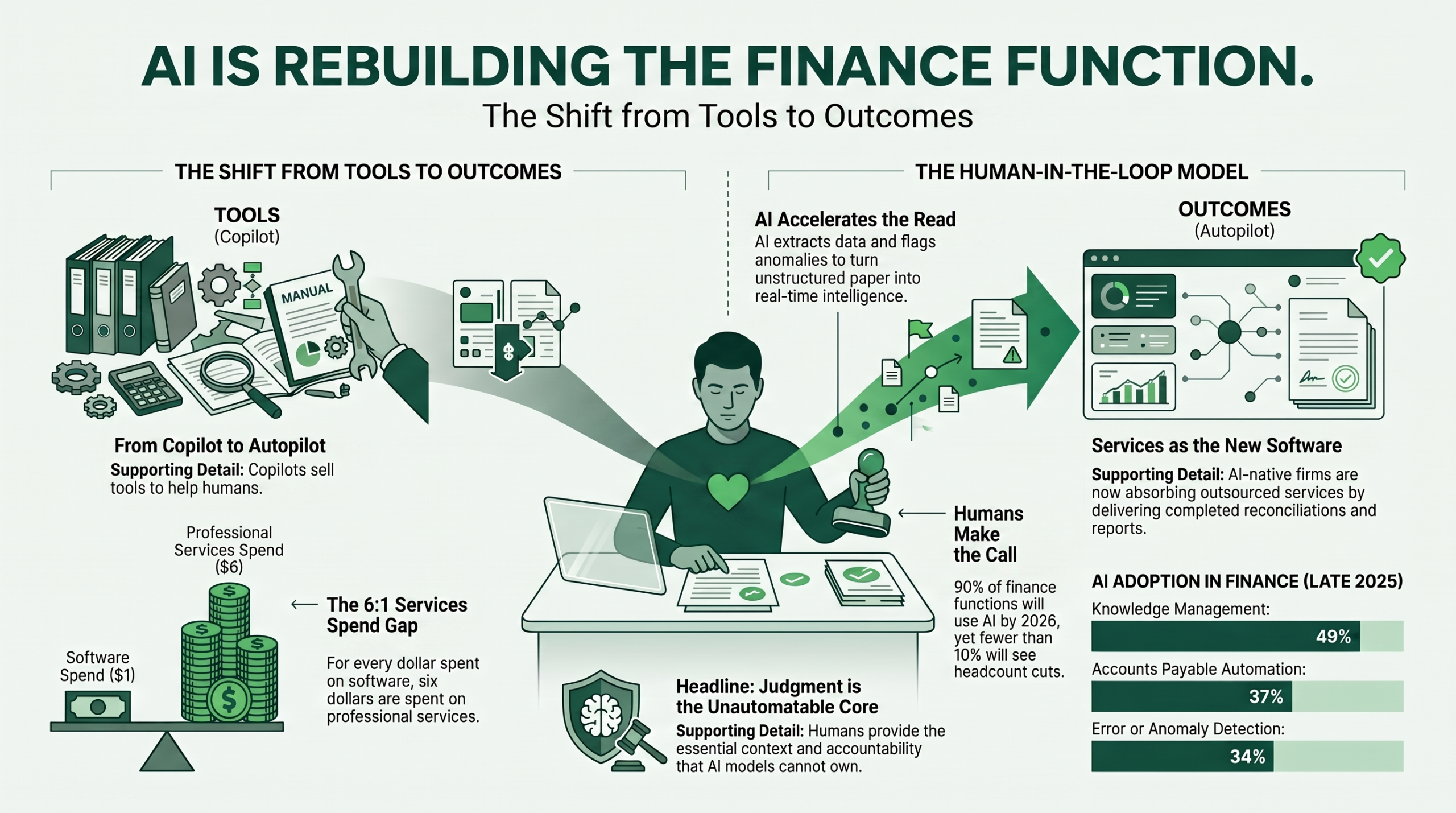
“Services as the new software” is the idea that AI lets a software company deliver the finished work a professional firm used to do, not just the tool that helps a human do it. Sequoia Capital argues the next trillion-dollar company will sell outcomes, not software, framing it bluntly: “the next $1 trillion company will be a software company masquerading as a services firm” (Sequoia Capital, “Services: The New Software,” March 2026). The wedge is the spending gap between the two categories.
Sequoia’s framing: for every dollar spent on software, roughly six are spent on services, a 6:1 ratio that AI-native firms are now positioned to displace by absorbing existing outsourced-services spend (Sequoia Capital, 2026).
Sequoia draws a clean line between two models: “a copilot sells the tool, an autopilot sells the work.” For finance, that distinction is the whole story. A copilot drafts a reconciliation faster; an autopilot delivers the reconciliation. As more of the finance stack moves from copilot to autopilot, the question for an operator stops being “which software do I buy?” and becomes “who do I trust to deliver the outcome, and how is their judgment built in?” That is a different purchasing decision, and it favors partners who pair real technology with real accountability for the result.
How is AI rebuilding the finance function?
AI is rebuilding the finance function by automating the document-heavy, backward-looking parts of the work and freeing people to focus on judgment, exceptions, and strategy. Adoption is already broad and steady rather than speculative. According to Gartner’s November 2025 survey of 183 finance leaders, 59% of finance functions reported using AI in 2025, up from 58% in 2024, with the leading use cases being knowledge management at 49%, accounts payable automation at 37%, and error or anomaly detection at 34% (Gartner, November 2025).
Look at where those use cases land and a pattern emerges. The finance function is being rebuilt along four lines:
- Document automation. AI extracts and classifies invoices, bank statements, and contracts that used to be keyed in by hand, turning unstructured paper into structured data in minutes.
- Real-time analysis. Instead of a backward-looking monthly close, finance teams can run faster forecasting and scenario modeling against current data, so the picture reflects this week rather than last quarter.
- Fraud and anomaly detection. Models flag the transaction that does not fit the pattern, catching errors and exposure earlier than a periodic manual review would.
- Decision support. With the routine work absorbed, finance people spend their time on the calls that require context, the ones a model can inform but should not make alone.
The economic prize behind this is large. McKinsey estimated that generative AI could add the equivalent of 9 to 15 percent of banking operating profits annually, a range it put at roughly $200 billion to $340 billion across the sector (McKinsey, 2023). Numbers of that scale are why every serious player in finance, including us, is rebuilding rather than bolting AI onto an unchanged process.
McKinsey, 2023: generative AI could add the equivalent of 9 to 15 percent of banking operating profits annually, on the order of $200 billion to $340 billion across the sector (McKinsey, 2023).
What are banks and lenders doing, and what does “wait and see” cost?
Banks and lenders are adopting AI broadly while keeping people firmly in the loop, and the cost of waiting is falling behind on the speed and precision your competitors are already gaining. The direction of travel is not subtle. Gartner predicted in September 2024 that by 2026, 90% of finance functions will deploy at least one AI-enabled technology solution (Gartner, September 2024).
If you run a small or lower-middle-market business, “wait and see” rarely means standing still; it usually means working with backward-looking reports while the firm down the street works with real-time intelligence. That gap shows up in slower forecasting, later detection of problems, and capital decisions made on stale information. For referral partners, accountants, fractional CFOs, and brokers, the same dynamic decides which advisors clients keep: the ones whose tooling lets them answer “what happens if?” today, not next month.
The encouraging part is that this is not a story about people being replaced. The same Gartner analysis predicted that even as deployment reaches 90% by 2026, fewer than 10% of finance functions will see headcount reductions (Gartner, September 2024). The work is being rebuilt around judgment, not eliminated.
Gartner, September 2024: by 2026, 90% of finance functions will deploy at least one AI-enabled technology solution, yet fewer than 10% will see headcount reductions (Gartner, September 2024).
Why does a human-in-the-loop finance partner still matter?
A human-in-the-loop finance partner matters because the decisions that move capital, what to fund, how to size it, and how to structure it, require judgment that AI can inform but should not own. A human-in-the-loop model is one where AI handles the read, surfacing patterns, flagging exceptions, and compressing the analysis, while an experienced person makes the call. The Gartner data above is the proof point: deployment is near-universal, headcount is not falling, because judgment is the part of finance that does not automate away.
This is exactly how we built Capital Source, and it is where credit judgment meets technology. We use technology to accelerate the read on a deal, then real people apply the credit judgment that decides it. The same shift reshaping professional services is the principle we operate on: AI accelerates the read, humans make the call.
That model also produces better capital. Better real-time financial intelligence, the kind the rebuilt finance function now generates, lets a lender see your cash flow as it actually moves. Financing designed around your cash flow and structured around the deal depends on current, accurate data, not a snapshot from last quarter. The clearer the read, the better-timed and better-sized the working capital can be.
Let’s talk about how your numbers translate into capital
Tell us where your business is headed and we’ll structure capital around it, with technology to speed the read and people to make the call. Referral partners are welcome too.
Key takeaways
- Services are becoming the product. Sequoia argues the next trillion-dollar company will sell outcomes, not software, displacing the roughly six dollars spent on services for every one on software (Sequoia, 2026).
- Finance is being rebuilt now. 59% of finance functions reported using AI in 2025 for tasks like document automation, anomaly detection, and faster analysis (Gartner, 2025).
- The prize is large. McKinsey estimated generative AI could add the equivalent of 9 to 15 percent of banking operating profits annually (McKinsey, 2023).
- People still make the call. By 2026, 90% of finance functions will deploy AI, yet fewer than 10% will cut headcount (Gartner, 2024).
- Choose a partner built for the shift. A tech-forward, human-in-the-loop finance partner turns better real-time intelligence into better-timed, better-sized capital structured around your cash flow.
Frequently asked questions
What does “services are the new software” mean?
It is the idea that AI lets a software company deliver the finished work a professional firm used to do, not just the tool that helps a human do it. Sequoia Capital frames it as the difference between a copilot that sells the tool and an autopilot that sells the work, and argues the next trillion-dollar company will sell outcomes rather than software. The wedge is the roughly six dollars spent on services for every one spent on software.
How is AI changing the finance function?
AI is automating the document-heavy, backward-looking parts of finance and freeing people for judgment and strategy. The main lines are document automation that extracts and classifies invoices, statements, and contracts; real-time analysis and faster forecasting instead of backward-looking monthly reports; and fraud and anomaly detection. Gartner found 59% of finance functions reported using AI in 2025.
Is AI replacing finance jobs?
No. Gartner predicted that by 2026, 90% of finance functions will deploy at least one AI-enabled technology solution, yet fewer than 10% will see headcount reductions. The work is being rebuilt around judgment rather than eliminated, which is why a human-in-the-loop model is the durable one.
What is a human-in-the-loop finance partner?
It is a partner where AI handles the read, surfacing patterns, flagging exceptions, and compressing the analysis, while an experienced person makes the final call. The decisions that move capital, what to fund, how to size it, and how to structure it, require judgment that AI can inform but should not own. At Capital Source, technology accelerates the read and people make the credit decision.
Why does better financial intelligence lead to better financing?
Because financing designed around your cash flow depends on current, accurate data rather than a snapshot from last quarter. When the rebuilt finance function produces real-time intelligence, a lender can see your cash flow as it actually moves, which supports better-timed and better-sized working capital structured around the deal.
Sources
- Julien Bek, Sequoia Capital, “Services: The New Software” (March 2026).
- McKinsey & Company, “Capturing the full value of generative AI in banking” (operating-profit figure from McKinsey’s 2023 “Economic potential of generative AI” research).
- Gartner, “Gartner Survey Shows Finance AI Adoption Remains Steady in 2025” (November 2025).
- Gartner, “Gartner Predicts That 90% of Finance Functions Will Deploy at Least One AI-Enabled Technology Solution by 2026” (September 2024).
This article is for informational purposes only and does not constitute financial advice. Figures are drawn from the sources listed and are current as of their respective reporting periods. Capital Source is the brand of Capital Source Group, LLC; financing is offered through our affiliate, Stretch Finance, LLC. Availability, amounts, structures, and terms depend on each business’s circumstances and are subject to review and approval.