
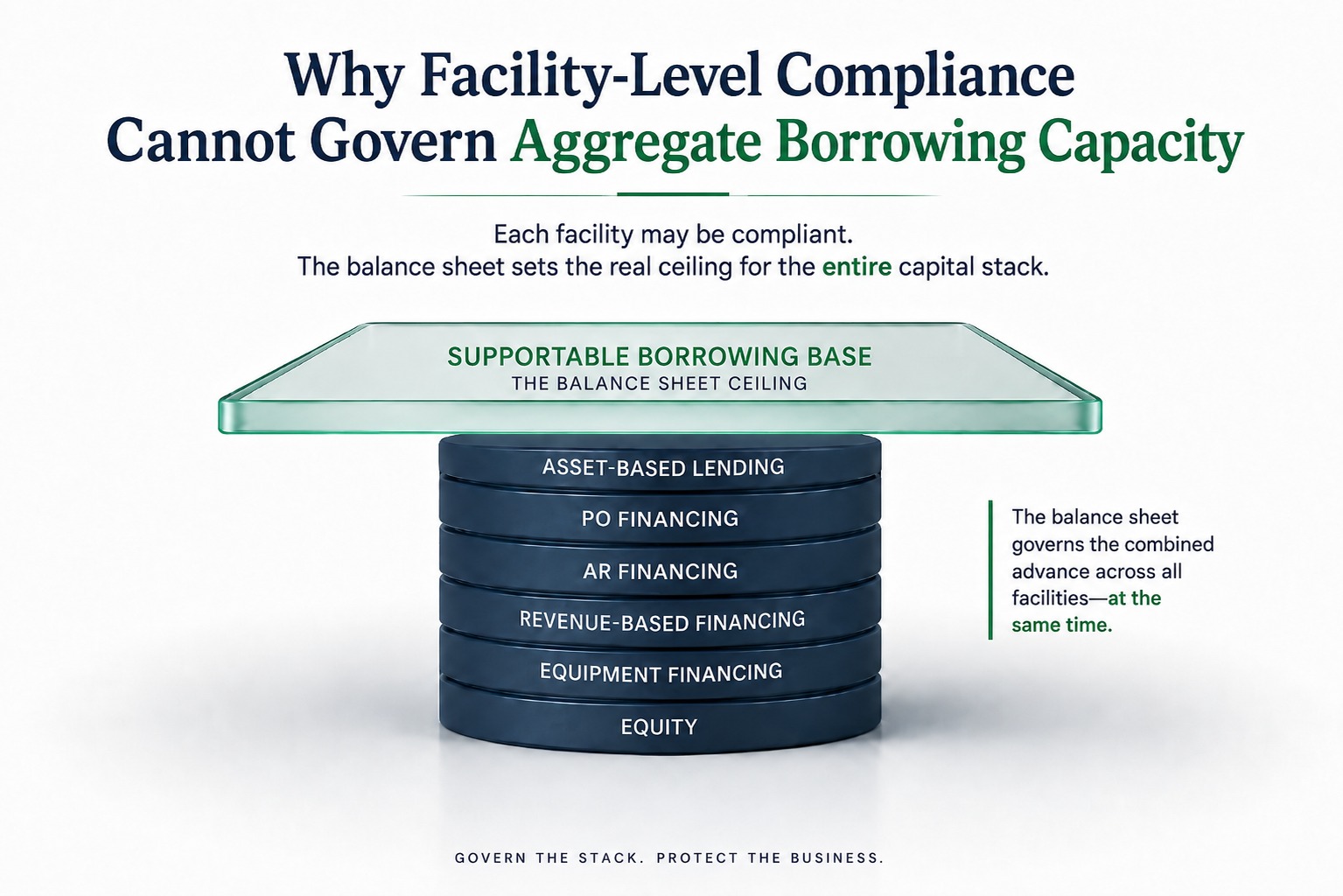
Supportable Borrowing Base: The Balance Sheet Ceiling for the Capital Stack
Why Facility-Level Compliance Cannot Govern Aggregate Borrowing Capacity
A business passes every covenant on every facility and still runs short of cash at the moment the cycle peaks. Each lender reads its own instrument and finds nothing wrong. None of them reads the combined draw against what the balance sheet can carry. The balance sheet is over its limit at the same time every facility looks compliant, since compliance is being measured one instrument at a time and the limit belongs to the whole stack.
This closes Series Three of Book Four. The Inventory Financing Series sized collateral. The Four-Instrument Capital Stack Series sequenced and phased the instruments. This series did the third thing: it governed the assembled stack against the balance sheet that has to carry it. Book Four governs the stack. Series Three governs it against the one document that sets its outer limit.
The Supportable Borrowing Base is the aggregate borrowing ceiling set by the balance sheet, not by any single facility. It is reached by reading equity adequacy, the Net Working Capital floor, and debt service coverage together, then treating the lowest constraint as the maximum combined advance the stack can support.
Key points
The series moved in one direction, from the gap to the governing number. The Integrated Borrowing Base Assessment named the gap: every lender governs its own facility against its own covenants, and no one calculates whether the combined utilization across all instruments is consistent with what the balance sheet can sustain. The Equity Adequacy Test read the first constraint, whether the equity base supports the combined advance at peak simultaneous draw. The NWC Floor Stack Test read the second, whether the combined draw service compresses Net Working Capital below the floor the operating cycle requires when every instrument draws at once. Debt service coverage read the third, whether the combined service can be carried without drawing on working capital.
The Supportable Borrowing Base combined the three, taking the lowest of the equity, working capital, and debt service constraints as the maximum aggregate advance the balance sheet can carry across all facilities. The Balance Sheet Governance Test then made that number a standing discipline, comparing live utilization against the Supportable Borrowing Base to place the stack in the harmony zone or the harm zone, with the Harmony-Harm Threshold as the boundary between them.
Series synthesis
The single point of the series is that the balance sheet sets a binding ceiling on the entire stack, and that ceiling can only be governed as a whole. A facility-by-facility view cannot see it. Each lender can be satisfied on its own terms at the same time the combined advance has already crossed the line the balance sheet can absorb. The three constraints do not average. They bind. The lowest of equity adequacy, the Net Working Capital floor, and debt service coverage sets the Supportable Borrowing Base, and a single binding constraint caps the whole stack regardless of how much room the other two appear to leave. Governance is not the sum of compliant facilities. It is the reading of the combined position against one number, held over time as conditions move.
The Supportable Borrowing Base is the most the balance sheet can carry across every facility at once. The Harmony-Harm Threshold is that number turned into a standing boundary. Below it, the stack supports the business. Above it, the stack erodes it.
A stack run above the Harmony-Harm Threshold consumes the equity and working capital the business needs to absorb the next cycle, so the failure does not appear in any covenant. It arrives instead as a liquidity shortfall the operating cycle can no longer fund.
What the series does not close
Series Three establishes the ceiling and the discipline that governs against it. It does not draw the three Book Four series into a single architecture. That is the work of the Book Four trilogy capstone, where inventory sizing, instrument phasing, and balance sheet governance become one method rather than three. And it reads the stack as instruments governed together from the start. It does not take up the harder case of instruments that already sit on the borrower under another lender’s control, where the repayment source may be impaired before a facility is placed. That question, control rather than capacity, is where the program turns next.
Govern the Stack Against the Balance Sheet
If every one of your facilities is compliant and the business still runs short of cash at the peak of the cycle, the stack is being governed one instrument at a time and the balance sheet ceiling is going unread.
Initiate a Balance Sheet Governance Assessment.
Capital Source runs the Balance Sheet Governance Test as a standard component of every engagement, calculating the Supportable Borrowing Base from the equity, working capital, and debt service constraints together, comparing live utilization against the Harmony-Harm Threshold, and governing the combined stack to the number the balance sheet can actually carry rather than to the covenants of any single facility.
Most lenders offer instruments. Capital Source governs stacks.
Frequently asked questions
What is the Supportable Borrowing Base?
It is the maximum aggregate advance the balance sheet can sustain across all facilities at once. It is calculated by combining three constraints simultaneously: equity adequacy, the Net Working Capital floor, and debt service coverage. The lowest of the three constraints binds the entire stack.
Why is facility-by-facility compliance not enough to govern a capital stack?
Each lender governs only its own facility against its own covenants. The balance sheet carries the combined advance across every instrument, and that combined position can exceed what the balance sheet can sustain at the same time each individual facility remains compliant. The ceiling belongs to the whole stack, not to any one instrument.
What is the Harmony-Harm Threshold?
It is the Supportable Borrowing Base used as a standing governance boundary. When combined utilization sits below it, the stack supports the business. When utilization crosses it, the stack begins to erode the equity and working capital the business needs. The Balance Sheet Governance Test compares live utilization against this threshold and recalculates it as conditions change.
Strategic disclosure
Capital Source structures and arranges capital for small and lower middle market businesses across asset-based lending, purchase order, accounts receivable, revenue-based, and equipment financing. The frameworks described here, including the Supportable Borrowing Base and the Harmony-Harm Threshold, are the analytical standards Capital Source applies to size and govern those structures. This article is analysis, not a financing commitment, and any structure depends on the specific facts of the business.
Proud to be ranked on the 2024 and 2025 Inc. 5000 list of America’s fastest-growing private companies.
Leave a Reply