
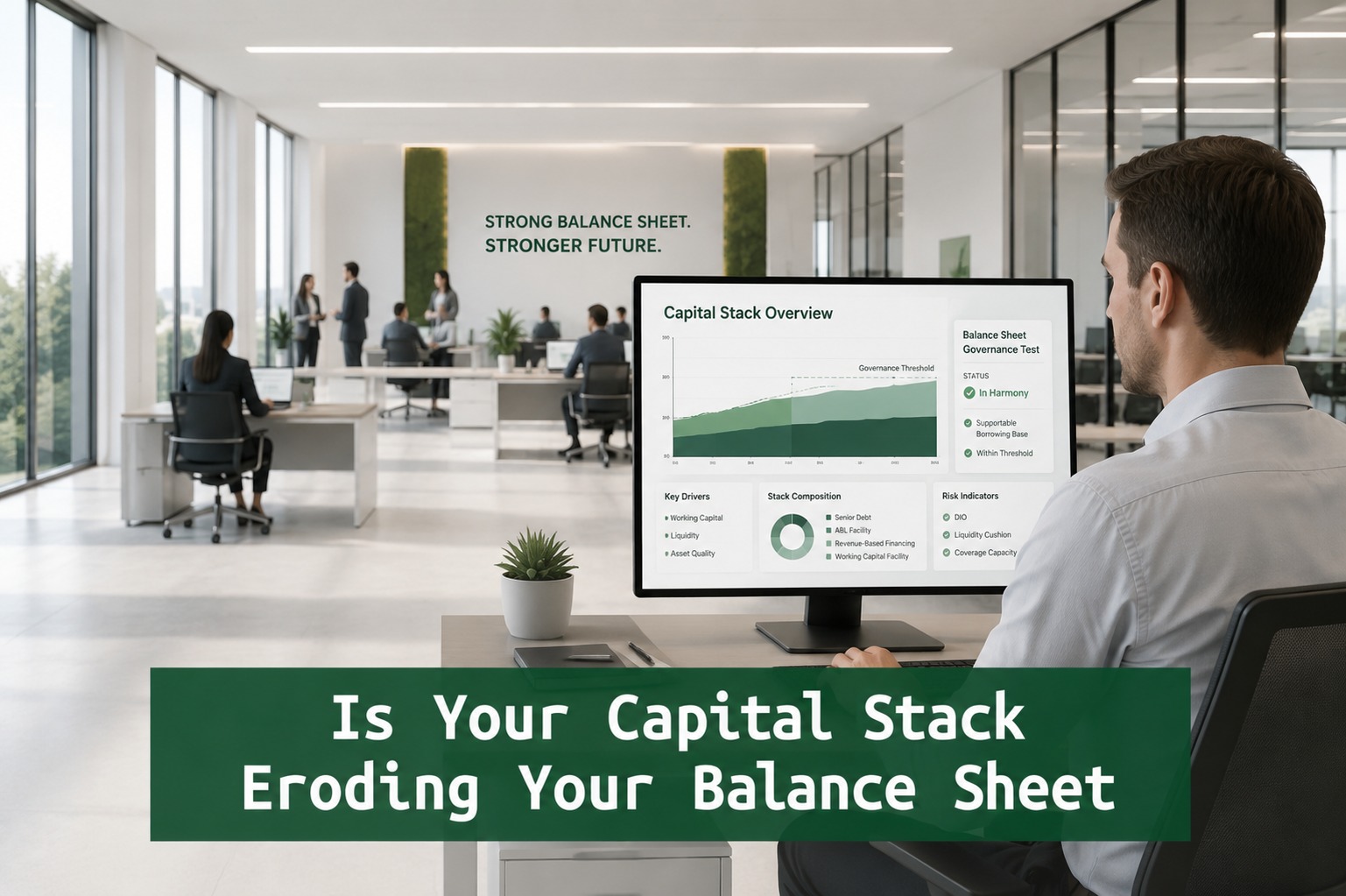
The Balance Sheet Governance Test: Is Your Capital Stack Eroding Your Balance Sheet?
How the Harmony-Harm Threshold turns the Supportable Borrowing Base into an ongoing governance standard for multi-instrument capital stacks
A capital structure does not fail the moment it crosses a threshold. It fails the moment it crosses a threshold that no one was watching.
The Supportable Borrowing Base established in Article Four is the ceiling below which the combined advance must remain for the balance sheet to sustain the full stack. The Balance Sheet Governance Test compares the current combined advance against that ceiling every borrowing base cycle and every time a Stack Reassessment Trigger fires.
The Harmony-Harm Threshold is the line the test draws.
Below it, the capital structure is in harmony with the balance sheet. Above it, the stack is eroding the balance sheet regardless of what each individual facility’s compliance picture shows.
This article is the fifth and final article in the Balance Sheet Governance Series. Articles One through Four established the governance gap, the Equity Adequacy Test, the NWC Floor Stack Test, and the Supportable Borrowing Base. This article develops the Balance Sheet Governance Test and the Harmony-Harm Threshold: the ongoing governance standard that keeps the capital structure within the balance sheet’s sustainable range through changing operating conditions.
Key Points
The Balance Sheet Governance Test compares the current combined outstanding advance across all instruments against the Supportable Borrowing Base and produces a binary governance determination: the capital structure is either in the harmony zone, below the threshold, or in the harm zone, above it. There is no gradation. The threshold is the governance standard. The test is whether the combined advance is on the correct side of it.
The Harmony-Harm Threshold is not a fixed number. It is the Supportable Borrowing Base expressed as a governance boundary. The Supportable Borrowing Base recalculates as the equity base, working capital floor, and debt service capacity change through the operating cycle. A capital structure that was in the harmony zone at origination may cross into the harm zone as conditions shift, especially when the threshold moves and no one recalculates it.
The Balance Sheet Governance Test must be run at every borrowing base cycle and at every Stack Reassessment Trigger. It is not a one-time origination assessment. The five events that trigger a mandatory reassessment are DIO extension, forced liquidation value decline, revenue trajectory compression, RBF renewal at higher cost, and ABL advance rate miscalibration. Any one of these can move the Harmony-Harm Threshold without moving the combined advance, producing a governance breach that no individual lender’s compliance picture identifies.
A capital structure in the harm zone is not necessarily in crisis. It is in a condition that is not sustainable indefinitely. The remediation options are widest earliest, when the threshold was first crossed and the margin of harm is smallest. They narrow as the harm compounds through each later operating cycle. The Balance Sheet Governance Test is most valuable as an early detection mechanism, not a crisis identification tool.
Capital Source runs the Balance Sheet Governance Test as a standard component of every engagement. Not because it is required by any individual lender. Because it is the only governance discipline that confirms the capital structure is working with the balance sheet rather than against it. Few advisory firms at the SMB level apply this kind of full-stack balance sheet governance discipline as a standard engagement practice. It is what Capital Source built.
Core Terms
Balance Sheet Governance Test — the comparison of the current combined outstanding advance across all instruments in the capital stack against the Supportable Borrowing Base that establishes the Harmony-Harm Threshold. The test produces a binary determination: the capital structure is in the harmony zone if the combined advance is at or below the Supportable Borrowing Base, and in the harm zone if the combined advance exceeds it. The test must be run at every borrowing base cycle and at every Stack Reassessment Trigger event.
In framework terms, the Balance Sheet Governance Test is the operating discipline, the Supportable Borrowing Base is the recalculated ceiling, and the Harmony-Harm Threshold is that ceiling expressed as the pass/fail boundary. The test answers one question each cycle and at each Stack Reassessment Trigger: is the current combined advance at or below the threshold, or has the capital stack crossed into harm?
Harmony-Harm Threshold — the Supportable Borrowing Base expressed as the governance boundary between a capital structure that is working with the balance sheet and one that is working against it. The Harmony-Harm Threshold is dynamic. It recalculates as the equity base, working capital floor, and debt service capacity change through the operating cycle. Crossing the Harmony-Harm Threshold means the combined advance has exceeded the balance sheet’s capacity to sustain the full stack in at least one of the three constraint dimensions without impairment.
The Harmony-Harm Threshold is the governance boundary that turns four articles of calculation discipline into one actionable standard. The equity adequacy constraint, the NWC floor constraint, and the debt service coverage constraint each produced a ceiling. The lowest ceiling became the Supportable Borrowing Base.
The Supportable Borrowing Base is the Harmony-Harm Threshold.
The Balance Sheet Governance Test compares the combined advance to that threshold every cycle. The result is the answer to the question the series was built to answer: is the capital structure working with the balance sheet or eroding it?
Section One: How the Balance Sheet Governance Test Works
Step One: Recalculate the Supportable Borrowing Base
The Balance Sheet Governance Test begins with a current-period recalculation of the Supportable Borrowing Base. This is not the origination Supportable Borrowing Base. It is the Supportable Borrowing Base at current balance sheet conditions: current adjusted equity base, current NWC floor and blended stack cost, current revenue trajectory, and current gross margin.
For businesses with stable operating cycles and minimal Stack Reassessment Trigger activity, the Supportable Borrowing Base may change slowly from period to period. For businesses with seasonal operating cycles, growth-phase investment programs, or volatile revenue trajectories, it may change materially from the seasonal peak to the trough recovery.
The recalculation must reflect current conditions to produce a governance determination that is accurate for the current operating cycle position.
Step Two: Aggregate the Current Combined Advance
The second step is the aggregation of the current combined outstanding advance across all instruments: the same Integrated Borrowing Base Assessment Article One established.
That means the outstanding PO financing advance at current utilization. The ABL advance against the current borrowing base at current advance rates. The RBF outstanding balance at current utilization. The sum is the current combined advance.
The current combined advance must reflect actual outstanding balances, not facility limits. A business with $12 million in combined facility limits and $7.2 million in current outstanding balances has a combined advance of $7.2 million for purposes of the Balance Sheet Governance Test.
The test governs the combined advance, not the combined capacity.
Step Three: Compare and Determine
The third step is the comparison.
If the current combined advance is at or below the current Supportable Borrowing Base, the capital structure is in the harmony zone. The test passes.
If the current combined advance exceeds the current Supportable Borrowing Base, the capital structure is in the harm zone. The test fails.
The determination is binary. The margin above or below the threshold is relevant for planning purposes. A combined advance that is $200,000 below the threshold has less governance buffer than one that is $800,000 below it. But the governance determination itself is not graduated.
The threshold is the standard. The structure is either within it or it is not.
The Balance Sheet Governance Test is not a risk score. It is a governance boundary. A capital structure in the harmony zone with a thin margin is not the same as one with a wide margin. The thin-margin structure is more exposed to a threshold crossing from a Stack Reassessment Trigger event. But both are in the harmony zone and both are being governed correctly.
A capital structure in the harm zone by any margin is not being governed correctly regardless of how each individual facility’s compliance picture appears.
Section Two: When the Threshold Moves Without the Combined Advance Moving
The most dangerous governance breach in a multi-instrument capital structure is the one that occurs when the Harmony-Harm Threshold moves below the combined advance without the combined advance having increased.
The business has not borrowed more. The threshold has come down to meet the combined advance. And no individual lender’s compliance picture shows a problem, since no individual lender is monitoring the threshold.
The five Stack Reassessment Triggers from the Four-Instrument Capital Stack Series are the events most likely to move the threshold without moving the combined advance.
DIO extension reduces the NWC floor constraint. When inventory turns more slowly, the combined draw service compresses the working capital floor at a higher rate per dollar of combined advance. The NWC floor constraint tightens. If it was the binding constraint, the Supportable Borrowing Base declines. The combined advance that was in the harmony zone yesterday crosses the Harmony-Harm Threshold today without a single new dollar of borrowing.
Forced liquidation value decline reduces the equity adequacy constraint. When the secondary market for the business’s specific inventory category deteriorates, the forensic advance rates must be reduced. The adjusted equity base declines as the net asset value of the eligible collateral declines. The equity adequacy constraint tightens. If it was the binding constraint, the Supportable Borrowing Base declines.
Revenue trajectory compression reduces the debt service coverage constraint. When gross margin on the capital-funded goods declines, the maximum combined advance permitted by the debt service coverage constraint declines. If debt service coverage was the binding constraint, the Supportable Borrowing Base declines.
RBF renewal at higher cost and ABL advance rate miscalibration both increase the blended stack cost without increasing the combined advance. A higher blended cost means the NWC floor constraint tightens. The same combined advance generates a higher monthly draw service and compresses the working capital floor at a faster rate. The Supportable Borrowing Base may decline even when the combined advance and the equity base have not changed.
The strategic consequence of the dynamic Harmony-Harm Threshold is direct: a business that calculates the Supportable Borrowing Base at origination and never recalculates it is not governing the Balance Sheet Governance Test. It is assuming that the origination threshold is still the threshold today.
For most businesses with multi-instrument capital structures originated more than one operating cycle ago, that assumption is wrong. The threshold has moved. The question is whether the combined advance is still inside it.
Section Three: Remediation When the Test Fails
A capital structure in the harm zone requires remediation. The remediation options depend on which constraint the combined advance has exceeded and by how much.
If the equity adequacy constraint is the binding violation, the options are equity base strengthening through retained earnings or equity injection, combined advance reduction below the equity adequacy ceiling, or instrument mix restructuring that reduces the equity buffer requirement by shifting into lower-risk asset classes or lower-concentration collateral positions.
If the NWC floor constraint is the binding violation, the options are blended stack cost reduction through instrument resequencing, usually by expanding the forensic ABL ceiling to replace RBF with lower-cost ABL; combined advance reduction to bring the monthly draw service within the floor-sustainable range; or operating cycle improvement that generates working capital more quickly through the cycle and reduces the floor compression rate.
If the debt service coverage constraint is the binding violation, the options are revenue trajectory improvement, gross margin improvement on the capital-funded goods, combined advance reduction to bring the annual carrying cost within the revenue-serviceable range, or blended stack cost reduction that reduces the annual carrying cost at the same combined advance level.
In all cases, remediation is most effective earliest. A capital structure that has crossed the Harmony-Harm Threshold by $200,000 has more remediation options than one that has crossed it by $1.2 million.
The Balance Sheet Governance Test is the early detection mechanism that helps the business identify the threshold crossing at the first cycle it occurs rather than after it has compounded through multiple cycles.
Forensic Stress Test: Is Your Capital Structure Being Governed Against the Balance Sheet?
Have you calculated the current Supportable Borrowing Base, the lowest of the equity adequacy, NWC floor, and debt service coverage constraints at current balance sheet conditions, rather than relying on an origination calculation that predates the current operating environment?
Have you aggregated the current combined outstanding advance across all instruments and compared it against the current Supportable Borrowing Base to determine whether the capital structure is in the harmony zone or the harm zone?
Have any Stack Reassessment Triggers fired since your Supportable Borrowing Base was last calculated: DIO extension, forced liquidation value decline, revenue trajectory compression, RBF renewal at higher cost, or ABL advance rate miscalibration? If so, has the Supportable Borrowing Base been recalculated to reflect the current Harmony-Harm Threshold?
If the current combined advance is above the current Supportable Borrowing Base, have you identified which constraint is violated, by how much, and what remediation the violation requires before the next operating cycle draws the combined advance farther above the threshold?
Frequently Asked Questions
What is the Balance Sheet Governance Test and what does it determine?
The Balance Sheet Governance Test compares the current combined outstanding advance across all instruments against the current Supportable Borrowing Base and determines whether the capital structure is in the harmony zone, at or below the threshold, or the harm zone, above it.
It is a binary determination made every borrowing base cycle and every time a Stack Reassessment Trigger fires. It is the governance test that confirms whether the combined capital structure is working with the balance sheet rather than against it.
What is the Harmony-Harm Threshold and why is it dynamic?
The Harmony-Harm Threshold is the Supportable Borrowing Base expressed as the governance boundary between a capital structure that is sustainable and one that is not.
It is dynamic because the Supportable Borrowing Base recalculates as the equity base, working capital floor, and debt service capacity change through the operating cycle. A threshold that was $8 million at origination may be $6.8 million today after DIO has extended, forced liquidation values have declined, and the blended stack cost has increased at renewal.
The threshold moves whether or not the business tracks it.
How is the Balance Sheet Governance Test different from a covenant compliance check?
A covenant compliance check confirms that each instrument is operating within its documented parameters. The Balance Sheet Governance Test confirms that all instruments combined are operating within the balance sheet’s capacity to sustain them.
The two checks answer different questions and can produce different results at the same time. A business can be fully covenant-compliant on every instrument and in the harm zone on the Balance Sheet Governance Test. Covenants govern individual instruments. The test governs the aggregate.
What should a business do when the Balance Sheet Governance Test shows it is in the harm zone?
The first step is to identify which constraint is violated: equity adequacy, NWC floor, or debt service coverage. The second step is to determine the size of the violation and assess the remediation options for the binding constraint before the next operating cycle compounds the problem.
The remediation options narrow as the margin of harm grows. A business that identifies the violation at the first cycle it occurs and acts immediately has more options than one that discovers the violation after three cycles of compounding.
The Balance Sheet Governance Test is most valuable as an early detection mechanism.
What does Capital Source do that makes the Balance Sheet Governance Test available to SMB businesses?
Most lenders do not have visibility into the combined advance the business is carrying across all instruments. Each lender usually sees only its own facility.
Capital Source has the full stack in view for every engagement and runs the Balance Sheet Governance Test as a standard component of every capital structure assessment: recalculating the Supportable Borrowing Base at current balance sheet conditions, aggregating the current combined advance, comparing the two, and identifying whether the capital structure is in the harmony zone or the harm zone.
Few advisory firms at the SMB level apply this kind of full-stack balance sheet governance discipline as a standard engagement practice. It is what Capital Source built, and it is what separates every engagement we take on from the transactional lending relationships that leave businesses in stacks that erode them.
Conclusion
The Balance Sheet Governance Test is the governance discipline that turns four articles of calculation into one actionable standard.
The equity adequacy, NWC floor, and debt service coverage constraints produce the Supportable Borrowing Base. The Supportable Borrowing Base is the Harmony-Harm Threshold. The test compares the combined advance to the threshold every cycle and produces the binary determination that no individual lender’s compliance picture can produce:
Is the capital structure in harmony with the balance sheet or eroding it?
A capital structure below the Harmony-Harm Threshold is sustainable. Above it, the structure is not sustainable indefinitely, regardless of individual facility compliance, regardless of each instrument’s advance rate, and regardless of how well the stack was originally sequenced and priced.
The threshold governs the aggregate. The test monitors it.
That is the complete balance sheet governance architecture this series closes with.
If your capital structure has never been assessed against the Balance Sheet Governance Test, if no one has compared your combined outstanding advance to the Supportable Borrowing Base that governs whether your stack is in harmony with your balance sheet or eroding it, the governance gap Article One identified is still open.
Schedule a Balance Sheet Governance Assessment.
Capital Source runs the Balance Sheet Governance Test as a standard component of every engagement. We recalculate the Supportable Borrowing Base at current conditions, aggregate the combined outstanding advance across all instruments, and determine whether your capital structure is below the Harmony-Harm Threshold or has crossed into harm.
Most lenders will tell you which instrument you qualify for.
Capital Source tells you whether the instruments you are running are working with your balance sheet or against it.
That discipline changes the conversation from facility approval to balance sheet governance.
Series Articles
Article One: The Governance Gap in Multi-Instrument Capital Structures
Article Two: The Equity Adequacy Test
Article Three: The NWC Floor Stack Test
Article Four: The Supportable Borrowing Base
The Four-Instrument Capital Stack Series
The Inventory Financing Series Capstone
Strategic Disclosure
Capital Source is a commercial capital advisory firm. This article is produced for informational purposes and represents the firm’s analytical perspective on current credit market conditions. It does not constitute financial, legal, or investment advice. Businesses evaluating capital structure decisions should engage qualified advisors with direct knowledge of their specific operating circumstances.
Proud to be ranked on the 2024 and 2025 Inc. 5000 list of America’s fastest-growing private companies.