
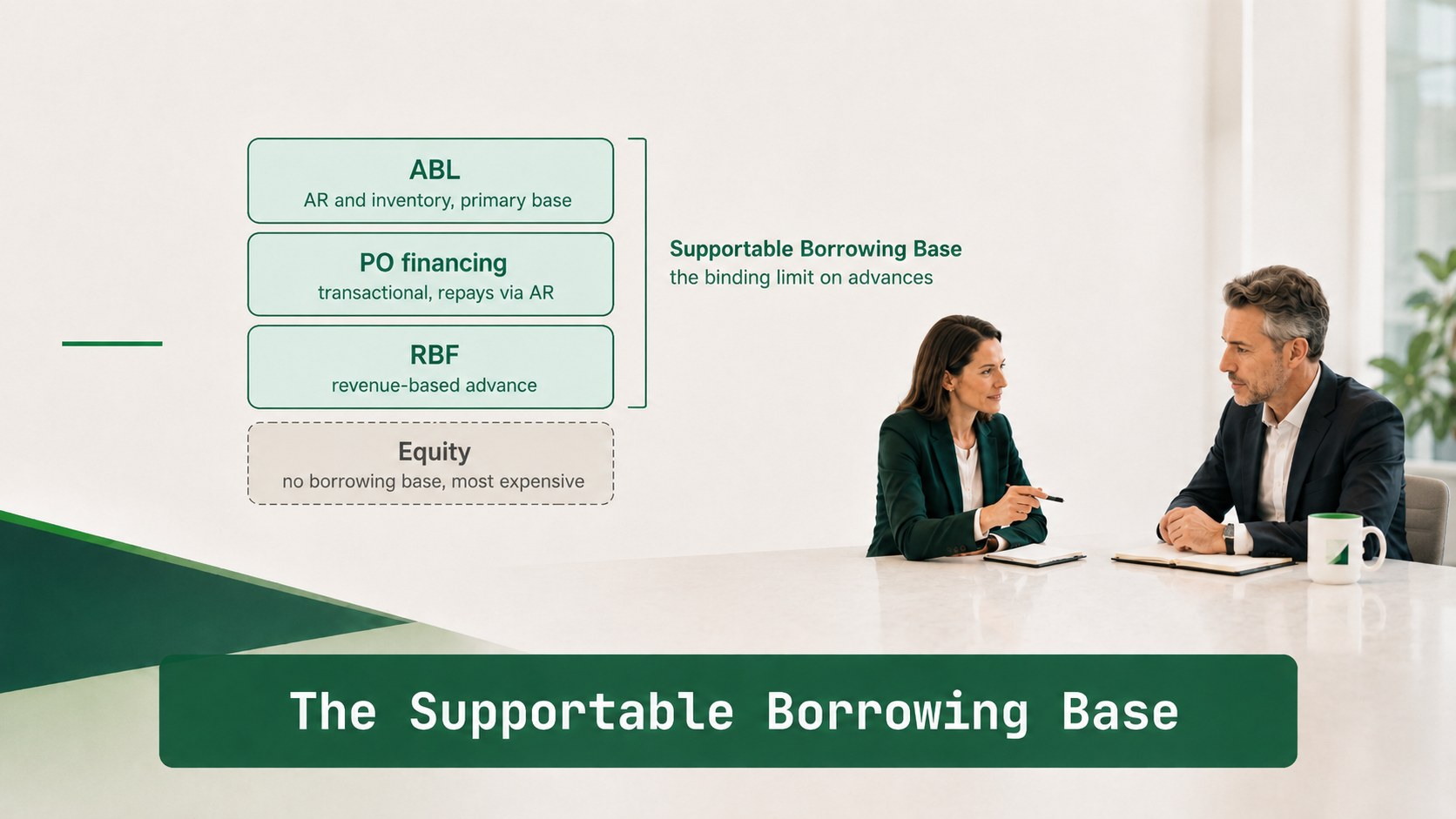
The Supportable Borrowing Base: How to Calculate the Maximum Your Balance Sheet Can Sustain Across All Facilities
How the Equity Adequacy Test, the NWC Floor Stack Test, and the Debt Service Coverage Test Establish the Binding Ceiling for the Full Stack
Most businesses know what their individual facilities will advance.
The ABL line has a borrowing base. The PO financing facility has an advance limit. The revenue-based financing instrument has a funded amount or renewal capacity. Each lender calculates its own exposure against its own collateral, repayment source, and risk model.
What most businesses do not calculate is the maximum aggregate advance the balance sheet can sustain across all facilities at the same time.
That number is the Supportable Borrowing Base.
The Supportable Borrowing Base is not the sum of lender advance limits. It is the balance sheet’s own full-stack ceiling. It answers a question no single borrowing base certificate answers:
How much combined debt can this business sustain before the capital stack begins impairing equity, working capital, or debt service capacity?
This article is the fourth article in the Balance Sheet Governance Series and the central calculation article in the sequence. Articles One through Three established the governance gap, the Equity Adequacy Test, and the NWC Floor Stack Test. This article adds the Debt Service Coverage Test and then combines all three tests into one governing ceiling.
The Supportable Borrowing Base is calculated as the lowest of three constraints applied at the same time:
- the equity adequacy constraint;
- the NWC floor constraint;
- the debt service coverage constraint.
The lowest constraint is the binding ceiling. That ceiling is the maximum aggregate advance the balance sheet can sustain across the full capital stack.
Key Points
- The Supportable Borrowing Base is not the maximum the individual facilities will advance. It is the maximum the balance sheet can sustain across all facilities at the same time. For most businesses with multi-instrument capital structures, those two numbers are different.
- The Supportable Borrowing Base is calculated as the lowest of three constraints: the equity adequacy constraint, the NWC floor constraint, and the debt service coverage constraint. The lowest of the three becomes the binding ceiling.
- The debt service coverage constraint is the third calculation layer in the series. It measures the maximum combined advance the operating cycle’s revenue trajectory can service without consuming the free cash flow required to sustain normal operations and fund the next operating cycle.
- The binding constraint changes by business type, margin profile, instrument mix, and operating cycle stage. Manufacturers at peak production often bind at the NWC floor. Seasonal distributors near the pre-revenue inventory peak often bind at equity adequacy. Growth-phase businesses often bind at debt service coverage.
- The Supportable Borrowing Base is dynamic. Equity changes, working capital needs change, blended stack cost changes, revenue trajectory changes, and the binding ceiling recalculates with those changes.
Core Term
Supportable Borrowing Base — the maximum aggregate advance across all instruments in the capital stack that the balance sheet can sustain without impairing the equity base below the minimum required, compressing the NWC floor below the minimum the operating cycle requires, or creating a combined debt service obligation the revenue trajectory cannot retire on schedule.
The Supportable Borrowing Base is calculated as the lowest of three constraints applied at the same time:
Supportable Borrowing Base = Lowest of:
- Equity Adequacy Constraint
- NWC Floor Constraint
- Debt Service Coverage Constraint
In this framework, the Supportable Borrowing Base is the balance sheet-governed ceiling for aggregate utilization across all facilities. It is produced by calculating the equity adequacy constraint, the NWC floor constraint, and the debt service coverage constraint separately, then using the lowest result as the binding ceiling. The test does not measure lender availability; it measures whether total outstanding advance can be sustained by equity, working capital, and revenue capacity at the same time.
That lowest constraint is the binding ceiling below which the combined advance across all instruments must remain for the capital structure to remain collectively sustainable.
Three articles of calculation discipline now converge.
The Equity Adequacy Test established the maximum combined advance the equity base can support. The NWC Floor Stack Test established the maximum combined draw service the working capital floor can sustain. This article introduces the Debt Service Coverage Test and then combines all three into the Supportable Borrowing Base.
Section One: The Three Constraints
Constraint One: Equity Adequacy
Article Two established the Equity Adequacy Test and its output: the maximum combined advance the adjusted equity base can support without consuming the equity buffer the operating cycle requires.
For the Supportable Borrowing Base calculation, the equity adequacy output becomes a dollar ceiling.
If the adjusted equity base is $2.4 million and the required equity buffer is 30 percent of the combined advance, the equity adequacy constraint is $8 million.
At $8 million, the $2.4 million equity base equals 30 percent of the combined advance. The buffer requirement is met.
Above $8 million, the equity buffer falls below the required level.
That $8 million is not a lender limit. It is the equity adequacy ceiling inside the Supportable Borrowing Base calculation.
Constraint Two: NWC Floor
Article Three established the NWC Floor Stack Test and its output: the maximum combined draw service the working capital floor can sustain without compression below the minimum required.
For the Supportable Borrowing Base calculation, that maximum draw service must be translated into a maximum combined advance.
If the maximum sustainable monthly draw service is $25,000 and the blended stack cost is 18 percent annualized, the NWC floor constraint is the combined advance that produces no more than $25,000 in monthly carrying cost at that blended rate.
This constraint is sensitive to cost.
The working capital floor may stay fixed, but the NWC floor constraint can still tighten when the stack becomes more expensive. If RBF renews at a higher factor rate, if PO financing cost increases, or if the ABL advance mix shifts, the same combined advance may create more monthly draw service. A higher blended stack cost means a lower aggregate advance reaches the same working capital pressure point.
The NWC floor constraint tells the business how much combined advance the operating cycle can carry before debt cost compresses the working capital floor below the level required to complete the cycle.
Constraint Three: Debt Service Coverage
The Debt Service Coverage Test is the third layer required to calculate the Supportable Borrowing Base.
It measures the maximum combined advance the operating cycle’s revenue trajectory can service without consuming the free cash flow required to sustain normal operations and fund the next operating cycle.
The debt service coverage constraint starts with annual revenue and gross margin. The combined annual carrying cost of the stack must be covered by the gross margin produced from the deployed capital, with enough margin left to support ordinary operating needs.
If annual gross margin is $1.2 million and the operating cycle requires $800,000 to sustain normal operations, the maximum annual stack carrying cost the business can support is $400,000.
At the company’s blended stack cost, that $400,000 annual carrying cost ceiling translates into the maximum combined advance permitted by the debt service coverage constraint.
For example, if the blended annual stack cost is 20 percent, a $400,000 annual carrying cost ceiling supports $2 million in combined advance. Above that amount, the stack consumes more gross margin than the operating cycle can support.
The debt service coverage constraint is often most binding for growth-phase businesses. The investment cycle may require more capital before the revenue trajectory has scaled enough to service the full stack. In that case, the business may have enough collateral availability and enough stated facility capacity, but the revenue trajectory cannot yet support the combined carrying cost.
For mature businesses with stable, high-margin revenue, the debt service coverage constraint may bind only at aggressive advance levels. For businesses in the middle — growing, capital-intensive, and still building margin depth — this constraint often becomes the most sensitive test.
Section Two: Calculating the Supportable Borrowing Base
The Supportable Borrowing Base is the lowest of the three constraints.
It is not the average of the three. It is not a weighted combination. It is not the amount the business feels it can manage across facilities.
The lowest constraint governs because each constraint protects a different part of the balance sheet.
If the equity adequacy constraint produces a maximum combined advance of $8 million, the NWC floor constraint produces a maximum combined advance of $6.5 million, and the debt service coverage constraint produces a maximum combined advance of $7.2 million, then the Supportable Borrowing Base is $6.5 million.
The NWC floor is the binding constraint.
The combined advance across all instruments must remain at or below $6.5 million for the balance sheet to sustain the full stack without compressing working capital below the minimum the operating cycle requires.
The binding constraint tells the business where the stack is placing the most pressure on the balance sheet.
An equity-binding result means the equity base is the limiting factor. The combined advance has reached the equity buffer boundary before the working capital or debt service constraints bind.
An NWC floor-binding result means combined draw service is the limiting factor. The cost of carrying the stack is compressing working capital before the equity or debt service constraints bind.
A debt service coverage-binding result means the revenue trajectory is the limiting factor. The business may be carrying a stack whose annual cost is too high for the gross margin produced by the current revenue base.
Each binding constraint points to a different remediation path.
An equity-binding constraint is remediated by strengthening the equity base, retaining earnings, reducing losses, or reducing the combined advance.
An NWC floor-binding constraint is remediated by reducing blended stack cost, often by replacing more expensive instruments with lower-cost ABL capacity where the forensic collateral position supports it.
A debt service coverage-binding constraint is remediated by improving revenue trajectory, improving gross margin, reducing blended stack cost, or restructuring capital deployment so the financed activity produces higher return on capital.
The Supportable Borrowing Base produces a number most businesses with multi-instrument capital structures have never calculated, but every one of those businesses is testing that number every day.
When the combined outstanding advance remains below the Supportable Borrowing Base, the capital structure is operating inside the sustainable range.
When the combined outstanding advance exceeds the Supportable Borrowing Base, the capital structure is collectively overextended. That overextension may not appear in any one lender’s compliance picture. It appears in the balance sheet.
Section Three: Cross-Industry Application
The Supportable Borrowing Base calculation produces different results across industries because the binding constraint changes with the operating cycle.
Manufacturers
For manufacturers at peak production, the NWC floor constraint often binds first.
PO financing, ABL against raw materials, work-in-process, and finished goods, and RBF above the forensic ceiling can create a combined monthly carrying cost that compresses working capital before the equity adequacy or debt service coverage constraints are reached.
The issue is not just total debt. It is the monthly cost of carrying the full stack through production, conversion, shipment, invoicing, and collection.
Seasonal Distributors and Food and Beverage Companies
For seasonal distributors and food and beverage companies at the pre-revenue seasonal peak, the equity adequacy constraint often binds first.
The business may have built a full seasonal inventory position before sell-through has tested demand. The combined advance against that inventory can reach the equity buffer boundary before the working capital floor or debt service coverage constraints bind.
In that situation, the capital stack is testing the balance sheet before the operating cycle has converted inventory into margin.
Growth-Phase Businesses
For growth-phase businesses across industries, the debt service coverage constraint often binds first.
The growth plan may require a level of combined advance that the current revenue trajectory cannot yet service. The business may have lender capacity, collateral availability, and a credible growth thesis, but the current gross margin may not cover the annual stack carrying cost with enough free cash flow left for normal operations.
The discipline is not simply to secure more facility capacity. The discipline is to keep the combined advance below the Supportable Borrowing Base until revenue catches up with the investment cycle.
Staffing Companies and Government Contractors
For staffing companies and government contractors, the binding constraint depends on the engagement mix.
Large contract ramps that require simultaneous payroll funding, ABL utilization, and short-term bridge capital may bind at the NWC floor. Mature contract portfolios with stable, high-margin billings may bind at debt service coverage only at higher advance levels.
The same business can shift from one binding constraint to another as contract mix, billing cadence, margin, and utilization change.
Forensic Stress Test: Do You Know Your Supportable Borrowing Base?
Ask four questions:
- Have you calculated the equity adequacy constraint — the maximum combined advance your adjusted equity base can support without consuming the equity buffer the operating cycle requires?
- Have you calculated the NWC floor constraint — the maximum combined draw service your working capital floor can sustain without compression below the minimum required — and translated that into a maximum combined advance at your current blended stack cost?
- Have you calculated the debt service coverage constraint — the maximum combined advance whose annual carrying cost your revenue trajectory can service with enough free cash flow left to sustain normal operations?
- Have you identified which of the three constraints is binding for your specific instrument mix, business type, and current operating cycle stage — and does your current combined advance remain below the Supportable Borrowing Base that constraint produces?
If the answer to any of these questions is no, the business does not know whether its capital structure is operating inside or outside its sustainable range.
Frequently Asked Questions
What is the Supportable Borrowing Base and how does it differ from individual facility limits?
Individual facility limits are the maximum advance each lender will make against its own instrument, collateral, and repayment model. They are calculated instrument by instrument and governed instrument by instrument.
The Supportable Borrowing Base is the maximum aggregate advance across all instruments that the balance sheet can sustain at the same time. It is calculated as the lowest of the equity adequacy constraint, the NWC floor constraint, and the debt service coverage constraint.
The two numbers are different because individual facility limits are set against individual instruments. The Supportable Borrowing Base is set against combined balance sheet capacity.
A business can have $12 million in combined facility limits and a Supportable Borrowing Base of $8 million.
Why is the Supportable Borrowing Base the lowest of the three constraints rather than an average?
The lowest constraint is the one the balance sheet cannot exceed without impairing the dimension it governs.
If the combined advance exceeds the equity adequacy constraint, the equity buffer is consumed below the minimum required.
If the combined advance exceeds the NWC floor constraint, working capital is compressed below the minimum required.
If the combined advance exceeds the debt service coverage constraint, the stack’s carrying cost consumes more gross margin than the revenue trajectory can support.
Each constraint governs a different dimension of the balance sheet. The lowest ceiling governs because crossing any one of the three ceilings creates impairment in that dimension.
What does it mean if the debt service coverage constraint is the binding constraint?
It means the revenue trajectory is the limiting factor on the Supportable Borrowing Base.
The combined stack carrying cost is consuming gross margin at a level that leaves insufficient free cash flow to sustain normal operations if the combined advance exceeds the debt service ceiling.
The remediation path may include improving revenue trajectory, improving gross margin, reducing blended stack cost, or restructuring the instrument mix toward lower-cost capital.
For growth-phase businesses, the remediation is often timing and discipline. The revenue trajectory may be moving toward the level required to service the investment, but the combined advance must remain below the Supportable Borrowing Base until the revenue base can support the stack.
How does the Supportable Borrowing Base change over time?
It recalculates as the three constraint inputs change.
The equity adequacy constraint changes as the equity base grows through retained earnings or is consumed by losses.
The NWC floor constraint changes as blended stack cost, instrument mix, advance rates, and operating-cycle working capital needs change.
The debt service coverage constraint changes as revenue trajectory, gross margin, and operating expense needs change.
The Supportable Borrowing Base should be recalculated at every borrowing base cycle and at every Stack Reassessment Trigger event identified in the Four-Instrument Capital Stack Series.
What does Capital Source calculate in an engagement that produces the Supportable Borrowing Base?
Capital Source calculates all three constraints at the same time.
The equity adequacy constraint is calculated from the adjusted equity base and required equity buffer.
The NWC floor constraint is calculated from the working capital floor, blended stack cost, and combined draw service at peak or relevant utilization.
The debt service coverage constraint is calculated from the revenue trajectory, gross margin, normal operating requirements, and combined stack carrying cost.
The lowest of the three becomes the Supportable Borrowing Base for that business at that operating cycle stage.
Capital Source then compares the current combined outstanding advance to the Supportable Borrowing Base and identifies whether the capital structure is operating inside the sustainable range or beyond it.
Conclusion
The Supportable Borrowing Base answers the question most multi-instrument capital structures never calculate directly:
What is the maximum aggregate advance across all instruments that the balance sheet can actually sustain?
The equity adequacy constraint, the NWC floor constraint, and the debt service coverage constraint each produce a ceiling. The lowest ceiling is the Supportable Borrowing Base.
Exceeding it means the capital stack has moved beyond the balance sheet’s sustainable range. The breach may appear first as equity impairment, working capital compression, or debt service pressure, but the root issue is the same: aggregate facility capacity has exceeded balance sheet capacity.
Article Five develops the Balance Sheet Governance Test — the ongoing governance standard that compares current combined utilization against the Supportable Borrowing Base and determines whether the capital stack is operating in the harmony zone or has crossed the Harmony-Harm Threshold.
If your combined outstanding advance across all instruments has never been compared against the Supportable Borrowing Base — the lowest of the equity adequacy, NWC floor, and debt service coverage constraints applied at the same time — you do not know whether your capital structure is operating inside your balance sheet’s sustainable range.
Request a Supportable Borrowing Base calculation.
Capital Source calculates all three constraints against your current balance sheet position, instrument mix, and operating cycle stage — identifying the binding constraint, producing the Supportable Borrowing Base, and comparing your current combined advance to that ceiling.
Series Articles — Insert Live URLs on Deployment
Article One: The Governance Gap in Multi-Instrument Capital Structures
Article Two: The Equity Adequacy Test
Article Three: The NWC Floor Stack Test
Article Five: The Balance Sheet Governance Test
The Four-Instrument Capital Stack Series
The Inventory Financing Series Capstone
Strategic Disclosure
Capital Source is a commercial capital advisory firm. This article is produced for informational purposes and represents the firm’s analytical perspective on current credit market conditions. It does not constitute financial, legal, or investment advice. Businesses evaluating capital structure decisions should engage qualified advisors with direct knowledge of their specific operating circumstances.
Proud to be ranked on the 2024 and 2025 Inc. 5000 list of America’s fastest-growing private companies.