
WORKING CAPITAL
The 2/10 Net 30 Decision: When a Credit-Line Draw Beats the Vendor Discount
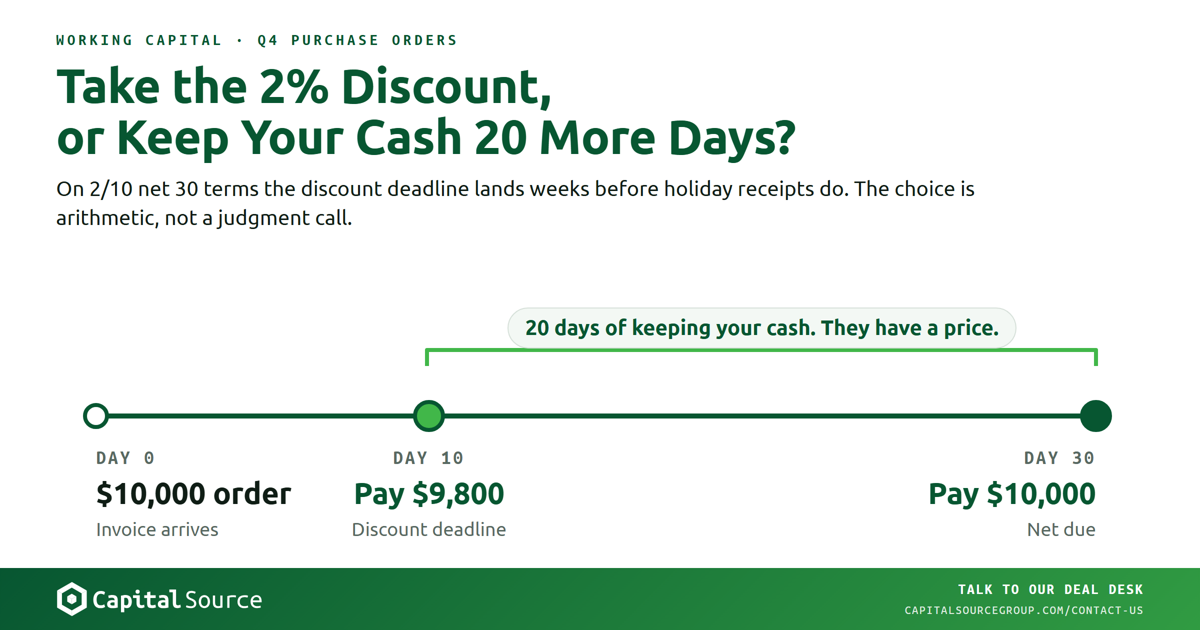
Q4 purchase orders arrive with terms like 2/10 net 30, and the discount deadline lands weeks before holiday receipts do. Here is the formula that prices the decision, the threshold that settles it, and the cases where letting the discount go is the right call.
Every fourth quarter the same question faces distributors, retailers and anyone else carrying inventory into the holidays: the vendor offers 2% for paying 20 days early, cash is committed to the selling season already underway, and the purchase order will not wait. The decision feels like a judgment call. It is arithmetic, and it takes two minutes.
What does 2/10 net 30 mean?
2/10 net 30 is a trade-credit term that gives the buyer a 2% discount for paying within 10 days, with the full invoice otherwise due within 30 days (Corporate Finance Institute). On a $10,000 order, paying by day 10 costs $9,800; paying on day 30 costs the full $10,000. Trade credit of this kind is one of the most common forms of short-term business financing, because the supplier is extending credit for the length of the term (Investopedia).
The 20 days between the discount deadline and the net deadline is the part owners misprice. Skipping the discount keeps cash in your account for those 20 days, and that convenience carries an annualized price tag you can compute.
What does it cost to skip the discount?
On standard 2/10 net 30 terms, skipping the discount is equivalent to borrowing at an implied 37.2% a year. The cost of forgoing a cash discount is the annualized implied rate a buyer pays by settling after the discount window instead of inside it, and the formula prices any term set: divide the discount percentage by 100 minus the discount percentage, then multiply by 365 divided by the difference between the net period and the discount period (Stampli; Bizfluent works the same steps as an effective annual rate).
For 2/10 net 30: 2 / 98 = 2.0408% per 20-day period. A year contains 365 / 20 = 18.25 such periods. Multiply the two and skipping the discount implies an annual rate of 37.2%. Compound each period instead of annualizing simply, (1 + 2/98) raised to the 18.25th power, and the effective annual rate is about 44.6%.
Skipping a 2/10 net 30 discount and paying on day 30 is borrowing at roughly 37% annualized. Compound the periods and the effective rate is about 44.6%.
Two footnotes for accuracy. Some sources annualize on a 360-day year and quote 36.7% for the same terms (Tipalti); the convention moves the decimal, not the decision. And the formula generalizes: Bizfluent’s worked example, 1/10 net 45, implies about 10.5%, a little over a quarter the price of 2/10 net 30. Price every term set you are offered, because they are not equally expensive to skip.
When does a credit-line draw beat the vendor discount?
The threshold is one comparison: draw when your facility’s all-in cost for the 20 days is below the implied annual cost of the discount. All-in means interest plus draw fees. A 37.2% hurdle is a high bar for any financing cost, which is why the comparison is worth running on every order.
Worked example, hypothetical numbers. A $250,000 purchase order carries 2/10 net 30 terms. The discount is $5,000, so paying by day 10 costs $245,000. Assume, purely for arithmetic, a revolving line with a 12% all-in annual rate. Borrowing $245,000 for 20 days costs about $1,611 in interest. Pay $1,611 to save $5,000 and the draw nets about $3,389. The 12% rate is a placeholder for the example, not a quote, offer, or Capital Source term; run the same two lines with your own facility’s all-in cost before deciding.
If cash on hand covers the order without touching payroll or other must-pay obligations, use the cash. Earning 2.04% for 20 days beats anything a deposit account pays. The line is for the timing gap: the cash exists, but it is standing in last season’s inventory or in receivables that convert after the discount window closes. Bridging exactly that gap is what a revolving inventory line is built for, as we covered in 5 Smart Ways to Finance Your Inventory.
When should you let the discount go?
Skipping is sometimes correct, and the same formula tells you when.
- The implied rate is cheap. A 1/15 net 60 term implies about 8.2% annualized (1 / 99 x 365 / 45). If your facility’s all-in cost is above that, or cash is tight, paying on day 60 is a priced decision rather than a missed one.
- The line is near capacity. Drawing to capture a discount while crowding out payroll, rent, or a larger seasonal buy trades one funding problem for a worse one. Remaining capacity is a strategy constraint, not a detail.
- The inventory is marginal. The discount only pays if the goods sell. Two percent saved on stock that sits through Q1 is a rounding error next to the carrying cost and the eventual markdown. Buy the turn first, then the discount.
- The terms are negotiable. Vendors use discounts to pull cash forward. Extended dating or better pricing on a larger commitment can beat both choices; ask before you draw.
To run this comparison on your own open purchase orders, paste the prompt below into the AI assistant you use and answer its questions. It applies the formula above, prices the draw, and checks each of the cases where letting the discount go is the better call.
Why Q4 forces this decision early
The discount clock and the selling clock run out of phase. On 2/10 net 30 terms the decision falls due 10 days after the invoice date, while the goods may not sell until November or December and the receipts convert after that. In cash-conversion-cycle terms, the payables side is offering a discount precisely when inventory days are about to spike (The Working Capital Cycle). Fourth-quarter buying compresses the problem further, because the largest purchase orders of the year arrive inside a few weeks (Capitalizing for Q4: Planning Inventory).
This is where a revolving structure earns its keep against a term loan. Draw for each discount window, repay as the holiday receipts land, and the same capacity is available for the next turn. We covered the seasonal funding calendar in Back-to-School and Holiday Inventory Financing, the line-versus-loan mechanics in Inventory Financing Options: Choosing Between a Line of Credit and a Loan, and our inventory line of credit page walks through what the facility can cover.
How Capital Source structures the draw side
Capital Source arranges inventory financing built around the reorder cycle instead of a fixed amortization schedule, placed with our network of lenders, including our affiliate, Stretch Finance, LLC: capacity designed to be drawn when vendor terms or seasonal buys call for it and repaid as the inventory converts. We structure the request around the deal, the purchase orders, the turns and the vendor terms; the lender underwrites, sets terms and makes the credit decision, so every structure is subject to underwriting and lender approval.
Put the Q4 reorder cycle on a plan
Tell us where your vendor terms and your cash conversion collide, and we will structure capital around it.
Or apply online.
Key takeaways
- Vendor discounts are priced credit. Skipping 2/10 net 30 implies 37.2% annualized, about 44.6% compounded.
- The decision is one comparison. Draw when the facility’s all-in cost for the window is below the implied discount cost; use idle cash first.
- Weak discounts can be skipped rationally. 1/15 net 60 implies about 8.2%, cheap enough to forgo when capacity is tight.
- The discount pays only if the inventory turns. Q4 timing forces the draw decision before the receipts arrive, which is what a revolving line is for.
Frequently asked questions
What does 2/10 net 30 mean?
2/10 net 30 is a vendor payment term that gives the buyer a 2% discount for paying within 10 days, with the full invoice otherwise due within 30 days. On a $10,000 order, paying by day 10 costs $9,800, while paying on day 30 costs the full $10,000.
Is it worth taking a vendor early payment discount?
It is worth taking when your cost of coming up with the cash early is below the discount’s implied annual cost. For 2/10 net 30 that implied cost is roughly 37% annualized, so paying early with idle cash or a draw priced below that rate usually wins. Smaller discounts or longer windows imply much lower rates, so run the formula on each term set.
When is a line of credit draw better than waiting for vendor terms?
A draw is better when the all-in cost of borrowing for the discount window is below the implied annual cost of skipping the discount, and the inventory will sell within the cycle. Waiting until day 30 preserves cash for 20 extra days but pays an implied rate of roughly 37% on 2/10 net 30 terms.
How do I annualize a cash discount?
Divide the discount percentage by 100 minus the discount percentage, then multiply by 365 divided by the difference between the net period and the discount period. For 2/10 net 30 that is (2 / 98) x (365 / 20), or about 37.2%. Compounding each period instead of annualizing simply raises the effective rate to about 44.6%.
Sources
- Corporate Finance Institute, 2/10 Net 30.
- Chirantan Basu, Bizfluent, How to Calculate the Effective Annual Percentage Rate of Forgoing a Cash Discount.
- Stampli, What does 2/10 net 30 mean and how do I calculate the return on an early payment discount.
- Tipalti, Complete Guide to 2/10 Net 30 Early Payment Discounts.
- Investopedia, Understanding Trade Credit: Benefits, Risks, and Accounting Practices.
This article is for informational and educational purposes only and does not constitute financial, investment, accounting, tax, or legal advice. The concepts discussed are general in nature and should be reviewed with qualified professionals based on your specific circumstances. Capital Source arranges commercial financing provided by its affiliates, network of banks, lending partners, and private credit groups. Availability, approval, funding amount, structure, and terms are subject to business review, underwriting, and lender approval.
Leave a Reply