
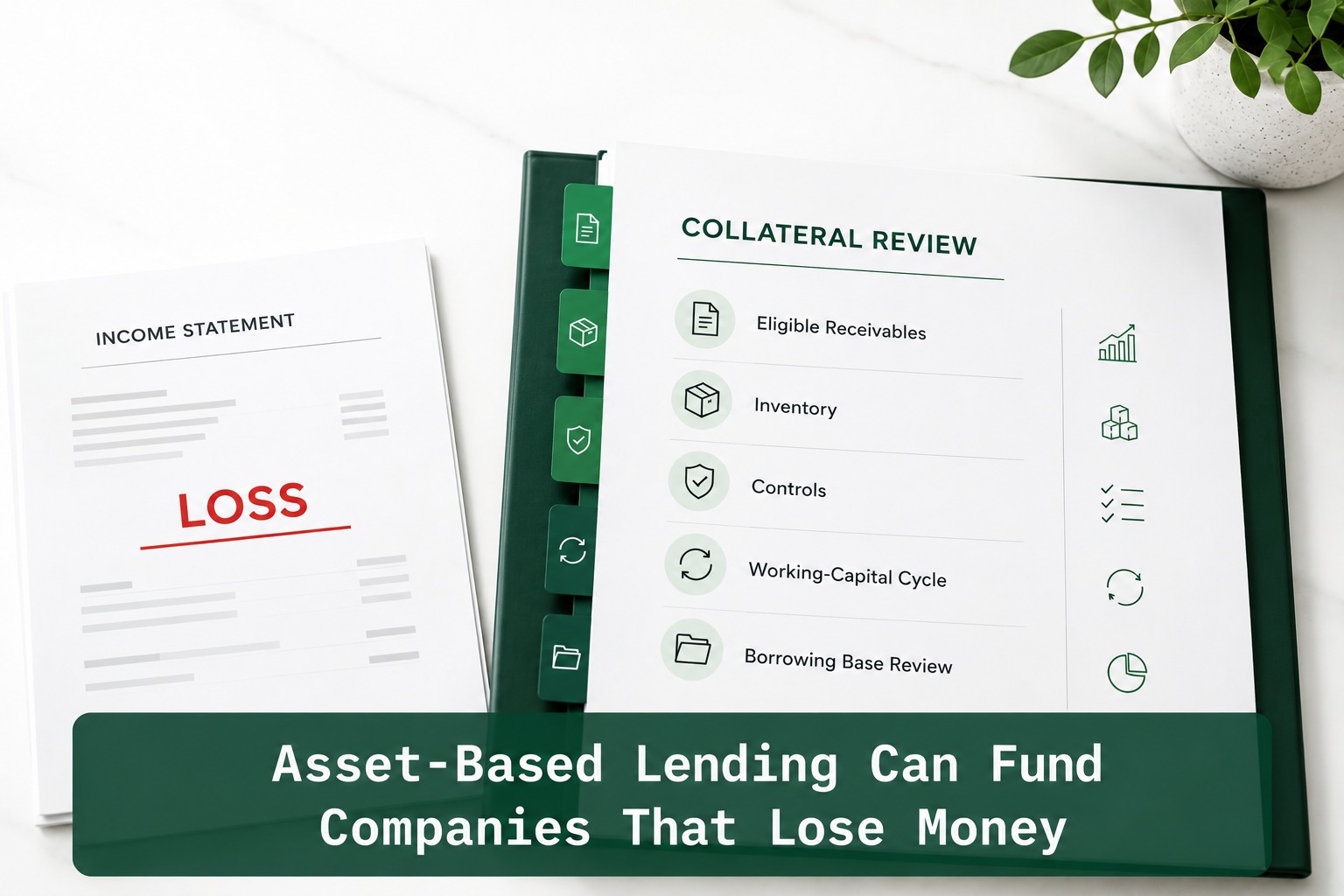
Why Asset-Based Lending Can Fund Companies That Lose Money
The Collateral Selection Criterion explains why asset-based lenders underwrite eligible collateral, controls, and the working-capital cycle—not last year’s profit.
A lender looks at a company that lost money last year and declines. A second lender looks at the same company and extends an asset-based facility. Both read the same financials. They were not reading the same thing.
The first lender read the income statement and saw a loss. The second lender read the collateral base, the working-capital cycle, and the controls around collections, then saw a borrowing base. The difference is not appetite or risk tolerance. It is what each lender selects for, and only one of them was reading the surface the facility is underwritten against.
This is the first article in Book Five of the Capital Governance Stack. Book Four governed the stack. Book Five reads it. The thesis runs through every article: most lenders read financials. Capital Source reads control.
Series One begins upstream of control, at selection: the question of what each instrument actually underwrites. Before you can read who controls a repayment source, you have to read what the facility was extended against in the first place.
The error this series corrects has a name. The Income Statement Misread is the habit of treating the income statement as the credit surface, reading profit or loss as the verdict on whether a business can borrow. It is the most common mistake in the market, and it is wrong in a precise and costly way. It reads the wrong document.
Profitability is one fact about a business. It is rarely the fact a given instrument underwrites.
Every instrument selects for something. The Selection Criterion is the property an instrument actually underwrites, the property that determines whether it advances and how much. For asset-based lending, that property is not profit. It is the Collateral Selection Criterion: the strength, eligibility, and control of the collateral base, read together with the working-capital cycle that converts that collateral into cash.
An asset-based facility advances against eligible accounts receivable and inventory, monitored and controlled, then sized to how quickly the cycle turns. Last year’s profit is not the criterion. The collateral is.
The Collateral Selection Criterion is the asset-based lending test that answers one question: does the eligible collateral base, supported by lender controls and a measurable working-capital cycle, support the requested advance? It does not treat profit as irrelevant. It treats profit as context, not the property the facility selects for when sizing credit availability.
What asset-based lending actually underwrites
Asset-based lending is collateral-first. The advance is sized to eligible receivables and inventory, then adjusted for dilution, customer concentration, ineligibles, and reserves. It is governed through controls, field exams, reporting, and dominion over collections.
This is Collateral-First Underwriting: the discipline of underwriting to the collateral base and its conversion rather than to earnings. Profitability is context. It informs the picture. It is not the line the advance is drawn against.
Read this way, a loss-making company with strong eligible receivables, clean dilution, controlled cash, and a working cycle can be a fundable asset-based borrower. A profitable company with concentrated, dilutive, or uncontrolled receivables may not be.
The two outcomes invert what an income-statement-first read would predict. The income statement is not the surface the facility reads. The collateral and the cycle are.
Eligibility is where the criterion does its work. The gross receivable balance is not the borrowing base. The base is what remains after dilution from credits and returns, after concentration limits cap any single customer, after past-due and cross-aged accounts are removed, and after reserves are held against identifiable risks.
Inventory passes through the same discipline. It is advanced at rates that reflect what it would convert to under the lender’s recovery assumptions. The result is a base built from collateral the lender can rely on, not a base tied mechanically to the profit the business reported.
This is what separates asset-based lending from cash-flow lending. A cash-flow facility is underwritten on earnings and repaid from them, so for that instrument the income statement is closer to the criterion. Asset-based lending is underwritten on collateral and repaid from its conversion. Reading an asset-based facility as if it were a cash-flow facility applies the wrong instrument’s criterion and produces the wrong decision.
Picture two businesses. The first is profitable but sells to three customers on extended terms, has heavy returns, and lacks control over collections. The second lost money last year but bills a diversified customer base, collects cleanly, and runs cash through a controlled account.
On the income statement, the first looks like the borrower and the second looks like the risk. On the Collateral Selection Criterion, the order reverses. The second has a clean, controllable base. The first does not. The instrument funds the second.
A lender that declines a fundable asset-based borrower because the income statement showed a loss has not made a credit decision. It has misread the document. The collateral was there to support the advance, and the wrong page was turned to.
Asset-based lending does not start by asking whether the business made money. It asks what the collateral is, how clean it is, who controls it, and how fast the cycle turns it into cash.
Why the misread costs both sides
The income statement is the most visible document a business produces, so it becomes the default lens. But it measures a period’s earnings. It does not measure the collateral, and it does not measure the cycle that converts the collateral into liquidity.
Reading a loss as uncreditworthy when the collateral fully supports an advance is the Income Statement Misread in its purest form. It costs both sides. The lender passes on a sound asset. The business is told it cannot borrow against capital it plainly has.
A loss-making company can carry an asset-based facility when the facility is built to fund the working-capital cycle. The facility advances against eligible collateral before the cycle completes, then relies on that collateral turning into collected cash.
The Forensic ABL Framework treats conversion, not earnings, as the underwriting surface. A business can lose money on the income statement for reasons that have little to do with whether its receivables will be collected and its inventory will sell. The facility is sized to the latter.
Control is the part of the criterion the income statement cannot speak to at all. An asset-based lender does not ask only what the collateral is worth. It asks who governs the collections and how reliably.
Dominion over cash, lockboxes and blocked accounts, field exams, and reporting are not paperwork around the loan. They are part of what is underwritten. Collateral the lender cannot monitor or control is collateral the lender cannot fully rely on.
A clean control structure can make a modest collateral base fundable. A weak one can leave a strong base unusable. Neither condition appears on the income statement.
A business turned away on the income statement may be sitting on a collateral base that fully supports the capital it needs. It may never learn that if the wrong document is read and the conversation ends there.
The question is not whether the business is profitable. It is whether the collateral base and the cycle support the advance.
Reading the right surface
The forensic move is to read the collateral base and the working-capital cycle as the criterion. That means reading:
- eligibility after dilution and concentration limits
- reserves
- the cleanliness of controls
- who holds dominion over collections
- the timing of the cycle that turns collateral into collected cash
Those readings, not the prior year’s profit, determine whether and how much an asset-based facility can advance.
Done properly, this read can produce more capital than a profit-based view would. A business in a loss year may still carry a built receivables base and inventory the income statement gives no credit for. Reading the collateral surfaces capacity the earnings figure conceals.
That is the practical consequence of selecting on the right criterion. It does not merely avoid wrongly declining a borrower. It can find borrowing capacity the wrong lens leaves on the table.
That is the difference the criterion makes in practice. The same business, read on two different surfaces, produces two different answers. Only one reflects what the facility is actually secured by.
This article is not asking which instrument should be arranged next or how to sequence a capital stack. That is a different question for a later book. It is asking one thing only: what asset-based lending actually underwrites.
The answer is the collateral and the cycle. That answer sets the pattern for the rest of this series. Revenue-based financing selects for something else. Equipment financing selects for something else again. None of the three selects for the income statement.
Forensic stress test
Before an asset-based facility is accepted or declined, four questions read the Collateral Selection Criterion.
- What is the eligible collateral base, after dilution, concentration limits, and reserves, and how does it compare to the capital the business needs?
- How quickly does the working-capital cycle convert that collateral into collected cash?
- Who controls the collateral and the collections, and how clean are the controls?
- Is the decision being driven by the collateral and the cycle, or by a profit or loss figure the instrument does not underwrite?
Conclusion
Asset-based lending can fund companies that lose money because profit is not what it selects for.
The Collateral Selection Criterion is the collateral base and the cycle that converts it. Read the right surface, and a loss-making business with strong, controlled collateral may be exactly the borrower asset-based lending exists to serve. Read the wrong one, and a fundable business is declined on a document the facility never underwrote.
The next article turns to revenue-based financing, where the selection criterion changes again. The question is not collateral, and it is still not profit.
Read the Right Credit Surface
If a lender passed on your business because last year showed a loss, the issue may have been the lens, not the business.
Request a collateral-based read of your borrowing capacity.
Capital Source reads the collateral base, the eligibility and dilution, the controls and dominion, and the working-capital cycle that converts it. We size capital to what the collateral and cycle can support, rather than treating the income statement as the whole credit story.
Most lenders read financials. Capital Source reads control.
Frequently asked questions
Why would an asset-based lender fund a company that is losing money?
Profitability is not what asset-based lending underwrites. The facility advances against eligible accounts receivable and inventory, sized to the collateral base and the working-capital cycle that converts it into cash. A loss-making company with strong, clean, controlled collateral can be a fundable asset-based borrower.
What does asset-based lending actually underwrite, if not profitability?
It underwrites the Collateral Selection Criterion: the strength, eligibility, and control of the collateral base, read together with how quickly the working-capital cycle turns that collateral into collected cash. The income statement is context, not the line the advance is drawn against.
What is the Collateral Selection Criterion?
The Collateral Selection Criterion is the property asset-based lending selects for. It includes the eligible collateral base after dilution, concentration limits, and reserves; the cleanliness of controls; who holds dominion over collections; and the conversion timing of the working-capital cycle. Those factors determine whether the facility advances and how much.
Can a profitable company be turned down for an asset-based facility?
Yes. A profitable company with concentrated, dilutive, or uncontrolled receivables can fail the Collateral Selection Criterion. A loss-making company with clean, controlled collateral can pass it. The decision follows the collateral and the cycle, not reported profit.
What is the Income Statement Misread?
The Income Statement Misread is the habit of treating the income statement as the credit surface, reading profit or loss as the verdict on whether a business can borrow. It is a misread when the instrument underwrites a different property. In asset-based lending, that property is the collateral base and the working-capital cycle.
Strategic disclosure
Capital Source Group structures and arranges capital for small and lower middle market businesses, including asset-based lending, purchase order financing, accounts receivable financing, revenue-based financing, and equipment financing.
The analytical framework described here is the framework Capital Source applies to read credit and to size and govern those structures. This article is analysis, not a financing commitment, and any structure depends on the facts of the business.
Proud to be ranked on the 2024 and 2025 Inc. 5000 list of America’s fastest-growing private companies.