
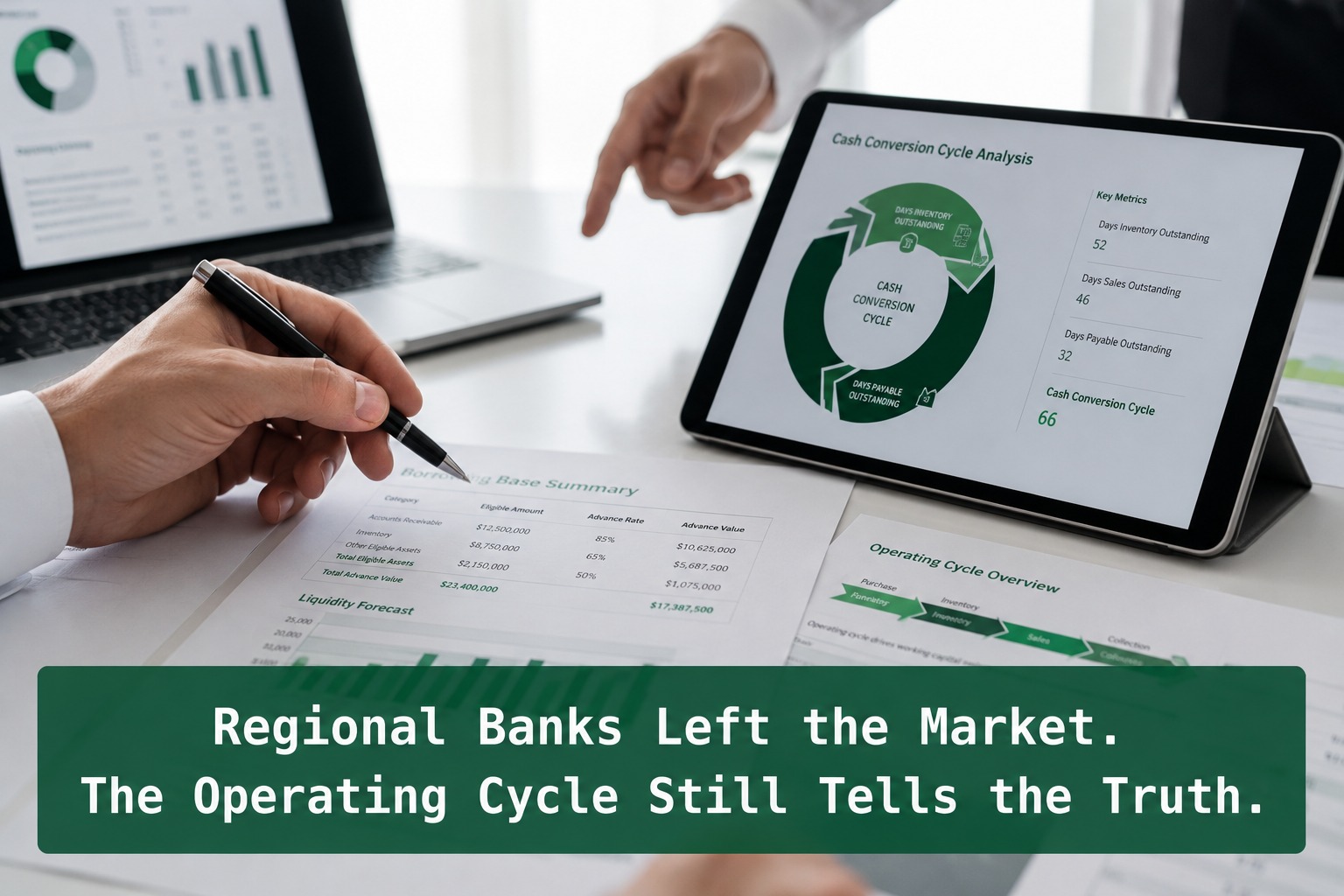
The ABL Void and the Forensic Alternative: What Regional Banks Could No Longer Measure
The Measurement Problem Behind Regional Bank ABL Withdrawal — and the Forensic Framework Built to Close It
SERIES CONTEXT
This article is the capstone of the ABL Void Series — a three-part series examining the structural withdrawal of regional bank capital from the SMB asset-based lending market. It is published on the Capital Source thought-leadership platform for financially literate SMB operators, CFOs, and business owners navigating regional bank ABL withdrawal, borrowing base compression, and working capital lending pressure. The three articles established why the ABL Void exists, which businesses it concentrates on, and what the forensic alternative looks like. This capstone closes that arc and establishes what comes next.
KEY POINTS
- The ABL Void is not a credit quality problem. It is a measurement problem. Regional banks did not exit the businesses this series identified because those businesses weakened. They exited because the cost of evaluating those borrowers accurately — particularly in asset-based lending relationships requiring interpretive underwriting — exceeded what the regulatory economics of maintaining those relationships would support.
- The four profiles most exposed — working capital intensive operators, seasonally asymmetric businesses, growth phase companies, and inventory-heavy distributors — share one structural reality. The income statement cannot tell their credit story accurately. The operating cycle can.
- The forensic alternative does not make those businesses easier to lend to. It makes them possible to evaluate accurately — against the Forensic Borrowing Base, the Forensic Advance Rate, and the Borrowing Base Velocity that reflect the operating cycle that actually exists rather than the formula that was designed for a different one.
- Correct measurement is the starting point. But measurement alone does not produce a correctly sized facility. The NWC-CCC-WCC Governance Trinity — the subject of the next series — is the analytical foundation that sizes the forensic facility against the operating-cycle variables the Forensic Borrowing Base assessment reveals.
WHAT THE SERIES ESTABLISHED
The ABL Void Series opened with a claim that many businesses experiencing regional bank pullback or borrowing base pressure have not heard stated clearly. The bank did not pull back because your business weakened. It pulled back because the cost of understanding your business correctly has risen beyond what the regulatory economics of maintaining the relationship will support. That is a measurement-cost event, not a credit-quality event. And those two realities require fundamentally different responses.
Article Two identified the four profiles the measurement-cost event concentrates on. Not randomly distributed across the SMB market, but specifically concentrated among businesses whose credit quality requires the greatest amount of interpretive analytical work to evaluate accurately. The working capital intensive operator whose income statement understates cycle-level cash generation. The seasonally asymmetric business whose WCC shape requires forward-looking analysis the trailing average cannot provide. The growth phase operator whose trailing compression masks a strengthening forward repayment trajectory. The inventory-heavy distributor whose forced liquidation gap has widened beyond what the origination advance rate assumed.
Article Three delivered the forensic framework. The Forensic Borrowing Base. The Forensic Advance Rate calibrated against current collection-cycle reality rather than against a standardized lending matrix. The Borrowing Base Velocity assessment that determines whether the underlying assets regenerate quickly enough to support the facility utilization the business requires. Together those three analytical disciplines constitute the measurement framework that sees the credit conventional regional bank underwriting metrics often cannot.
The businesses this series described are not waiting to be rescued. They are waiting to be correctly evaluated. The Forensic Borrowing Base does not give them more capital than they can support. It gives them the capital they can actually support — sized against the operating cycle that exists rather than the formula that was designed for a simpler one.
THE GAP THE SERIES DOES NOT CLOSE
The ABL Void Series established the forensic measurement framework. It identified the disciplines required to evaluate the four profiles correctly. What it did not fully develop is the analytical foundation those disciplines ultimately rest on.
The Forensic Borrowing Base is sized against the NWC floor. Whether that floor remains adequate through the full operating cycle — through the peak demand that draws it down and the trough recovery that must regenerate it before the next peak — is a question the borrowing base assessment alone cannot answer. That requires the NWC Velocity assessment and the NWC Floor Stress Test.
The Forensic Advance Rate is calibrated against the current CCC. Whether the CCC the advance rate was built around still reflects the collection cycle that actually exists — given extended counterparty payment behavior, slowed inventory turns, and compressed payables extension — requires the CCC Forensic Assessment.
The Borrowing Base Velocity is assessed against the WCC shape. Whether the facility is sized for the peak demand the operating cycle produces or for the trailing average that misrepresents it requires the WCC Shape Analysis.
Those three variables — NWC, CCC, and WCC — form the analytical foundation the forensic alternative requires to produce a facility that is correctly sized not just at origination but through the full operating cycle the facility is intended to support.
The strategic consequence of the measurement gap is straightforward: a Forensic Borrowing Base calculation without the NWC-CCC-WCC Governance Trinity produces a facility that is more accurately measured than the conventional borrowing base, but still not fully calibrated to the operating cycle. The trinity closes the remaining gap. That is the work the next series develops.
CONCLUSION
The ABL Void is structural and it is not resolving. The regulatory mechanics that made interpretive underwriting too expensive for many regional banks to perform have not changed, and the businesses that depended on those relationships are not getting them back. What now exists is a permanent gap between the credit quality those businesses carry and the market’s current capacity to evaluate that credit correctly.
The forensic alternative fills that gap. Not by lowering the standard of evaluation, but by applying a different and more accurate standard — one that reads operating-cycle reality rather than income-statement proxies and sizes the facility against the cycle that actually exists rather than the formula that was designed for a different one.
The ABL Void Series established that framework. The NWC-CCC-WCC Governance Trinity Series develops the analytical foundation that framework ultimately rests on.
If your business occupies one of the four profiles this series identified and your ABL relationship is showing early warning signals, active borrowing-base compression, or a non-renewal conversation, the forensic assessment starts with establishing what your operating cycle actually supports.
Capital Source performs that assessment across the full forensic framework — Forensic Borrowing Base, Forensic Advance Rate, Borrowing Base Velocity, and the NWC-CCC-WCC Governance Trinity that sizes the facility correctly through the full operating cycle.
Article One: Your Regional Bank Did Not Pull Back Because Your Business Weakened
Article Two: The Businesses the Regional Bank Market Is Leaving Are Not Random
Article Three: The Regional Bank Could Not See Your Credit
STRATEGIC DISCLOSURE
Capital Source is a commercial capital advisory firm. This article is produced for informational purposes and represents the firm’s analytical perspective on current credit-market conditions. It does not constitute financial, legal, or investment advice. Businesses evaluating capital-structure decisions should engage qualified advisors with direct knowledge of their specific operating circumstances.
Proud to be ranked on the 2024 and 2025 Inc. 5000 list of America’s fastest-growing private companies.