
SBA LENDING
What Changes for SBA Borrowers on October 1, 2026
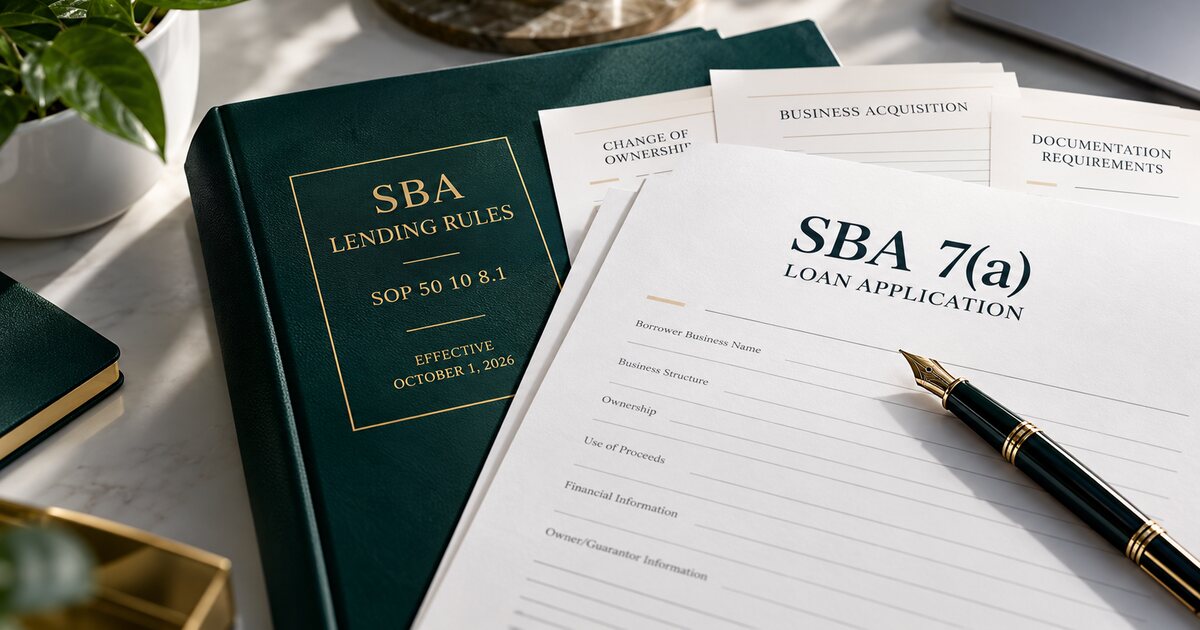
The SBA’s updated lending handbook, SOP 50 10 8.1, takes effect October 1, 2026. What owners, buyers, and advisors should know about eligibility, guarantees, and acquisition paperwork, and which financing paths stay open when a deal no longer fits the SBA box.
On October 1, 2026, the Small Business Administration’s newest rulebook, SOP 50 10 8.1, becomes the governing standard for the 7(a) program, the loan program behind most SBA-backed business purchases and growth financing. The SBA published the SOP on September 25, 2026 and announced it in Information Notice 5000-880695, issued August 14, 2026. Much of the revision is technical. Several provisions are not: they touch who qualifies, how ownership is counted, what a buyer has to document, and when an acquisition needs a Quality of Earnings report.
If you are buying a business, selling one, or financing growth through the SBA, business owners and acquisition buyers may want to revisit how these changes affect their financing strategy. The rules may have changed, but businesses may still have financing options. SBA lending remains an attractive path for qualified borrowers, and a changed rulebook is best read as a change in fit rather than a closed door.
What is SOP 50 10 8.1, and which loans does it cover?
SOP 50 10 8.1 is the SBA’s updated standard operating procedure for how lenders underwrite and process its loan programs, and it takes effect October 1, 2026, replacing SOP 50 10 8 from June 2025 (SBA Information Notice 5000-880695). Per guidance from the National Association of Government Guaranteed Lenders (NAGGL), the new SOP applies to loans that receive an SBA loan number on or after October 1, 2026. That makes the loan-number date, not the application date, the milestone to ask about if a deal is already in process.
The 2025 revision set the direction of travel, and 8.1 continues it. SOP 50 10 8 called for stronger lender due diligence on financials and projections, higher collateral and equity injection expectations, and longer approval timelines, with borrowers advised to plan on 60 to 120 days depending on lender workload and documentation. It also barred the use of SBA proceeds to refinance merchant cash advances. Our 2025 overview of those changes covers that ground. Against that backdrop, the provisions with the most practical weight in 8.1 land on eligibility, acquisitions, and ownership structure.
Do you still qualify? Citizenship, residency, and guarantees
Under SOP 50 10 8.1, eligibility turns on the citizenship and residency of everyone who owns the business, not just the applicant. One hundred percent of direct and indirect owners, plus every required guarantor, must be U.S. citizens or U.S. nationals whose principal residence is in the United States, its territories, or its possessions. Lawful permanent residents, meaning green card holders, are listed as ineligible (SBA Information Notice 5000-880695; NAGGL).
In practice this is a cap table question, and it rewards an early answer. A single indirect owner sitting inside a holding company or a trust can move an otherwise strong application outside the program, and historical cash flow only carries a deal once eligibility is settled. If your ownership structure includes non-citizen owners, ask an SBA lender how the structure will be evaluated before you commit to a timeline, and get familiar with alternatives now rather than after a decline. Changes in eligibility do not necessarily mean the underlying business opportunity has changed. They mean the financing plan around that opportunity may need to change with it.
How do the new rules treat buying or selling a business?
Appendix 15 of SOP 50 10 8.1 sorts every 7(a) change of ownership into one of four categories: Initial Acquisition, which is the default, plus Business Expansion, Owner Buyout, and ESOP and Cooperative transactions, each of which must be documented as such (NAGGL; SBA Information Notice 5000-880695). The category is not paperwork for its own sake. It drives what the lender collects, how the transaction is structured, and what the seller may do after closing.
One rule is easy to miss mid-negotiation. In an Initial Acquisition or Business Expansion transaction, a seller who stays involved may serve only as a consultant, and for no more than 24 months in aggregate. Transition-services or employment terms written into a purchase agreement can collide with that limit, so aligning the deal documents with the financing early is worth the calendar time. On a related point, some early coverage suggested smaller acquisitions would lose access to streamlined programs. The SOP says otherwise: 7(a) Small and SBA Express loans may still facilitate a change of ownership, subject to Appendix 15.
When does an acquisition require a Quality of Earnings report?
A Quality of Earnings report is an accountant’s examination of how much of a company’s reported earnings is sustainable and backed by actual cash flow. Under SOP 50 10 8.1, where the Business Purchase Price is $3 million or more, the lender must obtain that report in addition to the business valuation (SBA Information Notice 5000-880695).
New documentation threshold: acquisitions with a Business Purchase Price of $3 million or more now require a Quality of Earnings report alongside the business valuation.
Three details decide whether the requirement applies, and they change the answer more often than buyers expect. The threshold is measured before buyer equity, seller debt, or other financing is netted out. Owner-occupied real estate is excluded from the purchase price. And Owner Buyout and ESOP and Cooperative transactions are not subject to the QoE requirement at all. For deals anywhere near the line, a Quality of Earnings report adds accounting work, professional fees, and weeks to the closing calendar, so understanding the capital structure early may become increasingly important under the new rules. How a price is financed and what it includes can determine both the documentation burden and the size of the loan the numbers can support.
What about fees and program capacity in FY2027?
The SBA issued its FY2027 fee notices for both major programs: Information Notice 5000-881797 for 7(a) and Information Notice 5000-881796 for 504, both effective October 1, 2026. Fee schedules vary by program, loan size, and fiscal year, so confirm the current figures with your lender rather than relying on any summary, including this one.
Manufacturers have one specific item to confirm. The FY2026 upfront-fee waiver for 7(a) loans of $950,000 or less to businesses in NAICS 31-33 was scheduled to expire September 30, 2026. If a financing plan assumed that waiver, ask whether FY2027 continues it before treating the savings as committed. Capacity, meanwhile, moved the other direction this summer: since July 4, 2026, the combined 7(a) and 504 loan limit has been $10 million, which keeps the program relevant for larger, capital-intensive deals even as documentation tightens.
What happens if the deal no longer fits the SBA box?
Some transactions will not clear the new eligibility rules, and some will face a longer calendar while Appendix 15 documentation and a Quality of Earnings report are completed. Neither outcome says anything about the quality of the business or the deal. Transactions that no longer fit traditional SBA underwriting may still have other financing paths available, and the SBA itself remains a viable destination once a structure fits its rules.
Timing is usually the real pressure. SBA approvals were already running 60 to 120 days under the 2025 rules, and added documentation lengthens that calendar. A manufacturer waiting on an approval can miss the window to fill a new contract. A retailer can lose the timing on an expansion. A service business can be covering payroll and vendor obligations while proceeds are pending. Owners who build a Plan B before they need one keep those decisions strategic instead of forced.
The structures that fill the gap, conditionally and case by case, tend to fall into a few families:
One product deserves a specific caution. Since June 1, 2025, SBA proceeds cannot refinance a merchant cash advance, so filling a gap with an MCA today can close the SBA door tomorrow. That makes the choice of interim capital a structural decision, not a quick fix, and it is one more reason that understanding the full capital structure early pays for itself.
Talk to the Deal Desk before you assume the deal no longer works
Everything above is program rules, not a verdict on your transaction. Capital Source’s Deal Desk can review how the new SBA rules could affect your financing options and whether another capital structure may make sense for your business or transaction, evaluating SBA financing through our lending network, business acquisition financing, conventional term loans, working capital, Stretch Finance structures, asset-based lending, factoring, equipment financing, bridge financing, and combinations of products where appropriate.
Key takeaways
- Effective date: SOP 50 10 8.1 takes effect October 1, 2026, and per NAGGL guidance it governs loans that receive an SBA loan number on or after that date.
- Eligibility: one hundred percent of direct and indirect owners and required guarantors must be U.S. citizens or U.S. nationals with a principal residence in the U.S., its territories, or possessions; lawful permanent residents are ineligible.
- Change of ownership: Appendix 15 sorts every 7(a) change of ownership into four categories, and in an Initial Acquisition or Business Expansion a seller may stay on only as a consultant, for no more than 24 months in aggregate.
- Documentation: acquisitions with a Business Purchase Price of $3 million or more require a Quality of Earnings report in addition to the valuation, measured before buyer equity and seller debt and excluding owner-occupied real estate.
- Smaller deals: 7(a) Small and SBA Express may still finance a change of ownership, subject to Appendix 15.
- Options remain: a deal that no longer fits SBA underwriting may still be financeable through bridge, seller-note, conventional, asset-based, factoring, equipment, or combined structures.
Frequently asked questions
When do the new SBA lending rules take effect?
SOP 50 10 8.1 takes effect October 1, 2026. The SBA published it on September 25, 2026 and announced it in Information Notice 5000-880695, issued August 14, 2026. Per guidance from the National Association of Government Guaranteed Lenders, it applies to loans that receive an SBA loan number on or after October 1, 2026.
Are green card holders eligible for SBA 7(a) financing under the new rules?
No. Under SOP 50 10 8.1, one hundred percent of direct and indirect owners and every required guarantor must be a U.S. citizen or U.S. national whose principal residence is in the United States, its territories, or its possessions. Lawful permanent residents are listed as ineligible. Businesses with non-citizen owners may still have non-SBA financing paths worth evaluating, since each lender applies its own standards.
When does an SBA acquisition loan require a Quality of Earnings report?
Where the Business Purchase Price is $3 million or more, the lender must obtain a Quality of Earnings report in addition to the business valuation. The threshold is measured before buyer equity, seller debt, or other financing, and owner-occupied real estate is excluded from the purchase price. Owner Buyout and ESOP and Cooperative transactions are not subject to the requirement.
Can a seller stay involved after closing an SBA-financed sale?
In an Initial Acquisition or Business Expansion transaction, the seller may remain only as a consultant, for no more than 24 months in aggregate. Buyers and sellers should align any transition or employment terms in the purchase agreement with that limit before signing. The other Appendix 15 categories, including Owner Buyout and ESOP and Cooperative transactions, carry their own documentation requirements.
Can SBA Express still be used to buy a business?
Yes. The SOP provides that 7(a) Small and SBA Express loans may still facilitate a change of ownership, subject to the Appendix 15 categories and documentation. Early reports suggesting that smaller acquisitions would lose access to these programs do not match the SOP text.
Sources
- U.S. Small Business Administration, Information Notice 5000-880695: Issuance of SOP 50 10 8.1 (issued August 14, 2026; effective October 1, 2026).
- National Association of Government Guaranteed Lenders, Two Major SBA Announcements: Issuance of SOP 50 10 8(1) and a New Expansion of the ITL Program (August 14, 2026).
- U.S. Small Business Administration, Information Notice 5000-881797: FY2027 7(a) Program Fees (effective October 1, 2026).
- U.S. Small Business Administration, Information Notice 5000-881796: FY2027 504 Program Fees (effective October 1, 2026).
This article is for informational and educational purposes only and does not constitute financial, investment, accounting, tax, or legal advice. The concepts discussed are general in nature and should be reviewed with qualified professionals based on your specific circumstances. Capital Source provides access to commercial financing solutions through its affiliates, syndicates, network of banks, lending partners, and private credit funds/groups. Availability, approval, funding amount, structure, and terms are subject to business review, underwriting, and lender approval.
Leave a Reply