
Where Cash Gets Trapped in the Working Capital Cycle
Growth does not always create cash. In many businesses, growth consumes cash before it creates it, and the shortfall concentrates at one specific point in the operating cycle. This piece maps where cash gets trapped in the working capital cycle, why layering generic debt onto the problem can make it worse, and how underwriting the cycle itself changes what capital can do.
On paper, the business is winning. Revenue is up, gross margin is holding, and the order book is the strongest it has ever been. Yet payroll gets tighter every other Friday, supplier deposits keep getting larger, and the operating account keeps drifting toward zero. Owners usually read this as a capital problem and go looking for more money. In our experience underwriting these situations, the money is rarely missing. It is trapped, and it is trapped somewhere specific. The useful question is rarely how much. It is where, why, and what will release it. That is the question this article works through, from the mechanics of the cycle to the structures that unlock it.
Where does cash get trapped in the working capital cycle?
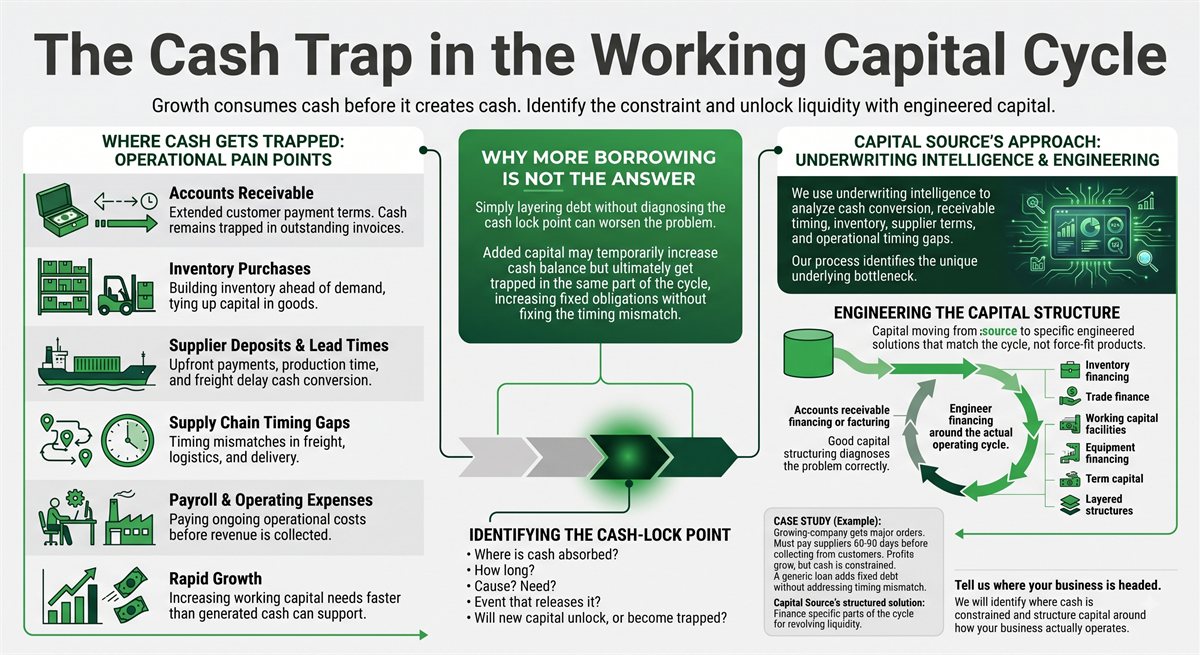
Cash gets trapped in the span between paying for work and getting paid for it. In a typical product business that span covers supplier deposits, production lead times, inventory sitting ahead of demand, freight in transit, invoicing lag, and receivables aging on extended customer terms. The working capital cycle is the full loop from cash going out for suppliers, labor, and inventory to cash coming back in from customer payments, and every stage of that loop holds cash for a period of time.
Walk the loop end to end and the pattern becomes visible. A purchase order often requires a supplier deposit before anything is made. Production takes weeks. Finished goods sit in a warehouse ahead of demand, then spend days or weeks in freight. Only after delivery does an invoice go out, and on net 30, net 60, or net 90 terms an invoice is a promise, not a payment. Each stage has its own timing band, and cash sits inside every one of them.
Extended terms would be manageable if customers honored them reliably. Often they do not. As of September 2025, the Atradius Payment Practices Barometer for North America found that 43% of U.S. credit-based B2B sales were overdue, and the leading cause of payment delay was customers’ own cash flow pressure. The receivables stage stretches because your customers are managing the same cycle you are.
Against all of that elastic inflow timing stands the outflow schedule, which does not flex. Payroll runs every week or two. Rent, insurance, software, and debt service go out on fixed dates whether the container is on the water or the invoice is 40 days past due. That mismatch between elastic inflows and fixed outflows is why the strain shows up in the operating account long before it shows up in the financial statements.
In the Federal Reserve Banks’ 2025 Report on Employer Firms, 56% of small employer firms cited paying operating expenses as a financial challenge and 51% cited uneven cash flow. Among firms that sought financing, meeting operating expenses (56%) was a more common reason than pursuing expansion (46%).
The JPMorgan Chase Institute’s 2016 study of 597,000 businesses found the median U.S. small business held just 27 cash buffer days, and 25% held 13 days or fewer.
Put those together and the stakes are clear. Most businesses run the cycle with a few weeks of cushion, so a stage of the cycle that holds cash a few weeks longer than planned is not an accounting curiosity. It is the difference between making payroll comfortably and sweating it.
The cash-lock point: every liquidity constraint has a location and a cause
A cash-lock point is the specific stage in a company’s operating cycle where cash is absorbed and held, waiting for a conversion event (a shipment, an invoice, a customer payment) to release it. Every liquidity constraint has a location and a cause, and the two together determine what kind of capital will actually help. A distributor whose cash is locked in receivables has a different problem than a manufacturer whose cash is locked in supplier deposits, even when the monthly shortfall looks identical.
Liquidity pressure behaves like water building behind a levee. The pressure does not distribute evenly across the system; it concentrates at one point, and adding more water does not relieve it. Led Zeppelin was onto something in “When the Levee Breaks”: once pressure finds the weak point, more volume only raises the stakes. The work is locating the point where the pressure concentrates, then engineering the release.
Finance puts days on this pressure with the cash conversion cycle. The cash conversion cycle is the number of days between paying suppliers and collecting cash from customers, calculated as days inventory outstanding plus days sales outstanding minus days payable outstanding. A useful rule of thumb follows: a one-day change in the cash conversion cycle ties up, or releases, roughly one day of sales, at cost, in cash. Cost is the honest basis, because inventory and supplier payments move at what the goods cost the business, not at what they sell for. For a hypothetical company doing $12 million a year with costs running 75% of sales, that is about $25,000 of cash per day, so adding five days to the cycle quietly absorbs roughly $125,000 that used to be available for operations.
This is not a small-company quirk. The Hackett Group’s 2025 Working Capital Survey, published in August 2025 on 2024 fiscal data, found roughly $1.7 trillion of excess working capital sitting trapped on the balance sheets of the 1,000 largest U.S. public companies, with receivables the largest component at about $600 billion and an average cash conversion cycle of 37 days. If the largest, best-resourced companies in the economy leave that much cash locked in the cycle, a growing mid-sized business should assume it has trapped cash too. And the amount trapped is the beginning of the story, not the end. What matters just as much is what the trapped cash costs while it stays trapped: the payroll it cannot cover, the supplier discount it cannot take, the order it cannot fund.
Why more borrowing isn’t automatically the answer
More capital is not automatically the answer because capital that does not address the lock point flows straight into it. A generic loan raises the cash balance temporarily. In a growing business, that cash is then absorbed by the same stage of the cycle that created the shortage: more supplier deposits, more inventory, more receivables. Within a quarter or two the operating account is back where it started, except the business now carries a new fixed monthly obligation. The wrong capital can become trapped in the same cycle it was intended to solve.
This is the compounding trap. When the cycle lengthens and the company borrows more to fund it, cash generation falls or stays flat while obligations rise, so coverage deteriorates faster than revenue or margin trends suggest. The income statement keeps improving while the capacity to meet obligations keeps eroding. Earnings are not cash, and a business can be cash-poor with positive EBITDA, a pattern we have examined in why profitable businesses still run out of cash and unpacked line by line in cash flow versus EBITDA.
Growth itself has a speed limit here. Writing in Harvard Business Review, Churchill and Mullins showed that every company has a self-financeable growth rate, set by its operating cash cycle, the cash each dollar of sales consumes, and the cash each dollar of sales generates. Grow faster than that rate and the business consumes cash even while it is profitable. Capital can responsibly extend that limit, but only when it is structured against the stage of the cycle doing the consuming.
The principle we underwrite by is simple. A facility that leaves a business with no working capital headroom after funding has not solved the liquidity problem; it has added a debt obligation on top of it.
Underwriting the operating cycle, not just the borrower
Underwriting is the analysis a lender performs to understand how a business earns and moves cash, and whether a proposed financing can be repaid from that movement. Traditional underwriting spends most of its effort on the borrower: credit history, collateral, historical financial statements. Those matter, but for a working capital problem they describe the patient without locating the injury. Our underwriting starts one level deeper, with the operating and financial mechanics of the business itself: cash conversion timing, receivable aging and who actually controls payment, inventory requirements, supplier terms and dependencies, operating expense timing, and the gap between cash out and cash in.
Technology does the mapping. Our underwriting platform maps the operating cycle end to end, from purchase order through production, freight, invoicing, and collection, and quantifies the timing gap at each stage. Experienced credit professionals make the decisions; the platform’s job is to make sure those decisions rest on an accurate picture of where cash actually moves and where it stalls.
Before any structure is proposed, the underwriting has to answer a specific set of questions:
- Where is cash actually being absorbed?
- How long does cash remain trapped?
- Is the constraint caused by receivables, inventory, supplier terms, growth, seasonality, or operating expenses?
- Is the liquidity need temporary, recurring, or structural?
- What event converts the financed asset or expenditure back into cash?
- What financing structure matches that conversion cycle?
- Will new capital unlock the cycle, or become trapped alongside existing capital?
The question is not how much capital the business needs. It is where the cash is trapped, what caused it, and what structure will release it. That reframing turns the cash conversion cycle from a diagnosis into a decision.
Want a first pass on your own numbers before you talk to anyone? Paste this into your AI assistant with your figures filled in.
Engineering capital around the cycle
Once the cash-lock point is identified, financing is engineered around the actual operating cycle rather than forcing the company into a predefined product. No product is presumed correct before the analysis is performed. The structure follows the diagnosis, and the same monthly shortfall can call for entirely different facilities depending on where the cash is locked. Financing is offered through Capital Source’s affiliate, Stretch Finance, and every structure is subject to underwriting and approval.
Cash locked in receivables. Accounts receivable financing or factoring advances cash against outstanding invoices and revolves as customers pay, so liquidity tracks the sales the business has already earned.
Cash committed to orders ahead of production. Purchase order financing or trade finance funds supplier costs against confirmed orders. It is typically the earliest-stage financing in the working capital cycle, preceding the receivables that will eventually repay it.
Cash absorbed by inventory build. Inventory financing supports stock built ahead of demand, structured to release as goods sell and convert into receivables and then cash.
Recurring gaps across multiple points. A working capital facility can cover a cycle that locks cash at several stages at once, sometimes layered with equipment financing or term capital when the economics support it.
The common thread is alignment. Capital is healthy when the structure of capital matches the structure of the business. When the structure matches, the financing is designed to self-liquidate as the cycle turns: the conversion event that releases the trapped cash is the same event that repays the facility.
A hypothetical example: the distributor that grew into a cash squeeze
The following example is hypothetical and illustrative only. It does not describe an actual client, and it does not promise any structure, amount, or outcome.
Picture a distributor doing $12 million a year that wins a major increase in customer orders. To fill them, it must pay suppliers and fund inventory 60 to 90 days before customers pay their invoices. Revenue and gross profit grow every quarter. Cash tightens every quarter, because growth extends the cash conversion cycle: larger supplier deposits, more inventory in transit, a bigger receivables book on net 60 terms. With costs running 75% of sales, roughly $25,000 of cash moves through the cycle each day, so a 75-day cycle holds about $1.9 million of the company’s cash at any given moment. Grow the order book 40% and the cycle now holds roughly $2.6 million. The additional $700,000 has to come from somewhere before a single new invoice is collected. It is the same dynamic we traced in the small business cash flow growth squeeze, seen here from the underwriting side.
Path one is the generic answer: a term loan. The proceeds arrive, the cash balance jumps, and within two quarters the money has flowed into the same inventory and receivables build that created the shortage. The lock point is untouched. The business now services a fixed monthly payment from a cash flow thinner than before, and the next growth quarter widens the gap again.
Path two starts with the diagnosis. The cash-lock point sits between supplier payment and customer collection, so the structure that fits is a revolving facility built to finance that specific stage: it advances against the assets moving through the cycle and self-liquidates as receivables convert to cash. Availability is designed to grow with the order book, instead of a fixed obligation growing against it. Same company, same numbers, structurally different outcome.
Structure capital around how your business actually operates
Tell us where your business is headed. We will work to identify where cash is constrained and why, then structure capital around how your business actually operates.
Key takeaways
- Cash gets trapped at specific stages, not everywhere at once. Supplier deposits, production, inventory, freight, invoicing, and receivables each hold cash for a period of time, while payroll and operating expenses go out on a fixed schedule regardless.
- Find the cash-lock point before financing anything. Every liquidity constraint has a location and a cause, and the two together determine the structure that will release it.
- The cycle is measurable. The cash conversion cycle (days inventory outstanding plus days sales outstanding minus days payable outstanding) puts days on the problem, and a one-day change ties up or frees roughly one day of sales, at cost, in cash.
- More capital is not automatically relief. A generic loan can sink into the same lock point while fixed obligations rise; the wrong capital can become trapped in the same cycle it was intended to solve.
- Underwrite the cycle, then engineer the structure. Receivables, purchase order, inventory, and working capital facilities each map to a different lock point, and capital is healthy when the structure of capital matches the structure of the business.
Frequently asked questions
What is a working capital cycle?
The working capital cycle is the full loop from cash going out for suppliers, labor, and inventory to cash coming back in from customer payments. Every stage of the loop (supplier deposits, production, inventory, freight, invoicing, receivables) holds cash for a period of time, while payroll and operating expenses go out on a fixed rhythm regardless. The longer the loop runs, the more cash a business needs simply to operate.
What is a cash-lock point?
A cash-lock point is the specific stage in a company’s operating cycle where cash is absorbed and held, waiting for a conversion event (a shipment, an invoice, a customer payment) to release it. Identifying the lock point matters because financing that targets the wrong stage leaves the constraint in place. Every liquidity constraint has a location and a cause, and the two together determine the right structure.
Why doesn’t more capital always improve liquidity?
More capital does not always improve liquidity because a generic loan raises the cash balance only temporarily. In a growing business, the proceeds flow to the same lock point, funding more inventory and receivables, while the company takes on a new fixed monthly obligation. Coverage can deteriorate even as revenue grows, and the wrong capital can become trapped in the same cycle it was intended to solve.
How does Capital Source decide which financing structure fits?
We start by underwriting the operating cycle itself: mapping cash conversion timing, receivable aging, inventory requirements, supplier terms, and expense timing to find where cash is absorbed and what event converts it back. The structure follows that diagnosis, whether it points to accounts receivable financing, purchase order financing, inventory financing, or a working capital facility. No product is presumed correct before the analysis is performed, and financing is offered through Capital Source’s affiliate, Stretch Finance, subject to underwriting and approval.
Sources
- Federal Reserve Banks, 2025 Report on Employer Firms: Findings from the 2024 Small Business Credit Survey.
- JPMorgan Chase Institute, Cash Is King: Flows, Balances, and Buffer Days (2016).
- Atradius, Payment Practices Barometer: North America 2025 (September 2025).
- The Hackett Group, 2025 Working Capital Survey (August 2025, 2024 fiscal data).
- Neil C. Churchill and John W. Mullins, “How Fast Can Your Company Afford to Grow?”, Harvard Business Review (May 2001).
This article is for informational and educational purposes only and does not constitute financial, investment, accounting, tax, or legal advice. The example presented is hypothetical and illustrative only, and the external figures cited are drawn from the sources listed and are current as of their respective reporting periods. Capital Source provides access to commercial financing solutions through its affiliates, syndicates, network of banks, lending partners, and private credit funds/groups. Availability, approval, funding amount, structure, and terms are subject to business review, underwriting, and lender approval.