
Financing a Sales Team: Revenue-Based, Term Loan, or Line of Credit?
A sales rep costs cash from the first payroll run and contributes cash months later. How you fund that gap matters more than most owners expect, because the three products owners reach for repay in three very different shapes.
You have two or three people selling, and the plan says the next handful of hires turns a good year into a growth curve. On paper the math works. On the bank statement it is harder: salary, benefits, and a draw against commission leave the account this month, while the pipeline those reps are building will not close for two or three quarters. Owners at that stage are rarely asking whether to hire. They are asking how to carry the hires until the hires carry themselves. Financing a sales team is not really a product choice. It is a question of which repayment shape matches the cash curve you are about to create.
Why does hiring salespeople create a cash gap?
Hiring salespeople creates a cash gap because payroll starts immediately and production starts much later. A new rep draws full compensation from the first pay period, while the deals that rep was hired to close sit months out in a pipeline that does not yet exist. That is the normal shape of the investment: a J-curve, with cost from month one and contribution from roughly month six.
Where ramp is measured most rigorously, it keeps getting longer. In B2B SaaS, the average account executive now takes 6.2 months to reach full productivity, the longest figure in the publisher’s research history, according to The Bridge Group, State of Sales: 2026 (published June 2026). That sample is software, not distribution, light manufacturing, or B2B services. Read it as evidence that ramp is long and lengthening, then measure your own.
In B2B SaaS, the average account executive takes 6.2 months to reach full productivity, the longest ramp in the publisher’s research history. Source: The Bridge Group, State of Sales: 2026 (published June 2026).
Outcomes are uneven too. Median quota attainment in that same B2B SaaS sample was 48%, down from 51% in the 2024 edition (The Bridge Group). In that population, fewer than half of reps hit quota, and it takes about six months to find out which half you hired.
The burn is also larger than the offer letter suggests. Benefits accounted for 30.1% of total employer compensation cost for private-industry workers, with wages averaging $32.60 an hour and benefits $14.01, for a total of $46.60, per the U.S. Bureau of Labor Statistics (reference period March 2026). Multiply the real cost of a seat by four hires and six months and you have the size of the investment you are making.
Why does hiring a sales team make it harder to borrow?
Hiring a sales team makes borrowing harder because lenders size term debt on cash flow a business has already produced, and a sales hire reduces that cash flow before it increases it. Payroll lands this quarter; the revenue those reps generate arrives two to four quarters later. In between, trailing EBITDA is lower, and trailing EBITDA feeds the ratio that gates the cheapest capital.
That ratio has a name. The debt service coverage ratio is operating cash flow divided by total debt service, including the payments on the loan being requested. Under SBA’s SOP 50 10 8, effective March 1, 2026, 7(a) Small Loans must show a debt service coverage ratio of at least 1.1 to 1, measured on historical and/or projected cash flow, according to Starfield & Smith. Conventional lenders set their own thresholds, generally higher.
SBA 7(a) Small Loans require a debt service coverage ratio of at least 1.1 to 1, measured on historical and/or projected cash flow, under SOP 50 10 8 effective March 1, 2026. Source: Starfield & Smith.
That is the trap: the growth investment disqualifies itself at the moment the capital is needed. Hire four reps in Q1 and your trailing twelve months reads worse in Q2 and Q3 than before you invested, even though the business is stronger. A backward-looking ratio cannot see a pipeline; it can only see the payroll. How the number is built, and where projected cash flow belongs, is covered in How to Calculate and Improve Your DSCR.
Needing capital here is ordinary, not exceptional. In the Federal Reserve Banks’ 2026 Report on Employer Firms (published March 2026), among firms that sought financing, 56% did so to meet operating expenses and 46% to pursue an expansion or a new opportunity. The Fed does not break out hiring as a use of proceeds, but a sales build sits inside its own wording, expansion or a new opportunity.
When does a term loan fit a sales hire?
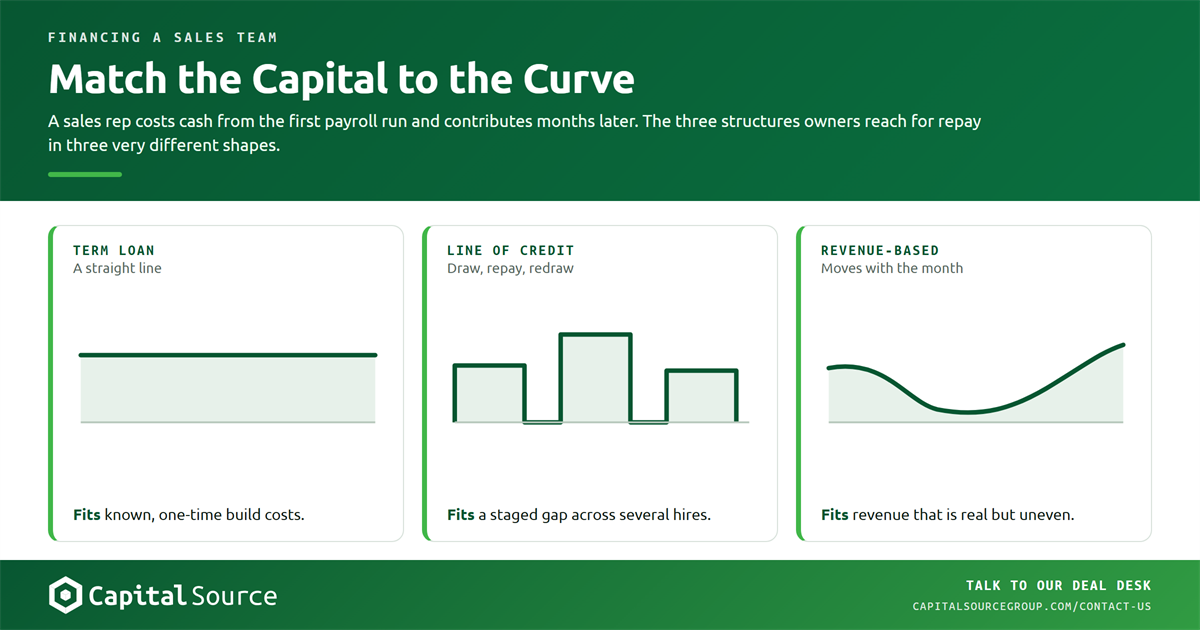
A term loan fits a sales hire when the cost is known, bounded, and one time. A term loan is a fixed amount of capital advanced up front and repaid on a fixed schedule over a set period. That makes it a straight line drawn against a curve: the payment is the same in month two, when the rep is producing nothing, as in month twenty, when the rep is at quota.
Straight lines fund straight costs well: recruiter fees, a CRM implementation, enablement content and training, a sales manager’s first year. Most SBA 7(a) term loans are repaid with monthly principal-and-interest payments from business cash flow, and on fixed-rate loans those payments stay the same, per the U.S. Small Business Administration.
The honest trade-off: a term loan is the least forgiving shape during the ramp and generally the most economical shape once reps are producing. If your trailing cash flow can absorb the payment before the new reps contribute anything, the pricing usually rewards that predictability. If it cannot, a fixed obligation stacked on new payroll compounds the squeeze the hiring created. See our overview of cash flow loans.
When does a business line of credit fit a sales ramp better than a term loan?
A business line of credit fits a sales ramp better than a term loan when the need is staged and recurring rather than bounded and one time. A business line of credit is a revolving facility that a business draws against as needs arise and repays as cash comes in, with interest charged only on the balance drawn. That shape maps onto a hiring gap that repeats: draw during a rep’s ramp, repay as commissions and receivables land, then redraw for rep number six.
The SBA describes lines of credit as the most flexible way for businesses to manage working capital needs, because interest is charged only when the line is in use, on its 7(a) Working Capital Pilot program page. The structural word for what follows is self-liquidating: the borrowing extinguishes itself as the thing it funded converts to cash. A sales ramp behaves that way once the reps produce.
The honest trade-off, plainly: a line renews. It can be reduced, repriced, or not renewed, usually on the strength of the same trailing financials your hiring just depressed. Availability is not permanence. Know your renewal date as well as you know your busiest month, and do not treat undrawn capacity as committed capital. More in our business line of credit overview.
When does revenue-based financing make sense?
Revenue-based financing makes sense when revenue is real but lumpy and a fixed monthly obligation during ramp is the thing most likely to break. Revenue-based financing is a form of sales-based financing in which repayment is calculated as a percentage of revenue rather than as a fixed monthly amount, so the payment falls in a slow month and rises in a strong one. New York Financial Services Law section 801 defines sales-based financing as a transaction repaid as a percentage of sales or revenue, in which the payment amount may increase or decrease according to the volume of sales or revenue received (N.Y. Fin. Serv. Law § 801).
That mechanism is the point. For a distributor with a lumpy order book or a services firm whose collections swing with three large clients, the risk is not the cost of capital in a good year, it is a fixed payment falling due in a bad month while four ramping reps are still consuming cash. Repayment that moves with revenue absorbs some of that variance.
The honest trade-off is predictability. A payment that moves with revenue is harder to forecast than a fixed installment, and a strong month means a larger payment than a fixed schedule would have asked for. That is the exchange: you give up a number you can budget to the dollar in return for one that breathes with the business. Whichever structure you land on, ask for the same two figures in writing, the total dollar amount to be repaid and the estimated annual percentage rate, so you are comparing like for like. New York already requires commercial financing disclosures that include an estimated annual percentage rate, set out in 23 NYCRR 600. Our revenue-based funding page covers where the structure fits.
How do you choose the right structure for financing a sales team?
You choose by matching the repayment shape to the cash curve you are about to create, not by ranking the three products against each other. A ramping sales team is a J-curve: cost from month one, contribution from roughly month six. First ask which shapes your business can carry through the bottom of that curve, then ask which of the survivors is cheapest. Reversing those two questions is how owners end up with the least expensive structure they cannot service in month four.
Most sales builds are not one shape. Bounded build costs and an open-ended ramp gap are different problems, often best served by different instruments layered deliberately rather than by whichever product a business qualified for first.
This is also where underwriting judgment does its work. A single trailing ratio is a thin way to read a business that just invested in its own growth, and reading it that way is how a healthy company gets told no in the very quarters it is spending on a sales team. At Capital Source we design capital around the deal, which means structuring around how your cash actually moves, including the ramp you are funding, rather than around one backward-looking number. Financing is offered through our affiliate, Stretch Finance, LLC, and availability, structure, and terms are subject to review and lender approval. If the real question is debt versus equity, we cover it in Choosing the Right Capital Structure.
Interactive
Match the capital to the curve
A sales hire costs cash from the first payroll run and contributes months later. Pick a structure below to see how its repayment shape sits against that curve.
Shape: a straight line
Fits known, bounded, one-time costs: recruiter fees, a CRM implementation, enablement and training, a sales manager’s first year.
Trade-off. The payment is identical in month two, when the rep produces nothing, and month twenty, when the rep is at quota. Least forgiving during the ramp, and generally the most economical shape once reps are producing.
Shape: draw, repay, redraw
Fits a staged, recurring gap across several hires. Draw during a rep’s ramp, repay as commissions and receivables land, then redraw for the next hire.
Trade-off. Interest applies only to the balance drawn, which is why it suits a repeating need. But a line renews, and it can be reduced, repriced, or not renewed on the strength of the same trailing financials your hiring just depressed. Availability is not permanence.
Shape: flexes with the month
Fits revenue that is real but lumpy, where a fixed monthly obligation during the ramp is the risk you most need to avoid.
Trade-off. Repayment is calculated as a percentage of revenue, so the payment falls in a slow month and rises in a strong one. You trade a payment you can budget to the dollar for one that moves with the business, which makes forecasting harder.
6.2 months
Average B2B SaaS account executive ramp to full productivity, the longest in the publisher’s research history. Read it as evidence that ramp is long and lengthening, then measure your own.
The Bridge Group, State of Sales: 2026 (June 2026)
48%
Median quota attainment in that same B2B SaaS sample. Fewer than half of reps hit quota, and it takes about six months to find out which half you hired.
The Bridge Group, State of Sales: 2026 (June 2026)
30.1%
Benefits as a share of total employer compensation cost for private-industry workers, so the real monthly burn runs well above base salary.
U.S. Bureau of Labor Statistics, Employer Costs for Employee Compensation (March 2026)
The growth trap. Hiring depresses trailing cash flow for two to three quarters, which weakens the debt service coverage ratio that gates the cheapest capital. SBA 7(a) Small Loans require a ratio of at least 1.1 to 1 under SOP 50 10 8, effective March 1, 2026 (Starfield & Smith). A backward-looking ratio sees the payroll, not the pipeline.
Capital Source
Structure the capital before you sign the offer letters
Tell us what the next hires cost and when you expect them to contribute. Our Deal Desk will help you think through which repayment shape fits your curve.
Key takeaways
- A sales hire is a J-curve, not a line item. Cost starts at the first payroll run and contribution starts months later, so the question is repayment shape, not product labels.
- Ramp is long and getting longer. Average B2B SaaS account executive ramp reached 6.2 months (The Bridge Group, June 2026), and carrying cost runs well above base salary, with benefits at 30.1% of employer compensation cost (BLS, March 2026).
- Growth investment degrades the metric that gates cheap capital. Hiring depresses trailing cash flow for two to three quarters, weakening DSCR, and SBA 7(a) Small Loans require at least 1.1 to 1 under SOP 50 10 8.
- Match the instrument to the cost. Term loans suit bounded one-time build costs, a line of credit suits a staged and recurring ramp gap, and revenue-based financing suits uneven revenue.
- Compare every structure on the same two numbers. Ask any funder for the total dollar amount to be repaid and the estimated APR in writing, so you are comparing like for like.
Frequently asked questions
How do businesses finance hiring a sales team?
Businesses generally fund a sales build with one of three structures: a term loan, a business line of credit, or revenue-based financing. A term loan advances a fixed amount repaid on a fixed schedule, which suits known, one-time costs such as recruiting fees and a CRM implementation. A line of credit revolves, so it can be drawn during a rep’s ramp and repaid as commissions and receivables land. Revenue-based financing repays as a percentage of revenue, so the payment moves with the month.
Is revenue-based financing a good way to fund sales hires?
Revenue-based financing can fit a sales build when revenue is real but uneven and a fixed monthly payment during ramp is the risk you most need to avoid, because repayment is calculated as a percentage of revenue rather than as a fixed amount. The trade-off is predictability: a payment that moves with revenue is harder to forecast, and a strong month means a larger payment. Whichever structure you choose, ask for the total dollar amount to be repaid and the estimated annual percentage rate in writing so you can compare like for like.
Why do lenders look at DSCR when I want to grow?
Lenders use the debt service coverage ratio because it tests whether cash flow the business has already produced can cover total debt service, including the payments on the loan being requested. Hiring salespeople depresses that trailing cash flow for two or three quarters before the revenue arrives, so a growth investment can weaken the exact metric that gates the cheapest capital. SBA 7(a) Small Loans require a debt service coverage ratio of at least 1.1 to 1 under SOP 50 10 8, effective March 1, 2026, measured on historical and/or projected cash flow.
Should I use a line of credit or a term loan for payroll during a sales ramp?
A line of credit is usually the closer structural match for payroll during a sales ramp, because the need is staged and recurring and the facility can be drawn and repaid as cash lands, with interest charged only on the balance drawn. A term loan fits the bounded, one-time pieces of a sales build better, such as recruiting fees, a CRM implementation, and training. The caution on a line is renewal: it can be reduced, repriced, or not renewed, so availability is not permanence.
Sources
- The Bridge Group, State of Sales: 2026 AE Models, Motions & Metrics (n=158, published June 2026).
- U.S. Bureau of Labor Statistics, Employer Costs for Employee Compensation (reference period March 2026, released June 12, 2026).
- Starfield & Smith, Best Practices: SOP 50 10 8 Update, New 7(a) Small Loan Underwriting Requirements.
- Federal Reserve Banks, 2026 Report on Employer Firms: Findings from the 2025 Small Business Credit Survey (published March 2026).
- U.S. Small Business Administration, Types of 7(a) loans.
- U.S. Small Business Administration, 7(a) Working Capital Pilot Program.
- New York State Senate, Financial Services Law § 801 (definitions, sales-based financing).
- New York State Department of Financial Services, 23 NYCRR 600, Commercial Financing Disclosures.
This article is for informational and educational purposes only and does not constitute financial, investment, accounting, tax, or legal advice. The concepts discussed are general in nature and should be reviewed with qualified professionals based on your specific circumstances. Capital Source provides access to commercial financing solutions through its affiliates, syndicates, network of banks, lending partners, and private credit funds/groups. Availability, approval, funding amount, structure, and terms are subject to business review, underwriting, and lender approval.