
For Factoring Partners
Your best client just got capped. Not because the credit turned, but because the formula did its job. Here is the arithmetic behind the gap that opens above a factoring facility, why it widens exactly when a client is winning, and how a junior capital partner can fund it without touching your first position.
Every factor knows the conversation. The client is performing, the account debtors pay, the aging looks clean, and the client still calls asking for more than the facility can deliver. Nothing has gone wrong. The borrowing base is doing precisely what it was designed to do, and the result is a real funding need sitting just above it.
What happens next is the part that matters to your book. The client either goes without the capital, goes somewhere else, or goes somewhere worse. This article walks the mechanics of that gap the way an underwriter would, then makes the case that referring it to a documented junior partner is a collateral-protection decision before it is a business-development one.
Why does a strong client still hit a ceiling on a factoring line?
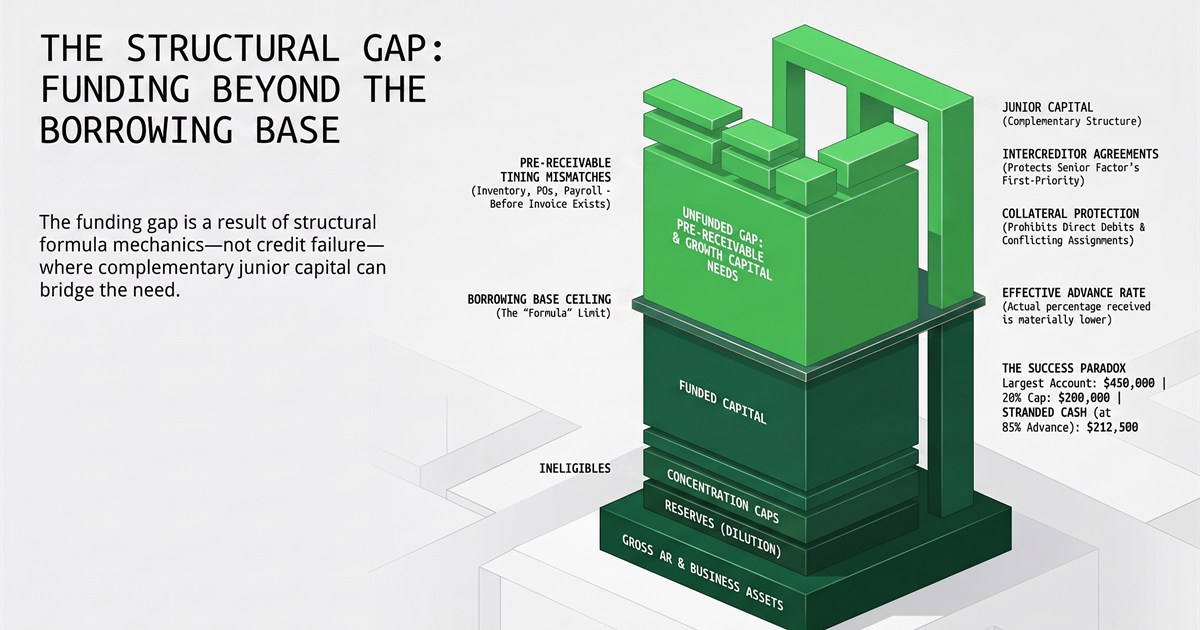
A client hits the ceiling because availability is calculated from a reduced pool, not from gross receivables. Gross accounts receivable are cut down by ineligibility rules, then capped by concentration limits, then further reduced by reserves, and only what survives that sequence gets multiplied by the advance rate. The number the client remembers is the advance rate. The number the client receives is the product of every haircut that came before it.
A borrowing base is the adjusted value of a borrower’s eligible collateral that a lender will extend credit against, calculated by reducing gross accounts receivable to eligible accounts and then applying an advance rate. Corporate Finance Institute describes it as the adjusted value of eligible collateral before a discount factor is applied to set the credit limit.
On advance rates themselves, the Office of the Comptroller of the Currency’s Accounts Receivable and Inventory Financing booklet (March 2000, still a current Comptroller’s Handbook title) indicates that banks usually advance between 70 percent and 80 percent of eligible receivables, and that advance rates should account for dilution trends, diversification, and the overall quality of the borrower’s customer base. Non-bank factoring commonly runs higher than the bank band, though that upper end is general market practice rather than a published figure.
The gap between the stated rate and the delivered cash has a name worth using with clients: the effective advance rate is the percentage of gross accounts receivable a company actually receives, which is materially lower than the stated advance rate because ineligibles, concentration caps, and dilution reserves are all subtracted before the advance rate is ever applied.
What is a concentration limit, and why does it strand collectible receivables?
A concentration limit is a cap on how much of a borrowing base may come from a single account debtor, and it renders otherwise collectible receivables ineligible once one customer exceeds the cap. It is a portfolio-construction rule, not a credit judgment about the invoice. The receivable can be perfect and still be excluded.
The OCC’s booklet gives two distinct numbers here, and it is worth keeping them apart. Lenders normally treat receivables as concentrated where single accounts represent 10 percent or more of the total receivables portfolio. Separately, the booklet indicates that lenders extending credit to borrowers with a concentrated customer base should limit concentrated accounts to no more than 10 to 20 percent of the receivables borrowing base. The first figure identifies a concentration. The second is the cap. Non-bank factoring frequently sets caps above that band, sometimes with carve-outs for investment-grade or credit-insured names, though that is market practice rather than published guidance. Writing in ABF Journal, collateral field examiner Neha Malhotra illustrates the mechanic with a 20 percent per-customer cap, on the rationale that it limits over-reliance on one buyer and protects the pool if that buyer is lost.
Here is the part that makes this the sharpest problem in your book. The cap binds hardest on your best clients. Consider an illustrative case, using hypothetical figures rather than any actual facility:
| Illustrative concentration test | Amount |
|---|---|
| Eligible receivables pool | $1,000,000 |
| Largest account debtor (a national retailer that pays reliably) | $450,000 |
| Concentration cap at 20 percent of the pool | $200,000 |
| Excess treated as ineligible | $250,000 |
| Cash withheld at an 85 percent advance rate, on invoices expected to pay in full | $212,500 |
In that illustration, the stranded balance is not a credit problem. It sits with the most creditworthy name in the book, and it is stranded precisely because the client succeeded at selling to a large account.
There is a second-order effect that compounds it. As the anchor customer grows, the whole pool grows, so the dollar cap rises too. It rarely rises fast enough. A client moving from 45 percent to 60 percent concentration generates excess faster than it generates availability, which means the better the growth story, the more capital the formula withholds.
Which receivables go ineligible, and what does that remove?
Ineligibility rules remove categories of receivables that carry collection, perfection, or offset risk, regardless of whether the specific invoice is sound. Each rule below exists for a defensible reason. Together they can take a meaningful bite out of a pool before the concentration test even runs.
| Category | Why it is excluded |
|---|---|
| Aged and past due | Commonly 90 days from invoice or 60 days past the due date, per ABF Journal, which notes the threshold often tracks roughly three times standard payment terms. |
| Cross-aged, or tainted, balances | Once a set share of one debtor’s balance goes past due, the entire balance for that debtor comes out. ABF Journal illustrates a 20 percent trigger. |
| Contra accounts | Where the customer is also a vendor, the ineligible is the lower of the payable or the eligible receivable, because the counterparty will offset in a liquidation. |
| Government receivables | Perfection runs through the Assignment of Claims Act rather than an ordinary UCC filing, with strict notice requirements and longer payment cycles. |
| Foreign account debtors | U.S. filings and remedies are not reliably enforceable abroad, as ABF Journal notes. |
| Intercompany and affiliate | Conflict of interest and collectability risk. |
| Consignment and bill-and-hold | Title or delivery has not passed, so the account is not earned in the ordinary course. |
| Disputed balances and credit memos | Subject to offsets and defenses, which cuts against the eligibility standard itself. |
Government receivables deserve a note, because they are the category factors most often exclude outright and the one a specialist can most often solve. Under 41 U.S.C. 6305, a contractor may not transfer a federal contract or any interest in it, and a purported transfer in violation of that rule annuls the contract as far as the Government is concerned. The statute then carves out an exception allowing amounts due to be assigned to a bank, trust company, federal lending agency, or other financing institution. 31 U.S.C. 3727 sets the conditions, including that the assignment cover the entire unpaid amount to a single party, that it not be reassigned, and that written notice be filed with the contracting official, the agency head, the surety, and the disbursing official.
Worth knowing, and worth not overstating: UCC 9-406 makes most contractual anti-assignment terms ineffective as to accounts, and subsection (f) reaches rules of law and regulations as well. It does not override the federal Assignment of Claims Act. State law does not displace the federal statute here.
How does dilution reduce availability after the fact?
Dilution reduces availability by shrinking the collateral value the advance rate is applied to, and it does so on a lag. Dilution is the reduction of accounts receivable by non-cash credits such as returns, allowances, disputes, discounts, and credit memos. The OCC’s Accounts Receivable and Inventory Financing booklet describes dilution risk as the possibility that non-cash credits will reduce the receivable balance, and its Asset-Based Lending booklet treats reserves as deductions from collateral value that account for liquidation costs, possible dilution, obsolescence, and other collectability factors.
Two features make this a common source of gap. First, the reserve is applied after ineligibles and concentration have already reduced the pool, so it is a haircut on an already-reduced base. Second, dilution is measured on trailing performance. A client that fixed its returns process this quarter still carries a trailing-twelve-month figure. That lag is a legitimate, non-credit reason a good client is under-funded today, and it is exactly the kind of gap that resolves itself over time if the client can bridge it.
Why is an over-advance usually the wrong tool for this gap?
An over-advance is the wrong tool because it moves the gap onto the factor’s own balance sheet at senior-collateral pricing, and it changes the character of the facility. An over-advance is a loan advance that increases the loan balance beyond the amount supported by the borrowing base, which means it is repaid from operating cash flow rather than from collateral.
The OCC’s guidance is direct on the point. Its Asset-Based Lending booklet (January 2017) indicates that reliance on illiquid borrowing base collateral or over-advances should be limited, and that over-advances are typically repaid from operating cash flow. The Accounts Receivable and Inventory Financing booklet adds a caution that a borrower needing to term out an over-advance often has serious financial problems, and that a lender should not use term debt to defer recognizing a problem.
There is also a practical constraint that rarely gets said out loud. Most non-bank factors fund themselves on a bank facility with its own borrowing base and its own eligibility rules. A receivable that is ineligible in your client’s base is frequently ineligible in yours too, which means the money to fund the gap is not actually available to lend, whatever your appetite.
The structural point. An over-advance asks a receivables facility to behave like a cash-flow loan. A junior facility behind you puts the same dollars on a different balance sheet, priced for the risk they actually carry, with your first position untouched and your monitoring cadence unchanged.
Run the analysis on your own capped client
Everything above is a sequence you can apply to a live file. The prompt below walks a general-purpose AI assistant through it in order: build the base, find the effective advance rate, separate the formula gap from the credit gap, isolate what is pre-receivable, and land on fund, over-advance, or refer. It is built to argue with you rather than agree with you.
A note on inputs: use anonymized figures. Client identifiers, tax IDs, and account numbers do not belong in a general-purpose AI tool, and nothing in this exercise needs them.
What does a factoring facility structurally not cover?
A factoring facility cannot reach needs that arise before a receivable exists, because factoring is a post-receivable product by definition. Corporate Finance Institute draws the line cleanly: receivables factoring is post-receivable financing, as distinct from purchase order financing, which is pre-receivable. None of the following is a shortcoming of the facility. Each is a timing mismatch between when the client spends and when the invoice exists.
What happens when the client closes the gap alone?
When a client closes the gap alone, it often does so with a merchant cash advance, and that structure attacks the factor’s position in ways a subordinate lien never could on paper. Stacking is a business taking on additional advances, typically merchant cash advances repaid by daily or weekly debits of its operating account, on top of an existing senior facility, without the senior lender’s knowledge or an intercreditor agreement.
The clients are already shopping. In the Federal Reserve’s 2026 Report on Employer Firms, the share of applicants seeking financing at online fintech lenders rose from 17 percent in the 2020 survey to 29 percent in the 2025 survey, an increase across the last five surveys. That population is wider than merchant cash advance users, so read it as a measure of where clients now look first rather than a count of stacked advances. The same report found that 60 percent of firms borrowing from online lenders said their actual borrowing costs were higher than expected, against 32 percent at large banks.
60 percent of firms that borrowed from online lenders reported borrowing costs higher than expected, nearly double the 32 percent who said so at large banks. Source: Federal Reserve Banks, 2026 Report on Employer Firms (2025 Small Business Credit Survey).
Two mechanics do the damage, and neither of them waits for a priority dispute to be resolved.
Cash interception. Writing in the International Factoring Association’s Commercial Factor, Robert DiNozzi and Harvey Gross describe how merchant cash advance providers take direct access to business operating accounts, allowing them to sweep cash from a subordinate position without court approval. Priority is not self-executing. The money leaves before anyone litigates.
Account debtor confusion. The same providers issue UCC 9-406 assignment notices telling your client’s customers to redirect payment. Reporting in ABF Journal, practitioners describe what actually happens: Aaron Todrin of Second Wind Consultants observes that most account debtors do not redirect payment, they pause, and that the notice operates as a mechanism leveraging confusion to exert pressure rather than a legitimate enforcement of rights. Michael Petrecca of Rise Alliance notes that these notices often follow payment defaults and compound the pressure by interfering with incoming cash flow. Annette Jarvis of Greenberg Traurig points out that account debtors have a right under UCC 9-406(c) to request reasonable proof of the assignment before complying.
Follow that through your own borrowing base. A paused invoice ages. An aged invoice becomes ineligible. Cross-aging can then pull the rest of that debtor’s balance out with it. Availability falls at the exact moment the client most needs it, which is how a stacked advance converts a liquidity problem into a borrowing base collapse. The Federal Trade Commission has brought enforcement actions in this market, including a permanent industry ban against a merchant cash advance operator for deceiving small businesses and seizing assets, and earlier bans with redress for small businesses.
How does junior capital sit behind a factoring facility?
Junior capital sits behind a factoring facility by contract, on a foundation the Uniform Commercial Code supplies directly. UCC 9-322(a)(1) ranks conflicting perfected security interests according to priority in time of filing or perfection. UCC 9-339 then provides that Article 9 does not preclude subordination by agreement by a person entitled to priority. Those two sections are the whole architecture: 9-322 sets the default order, and 9-339 lets the parties document something different on purpose.
Junior debt is financing that sits behind a senior facility in repayment priority, giving a borrower added capital without disturbing the senior lender’s first position. Subordinated debt, often called sub debt, is debt whose claim on collateral and repayment ranks below the senior facility, so the senior lender stays protected.
For the factor-specific playbook, Jim Cretella of Otterbourg P.C. has written the clearest treatment we have seen, in the IFA’s Commercial Factor: Intercreditor Agreements Between Factors and Inventory Lenders. It identifies the central problem precisely, that the sale of inventory on terms gives rise to an account receivable, so the junior lender’s collateral transforms into the factor’s collateral. It describes the buyout mechanic that resolves it, and notes that most intercreditor agreements grant the factor the exclusive right to collect all receivables, with a turnover obligation, specifically to prevent conflicting communications to account debtors.
What a factor should insist on
- Express acknowledgment of your first-priority perfected interest in accounts and proceeds.
- Exclusive collection rights and sole contact with account debtors, with mandatory turnover of any misdirected collections.
- A prohibition on the junior lender sending UCC 9-406 notices to account debtors while your facility is outstanding.
- Payment blockage on the junior facility during a default or covenant breach under your agreement.
- A standstill period before any junior enforcement against shared collateral, typically running several months.
- No direct debits of the client’s operating accounts by the junior lender, which is the specific mechanism that makes stacked advances destructive.
- A buyout or purchase option in your favor, with a negotiated cap, so you can take out the junior position rather than be pulled into a workout you do not control.
- Access, notice, and cure rights, plus agreed handling of DIP financing, cash collateral, and Section 363 sales.
The comparison that matters. Both outcomes put a second party into your client’s capital structure. One of them signs an intercreditor agreement that acknowledges your first position, gives you exclusive collection rights, blocks payment during your default, imposes a standstill, and forecloses 9-406 notices.
The other signs nothing, debits the operating account daily, and mails assignment notices to your account debtors. The choice is not outside capital or no outside capital. It is documented junior capital or undocumented cash interception.
Where Capital Source fits behind your facility
We are a junior capital partner built to sit behind senior facilities, not to compete with them. Capital Source is the brand of Capital Source Group, LLC, a commercial finance firm headquartered in Chicago, funding businesses since 2015 with over $500 million in active funding programs. Financing is offered through our affiliate, Stretch Finance, LLC. Stretch Financing is capital structured to bridge the gap between what a senior facility covers and what the client actually needs, layered behind the senior position.
We have completed more than 700 transactions alongside senior lenders and factoring companies, and we have partnered with factors since 2015. We welcome intercreditor agreements and expect to negotiate the terms listed above. What we can look at is conditional in every case: availability, structure, and terms depend on the client, the collateral, and underwriting review, and nothing here is a commitment to fund, a rate, or a timeline.
More detail on how the partnership works, including what you can expect from us on timing and client contact, is on our factoring firm partnerships page. If you want the borrower-side view of the same mechanics, our guides on factoring rates and advance rates and building a supportable borrowing base cover it in depth.
Send us the deal before you pass on it
Tell us where the need extends past the facility and we will come back to you with a clear yes or no. You keep the client, the first position, and the economics of your facility.
Refer a deal
Tell us about the client and where the need extends beyond the factoring line. A representative will review and reach out to discuss whether we can structure something behind your facility.
Prefer to talk it through first? Talk to Our Deal Desk. Looking for funding for your own business instead? Apply here.
Key takeaways
- The gap is arithmetic, not credit. Ineligibles, concentration caps, and dilution reserves all reduce the pool before the advance rate is applied, so the effective advance rate on gross receivables lands well below the stated one.
- Concentration caps punish success. The excess is stranded on the most creditworthy debtor in the book, and it grows faster than availability as that customer grows.
- Some needs are pre-receivable. Inventory, purchase orders, equipment, payroll timing, and seasonal ramp all arrive before an invoice exists, which is outside what a receivables product was built to do.
- An over-advance moves the gap onto your balance sheet. The OCC’s guidance points at limiting reliance on them, and your own funding facility may not permit it regardless of appetite.
- Undocumented capital is the real threat. Daily operating account debits and UCC 9-406 notices can freeze payments, age invoices, and trigger cross-aging, collapsing availability exactly when the client needs it.
- An intercreditor agreement is the whole difference. UCC 9-339 lets you document first position, exclusive collections, payment blockage, a standstill, and a buyout option before anyone funds a dollar.
Frequently asked questions
Why can a factoring facility not fund everything a good client needs?
Because availability is calculated from a reduced pool rather than gross receivables. Ineligibility rules, concentration caps, and dilution reserves all cut the collateral base before the advance rate is applied, so the cash a client actually receives is well below the stated advance rate. Separately, needs like inventory, purchase orders, and payroll timing arise before a receivable exists, which is outside what a receivables product covers.
What is a concentration limit and why does it make good receivables ineligible?
A concentration limit is a cap on how much of a borrowing base may come from a single account debtor, and it renders otherwise collectible receivables ineligible once one customer exceeds the cap. It is a portfolio rule, not a judgment about the invoice, so the excess is often stranded on the strongest paying customer in the book. The OCC’s Accounts Receivable and Inventory Financing booklet indicates that lenders should limit concentrated accounts to no more than 10 to 20 percent of the receivables borrowing base.
Should a factor just extend an over-advance instead of referring the gap?
An over-advance puts the gap on the factor’s own balance sheet and is repaid from operating cash flow rather than collateral, which changes the character of the facility. The OCC’s Asset-Based Lending booklet indicates that reliance on over-advances should be limited, and cautions against using term debt to defer recognizing a problem. A junior facility behind the factor places the same dollars on a different balance sheet while leaving first position intact.
What should a factor require in an intercreditor agreement with a junior lender?
At minimum: express acknowledgment of the factor’s first-priority perfected interest, exclusive collection rights and sole contact with account debtors, a prohibition on the junior lender sending UCC 9-406 notices, payment blockage during a senior default, a standstill before junior enforcement, no direct debits of the client’s operating accounts, and a buyout option in the factor’s favor. UCC 9-339 expressly permits subordination by agreement by a party entitled to priority.
Will Capital Source approach our client directly or compete for the facility?
No. We structure behind the senior position with deference to lien priority and facility terms, and we welcome intercreditor agreements. The factor keeps the relationship, the first position, and the economics of the facility. We have completed more than 700 transactions alongside senior lenders and factoring companies on that basis.
Sources
- Office of the Comptroller of the Currency, Comptroller’s Handbook: Accounts Receivable and Inventory Financing (March 2000, current booklet).
- Office of the Comptroller of the Currency, Comptroller’s Handbook: Asset-Based Lending (January 2017).
- Neha Malhotra, Understanding the Concept and Rationale of Standard Accounts Receivable Ineligibles, ABF Journal (December 18, 2023).
- Jim Cretella, Otterbourg P.C., Intercreditor Agreements Between Factors and Inventory Lenders: From Conflict to Cooperation, IFA Commercial Factor (Q4 2024).
- Robert DiNozzi and Harvey Gross, MCAs Are Back: Protect Collateral and Lending Relationships with UCC Article 9, IFA Commercial Factor (October 27, 2021).
- ABF Journal, UCC 9-406 Notices in the MCA Market: When Payment Must Be Redirected by Account Debtors.
- Federal Reserve Banks, 2026 Report on Employer Firms (2025 Small Business Credit Survey, published March 2026).
- Legal Information Institute, Cornell Law School, UCC 9-322, UCC 9-339, and UCC 9-406.
- Legal Information Institute, Cornell Law School, 31 U.S.C. 3727 and 41 U.S.C. 6305.
- Secured Finance Network, What Is Secured Finance.
- U.S. Small Business Administration, Types of 7(a) Loans (CAPLines).
- Corporate Finance Institute, Borrowing Base and Accounts Receivable Factoring.
- Federal Trade Commission, FTC Case Leads to Permanent Ban Against Merchant Cash Advance Owner (October 2023) and Merchant Cash Advance Providers Banned From Industry (January 2022).
This article is for informational and educational purposes only and does not constitute financial, investment, accounting, tax, or legal advice, and nothing here is a legal opinion on intercreditor or subordination documentation. The concepts discussed are general in nature and should be reviewed with qualified professionals based on your specific circumstances. Borrowing base figures shown are illustrative and hypothetical, used to demonstrate standard mechanics, and are not drawn from any actual facility. Advance rate and concentration ranges described as general practice are not published standards and are not a Capital Source or Stretch Finance offer. Capital Source provides access to commercial financing solutions through its affiliates, syndicates, network of banks, lending partners, and private credit funds/groups. Availability, approval, funding amount, structure, and terms are subject to business review, underwriting, and lender approval. The prompt provided in this article is a general analytical aid, not underwriting guidance, and any output it produces should be reviewed by qualified professionals against your own credit policy.
Leave a Reply