
The Selection Criterion as the True Entry Ticket
Why collateral, revenue durability, and useful life decide access to capital before profitability does.
Three articles, one correction. Across the three articles in Series One, the real issue was never whether the business was profitable. It was what each financing instrument actually underwrites. Asset-based lending selects for the collateral base. Revenue-based financing selects for the durability of the revenue. Equipment financing selects for the asset and its useful life. Three instruments, three criteria, and the income statement is the criterion for none of them.
The Selection Criterion is the property a capital instrument actually underwrites and advances against. It is the financing fact that governs access to that instrument before broader business health, profitability, or income-statement appearance can be read as the decision criterion.
Key points
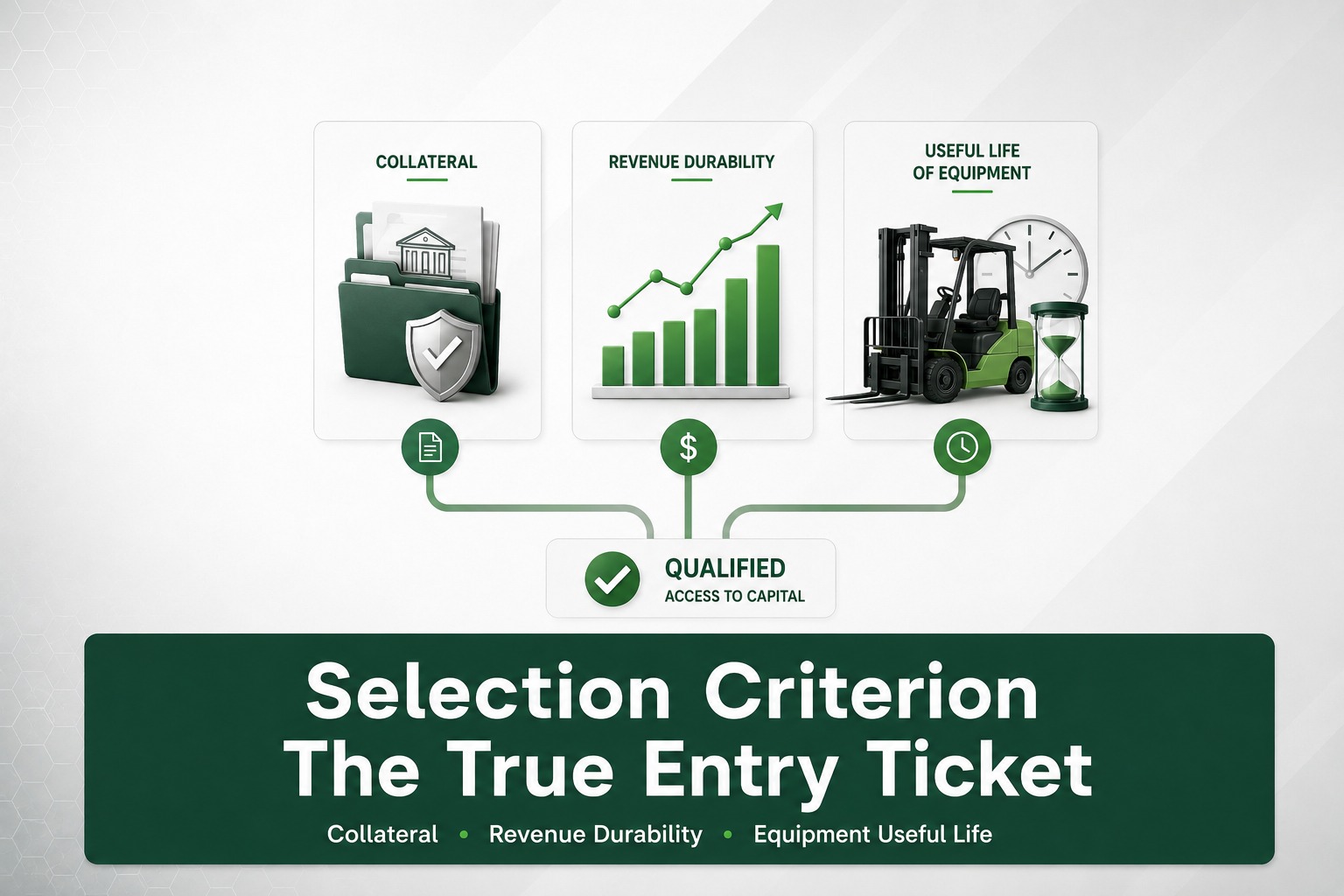
Each instrument has a Selection Criterion, the specific property it underwrites and advances against. For asset-based lending, it is the Collateral Selection Criterion: the eligible collateral base and the working-capital cycle that converts it. For revenue-based financing, it is the Revenue Durability Criterion: the stability and recurrence of the revenue that services the payment. For equipment financing, it is the Useful Life Coverage Criterion: the value of the asset over the life it has left against the term. Read in order, the three entry tickets are the collateral base, revenue durability, and useful life coverage.
Each article made the same move in a different register: state the diagnostic case, name the property the instrument actually underwrites, and show how reading the income statement instead produces the wrong decision. The criteria differ. The discipline behind them is one.
Series synthesis
The single point of the series is that the Selection Criterion, not profitability, is the true entry ticket for each instrument. The market reaches for the income statement since it is the most visible document, and in doing so commits the Income Statement Misread, reading profit or loss as the verdict on whether a business can borrow. But profitability is the criterion for none of the three instruments examined here. A loss-making business with clean, controlled collateral clears the collateral criterion. A thin-margin business with durable, recurring revenue clears the durability criterion. A weaker enterprise on a strong, long-lived asset clears the useful-life criterion. In each case, the entry ticket is the property the instrument actually underwrites, and reading the income statement instead is reading the wrong document.
What unifies the three is not that profitability is irrelevant. It is that profitability is not the property any of these instruments is repaid from. Asset-based lending is repaid from collateral conversion, revenue-based financing from the revenue stream, and equipment financing from the asset. The entry ticket in each case is the property that produces the repayment, and the income statement reports something else. Reading it as the criterion is not a small calibration error. It is reading the wrong document for the decision at hand.
Profitability is one fact about a business. It is rarely the fact a given instrument underwrites.
The Selection Criterion is the entry ticket. The income statement is not.
A market that underwrites on the income statement will decline fundable businesses and approve unfit ones in the same motion, since it is reading a document that does not describe what any of these instruments is repaid from.
Reading the criterion instead is not a softer standard. It is a more exact one. It aims the decision at the property that actually governs repayment, which is the only standard that reliably separates the fundable from the unfit.
What the series does not close
Series One establishes what each instrument selects for. It does not address what the existence of such a facility signals. If a facility is underwritten on collateral, revenue durability, or an asset rather than on borrower health, then the presence of that facility cannot, on its own, prove the borrower is healthy. So a question opens that this series does not answer. If these facilities do not prove borrower health, what does their existence actually signal? That is the subject of Series Two.
That question is not rhetorical. A facility underwritten on collateral, durability, or an asset is real evidence of something, just not of borrower health. Working out what it is evidence of, what the mere existence of a facility actually tells a reader, is the work of the next series. Series One clears the ground by removing the wrong reading. Series Two builds on it by correcting what the right reading reveals.
Read Past the Income Statement
If your capital was decided on last year’s profit, it was decided on a document the instrument does not underwrite.
Request Capital Source review of the criterion that actually governs your borrowing.
Capital Source reads the property each instrument is repaid from: the collateral base and cycle, the durability of the revenue, or the asset and its useful life. Then it sizes capital to the criterion that governs the instrument rather than to the income statement.
Most lenders read financials. Capital Source reads control.
Frequently asked questions
What is the Selection Criterion?
It is the specific property an instrument actually underwrites and advances against. Each instrument has one, and it is rarely profitability. Asset-based lending selects for the collateral base, revenue-based financing for revenue durability, and equipment financing for the asset and its useful life.
Why is profitability not the entry ticket for these instruments?
None of these instruments is repaid from profit. Asset-based lending is repaid from collateral conversion, revenue-based financing from the revenue stream, and equipment financing from the asset behind it. The entry ticket is the property the instrument is repaid from, which is the Selection Criterion, not the income statement.
What are the three entry tickets established in this series?
The collateral base for asset-based lending, revenue durability for revenue-based financing, and useful life coverage for equipment financing. Each is the property its instrument selects for, and profitability is none of them.
Strategic disclosure
Capital Source structures and arranges capital for small and lower middle market businesses, including asset-based lending, purchase order, accounts receivable, revenue-based, and equipment financing. The analytical framework described here is the framework Capital Source applies to read credit and to size and govern those structures. This article is analysis, not a financing commitment, and any structure depends on the specific facts of the business.
Proud to be ranked on the 2024 and 2025 Inc. 5000 list of America’s fastest-growing private companies.
Leave a Reply