
The CFO’s Four C’s of Capital: Sourcing, Allocation, Reporting, and Management
The CFO’s job, at its core, is the stewardship of capital across four linked functions: where it comes from, where it goes, whether it is working, and whether it stays healthy. Get the framework right and every dollar that enters or leaves the business has a job, a return to beat, and a place to land.
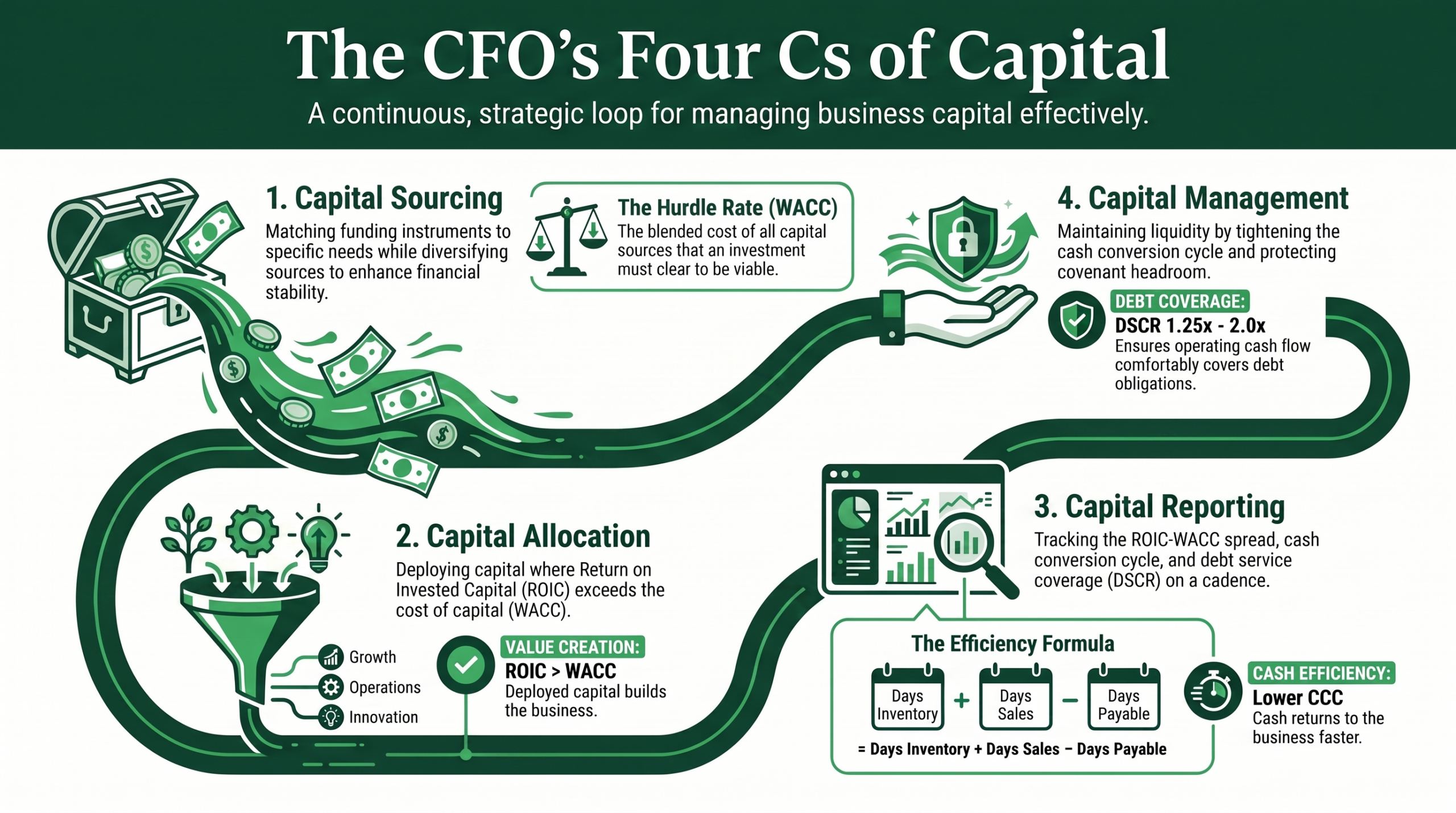
The CFO’s job, at its core, is the stewardship of capital across four linked functions: sourcing it (where funding comes from), allocating it (deploying it for the highest risk-adjusted return), reporting on it (the metrics that show whether it is working), and managing it (keeping liquidity and the cash cycle healthy). This “Four C’s” framing of the capital remit comes from finance educator Oana Labes, and it maps cleanly onto how a growth-stage operator should think about every dollar that enters and leaves the business. The four functions are not separate departments. They are one loop: you raise capital, you put it to work, you measure whether it earned its keep, and you keep enough liquidity to do it all again.
What makes this CFO capital management framework useful is that it scales. A large company spreads these four functions across treasury, FP&A, controllers, and a corporate development team. A lower-middle-market business compresses all four onto the owner or a fractional CFO. The math is the same at both ends. This guide walks each C, the few numbers that actually run it, and where a flexible capital partner plugs in when there is no full finance bench to lean on.
One quick disclaimer for the finance nerds in the room: these are not to be confused with the four C’s of lending, the ones a credit officer uses to size you up. Those four get run on you. The four below are the ones you run on yourself, ideally well before anyone else does.
Why has the CFO role expanded toward capital strategy?
The CFO role has expanded from recording capital to strategically directing it, taking on more of the business and more decisions about where money goes. The number of functional areas reporting to the CFO rose from roughly 4.5 in 2016 to about 6.2 in 2018, according to McKinsey, a sign that the seat now owns territory well beyond the ledger. The modern finance leader is expected to shape strategy, not just report on it.
That shift shows up in how CFOs describe their own value. Roughly four in ten CFOs told McKinsey they created the most value through strategic leadership and performance management rather than through traditional finance tasks. McKinsey also frames capital allocation as a core CFO discipline: the discipline of shifting capital across business units over time as opportunities change, rather than anchoring each year’s spend to last year’s budget. For an owner-operator, the lesson is the same even without the title. Treating capital as something you actively steward, rather than something you simply track, is the difference between finance as a scoreboard and finance as a strategy.
Capital Sourcing: where should your funding come from?
Capital sourcing is the function of deciding where funding comes from and matching each instrument to the use it is meant to serve. The capital stack runs from internal cash flow to debt, to equity, to hybrid and alternative instruments, and each carries a different cost and a different set of obligations. The discipline is to match the instrument to the need: short-term working capital deserves a short-term, flexible structure, while a long-term growth investment can carry longer-term capital.
The other half of sourcing is not relying on a single tap. Oana Labes advises operators to “diversify sources: mix equity, debt, and alternative instruments to enhance financial stability,” and to build a diverse funder base so the business is not exposed when one channel tightens. A founder who funds everything from one bank line learns the limit of that approach the first time the line gets capped. A diversified base means the next dollar can come from the source that fits the use, instead of the only source available.
Sourcing also has a price, and that price has a name. WACC, the weighted average cost of capital, is the blended cost of all of a company’s capital sources, weighted by each source’s share of the total. It is, as the Corporate Finance Institute describes, commonly used as the hurdle rate that a new investment must clear to be worth funding. In other words, the cost of your capital sets the bar that your uses of capital have to beat.
WACC = the blended cost of all capital sources (debt and equity), weighted by each source’s share of the total. It is commonly used as the hurdle rate an investment must clear. Source: Corporate Finance Institute, WACC.
This is where we plug in at the first C. At Capital Source, we help structure the right instrument rather than pushing a single product, and financing is offered through our affiliate, Stretch Finance. The point is to add a source that fits the use, designed around your cash flow rather than forced into a fixed template. For referral partners and fractional CFOs, that is often the value of a capital partnership: another well-fit line in the client’s stack.
Capital Allocation: how do you deploy capital for the highest return?
Capital allocation is the function of deploying capital for the highest risk-adjusted return, and the test for whether it worked is whether the return beats the cost. The cleanest version of that test compares two numbers: return on invested capital against the weighted average cost of capital. ROIC, return on invested capital, is a profitability or performance measure of the return earned by those who provide a company’s capital, per the Corporate Finance Institute.
The rule of thumb is short enough to keep on a sticky note. When ROIC is greater than WACC, the deployed capital creates value; when ROIC is less than WACC, it destroys value, according to the Corporate Finance Institute. Every allocation decision can be read through that lens: an order you finance, a piece of equipment you buy, a market you enter. If the return on that use clears the cost of the capital funding it, the decision builds the business. If it does not, it quietly drains it.
ROIC > WACC creates value; ROIC < WACC destroys value. Return on invested capital measures the return earned by those who provide capital; the weighted average cost of capital is what that capital costs. Source: Corporate Finance Institute, ROIC.
The classic menu of uses is well established: reinvest in the business (capex, research, expansion), pursue strategic acquisitions, pay down debt, or return capital to owners. Harvard Business School Online and McKinsey both treat disciplined allocation across these options as a core driver of long-term value. We have written a fuller breakdown of these choices in The 5 Smartest Uses of Cash, so rather than repeat it here, the takeaway is this: when capital is structured around a specific return-generating use, an order to fill, an expansion to fund, an acquisition to close, the structure itself supports keeping ROIC above WACC. That is the allocation case for flexible capital: it is deployed against a return, not against a budget line.
Capital Reporting: how do you know whether your capital is working?
Capital reporting is the function of measuring, on a regular cadence, whether the capital you sourced and allocated is actually earning above its cost. It is the feedback loop that closes the system: without it, sourcing and allocation are guesses. A small set of metrics, tracked consistently, tells you whether the loop is working.
The first metric is the one from the allocation test: the spread between ROIC and WACC, which shows whether the business is creating or destroying value over time, per the Corporate Finance Institute. The second is the cash conversion cycle. The cash conversion cycle (CCC) is the time it takes to convert investments in inventory and other resources back into cash, calculated as days inventory outstanding plus days sales outstanding minus days payable outstanding (DIO + DSO − DPO). A lower number is more efficient, because it means cash spends less time tied up before it returns, as the Corporate Finance Institute explains.
Cash Conversion Cycle = DIO + DSO − DPO (days inventory outstanding + days sales outstanding − days payable outstanding). A lower CCC means cash returns to the business faster. Source: Corporate Finance Institute, Cash Conversion Cycle.
The third reporting line is the one lenders watch, and it is worth knowing the way they read it. The debt service coverage ratio measures how easily operating cash flow covers a year of interest and principal, often using EBITDA as a proxy for that cash flow. A ratio below 1.0x is weak because the business is not generating enough to cover its debt; many lenders want to see at least about 1.25x, and often prefer something closer to 2x, according to the Corporate Finance Institute. Those are typical lender preferences that vary by program and institution, not a Capital Source threshold. We walk through the full mechanics, including how seasonality can distort the number, in How to Calculate and Improve Your DSCR. The reporting discipline is to track these three on a cadence, because the diligence conversation a lender has with you will surface the very same metrics an internal finance team would.
If you do not have a dashboard yet, this prompt will draft one. Paste it into any AI assistant and fill in the brackets.
Capital Management: how do you keep liquidity and the cash cycle healthy?
Capital management is the function of keeping liquidity adequate and the cash conversion cycle tight, so the business always has the cash it needs when it needs it. This is the working-capital home base of the four C’s, and it is where reporting turns into action. If reporting tells you the CCC is too long, management is the set of levers you pull to shorten it.
The levers map directly onto the components of the cash conversion cycle. You can lower days inventory outstanding by holding less stock for less time, lower days sales outstanding by invoicing faster and collecting sooner, or raise days payable outstanding by negotiating longer supplier terms, all of which free up cash, per the Corporate Finance Institute. The discipline is to do this without breaking the relationships that keep the business running: stretching a supplier too far can cost more than the cash it frees. Two more management priorities sit alongside the cycle: keeping covenant headroom so a weak period does not trip a DSCR or leverage threshold, and running scenario and runway planning so a downturn or a slow quarter does not become a liquidity crisis.
This is the C where flexible capital does its most direct work. Capital designed around the cash conversion cycle is the explicit bridge for seasonality, long collection cycles, and the moments when covenant headroom gets thin. At Capital Source, we design capital around the deal, which in practice means structuring around how your cash actually moves rather than against a fixed calendar. If a rigid line has capped your working capital, the same business can read differently inside a structure built for its cycle, with financing offered through our affiliate, Stretch Finance.
How do you apply the Four C’s without a full finance team?
You apply the Four C’s without a full finance team by recognizing that the four functions do not disappear when the org chart shrinks; they compress onto the owner or a fractional CFO. A large company runs sourcing, allocation, reporting, and management through separate treasury, corporate development, controller, and FP&A teams. A lower-middle-market operator runs all four, often between everything else the day demands.
The framework still works because each C reduces to a small, answerable question. Sourcing: is the next dollar coming from the right instrument, and is the funder base diversified? Allocation: does this use clear the cost of the capital funding it? Reporting: are we tracking the ROIC-WACC spread, the cash conversion cycle, and coverage on a cadence? Management: is liquidity adequate and the cycle tight? An owner who can answer those four questions is, functionally, running a CFO’s capital remit. The financial models behind the answers are learnable too; we cover the core set in The 7 Financial Models Every Founder Should Know.
If you want to run that audit right now, paste the prompt below into any AI assistant and fill in the brackets. It walks all four C’s and ends on the one to fix first.
Where in-house capacity runs short, an outside capital partner can substitute credit judgment for a missing finance bench. At sourcing, we help structure the right instrument. At allocation, capital built around a return-generating use supports ROIC above WACC. At reporting, the diligence conversation surfaces the same metrics an internal team would track. At management, capital structured around the cash conversion cycle bridges the gaps that liquidity planning is meant to catch. None of that promises an outcome; it means the four C’s have support at each step, even without a department behind each one.
Put a capital partner behind each of the four C’s
Whether you run finance yourself or alongside a fractional CFO, we can plug in at sourcing, allocation, reporting, and management. Tell us how your capital moves and we will help structure it around the deal.
If you advise operators as a fractional CFO or referral partner, you can also partner with us to bring a flexible capital source into your clients’ stacks.
Key takeaways
- The CFO’s capital remit is four linked functions. Sourcing, allocation, reporting, and management form one loop, a framing finance educator Oana Labes calls the Four C’s of capital.
- Source by matching instrument to need. Diversify across debt, equity, and alternative instruments, and know your WACC, the blended cost of capital that sets the hurdle every use must clear (Oana Labes; Corporate Finance Institute).
- Allocate for return above cost. ROIC greater than WACC creates value; ROIC below it destroys value, so deploy capital against a return, not a budget line (Corporate Finance Institute).
- Report on a cadence. Track the ROIC-WACC spread, the cash conversion cycle (DIO + DSO − DPO), and coverage; many lenders look for a DSCR of at least about 1.25x, often nearer 2x (Corporate Finance Institute).
- Manage liquidity and the cycle. Tighten the cash conversion cycle, protect covenant headroom, and plan runway; the four C’s compress onto the owner or a fractional CFO when there is no full bench.
Frequently asked questions
What are the “Four C’s” of capital for a CFO?
The Four C’s are Capital Sourcing, Capital Allocation, Capital Reporting, and Capital Management. The framing comes from finance educator Oana Labes and treats the CFO’s job as the stewardship of capital across those four linked functions: deciding where funding comes from, deploying it for the best risk-adjusted return, measuring whether it is working, and keeping liquidity and the cash cycle healthy.
How do I know if our capital is creating value?
Compare return on invested capital (ROIC) to the weighted average cost of capital (WACC). When ROIC is greater than WACC, the deployed capital creates value; when ROIC is below WACC, it destroys value. The test applies to any use of capital, from financing an order to funding an expansion.
What is the cash conversion cycle and why does it matter?
The cash conversion cycle is the time it takes to turn investments in inventory back into cash, calculated as days inventory outstanding plus days sales outstanding minus days payable outstanding (DIO + DSO − DPO). A shorter cycle frees up cash and reduces the amount of outside funding a business has to carry, which is why managing it is a core part of the CFO’s capital remit.
What DSCR do lenders look for?
The debt service coverage ratio measures how easily operating cash flow covers a year of debt obligations. A ratio below 1.0x is weak; many lenders want to see at least about 1.25x and often prefer something closer to 2x. These are typical lender preferences that vary by program and institution, not a fixed rule, and not a Capital Source threshold.
How do the Four C’s work without a finance team?
The same four functions apply, compressed onto the owner or a fractional CFO instead of separate treasury, FP&A, and controller teams. Each C reduces to a small question about sourcing, return, measurement, and liquidity. A flexible capital partner can support each step, with lending offered through Capital Source’s affiliate, Stretch Finance.
Sources
- Oana Labes, MBA, CPA, LinkedIn profile and post on the CFO role.
- Corporate Finance Institute, Return on Invested Capital (ROIC).
- Corporate Finance Institute, WACC Formula, Definition and Uses.
- Corporate Finance Institute, Cash Conversion Cycle.
- Corporate Finance Institute, Debt Service Coverage Ratio.
- McKinsey & Company, The evolution of the CFO.
- McKinsey & Company, Capital allocation.
- Harvard Business School Online, The Importance of Proper Capital Allocation.
This article is for informational purposes only and does not constitute financial, accounting, or lending advice. The frameworks, metrics, and thresholds described are general guidelines drawn from the cited sources and vary by business, lender, program, and industry; they are not lending criteria or guarantees. The “Four C’s” framing is attributed to finance educator Oana Labes. External figures are drawn from the sources listed and are current as of their respective reporting periods. Capital Source provides commercial financing solutions through its affiliate, Stretch Finance, LLC; availability, amounts, structures, and terms depend on each business’s circumstances and are subject to review and approval.