
How to Calculate and Improve Your DSCR (the Number Lenders Want to See)
A bank can like your business, respect your story, and still decline the request, all because of one ratio you may never have been shown. Debt service coverage is the number that quietly decides most of these conversations, and once you understand how it is built, you can move it before you ever apply.
If a lender has capped your line or turned down a request without a satisfying explanation, the real reason is often a single figure: your debt service coverage ratio. It is the math behind the no, and most owners are never walked through it. The frustrating part is that the ratio rarely measures whether you run a good company. It measures a moment in time, and a moment can be distorted by seasonality, slow invoicing, or a short-term loan that is amortizing faster than it should. This guide demystifies the formula, gives you the real thresholds, and shows the legitimate levers that move the number before you submit. Treat the figures below as typical lender guidelines, not hard promises, since every credit decision turns on a full review.
What is the debt service coverage ratio?
The debt service coverage ratio (DSCR) is a measure of how much cash flow a business generates relative to the debt payments it owes, expressed as a single number. A DSCR of 1.0 means your cash flow exactly equals your debt payments, with no cushion, and a ratio below 1.0 means you do not generate enough income to cover the debt you already carry, according to J.P. Morgan. The higher the number, the more comfortably your earnings cover what you owe, which is exactly the comfort a lender is buying when it approves a facility.
Put simply, the ratio answers the one question every credit decision turns on: if we lend you this money, will the business throw off enough cash to pay us back on schedule, with room to spare when a month runs slow? That is why DSCR so often decides the outcome. The number speaks before your narrative does.
How do you calculate DSCR?
You calculate DSCR by dividing the cash flow available to service debt by the total debt payments due over the same period. There are two common versions of the formula, and which one applies depends on whether the lender is underwriting a property or an operating business, so it is worth knowing both.
The property formula (real estate)
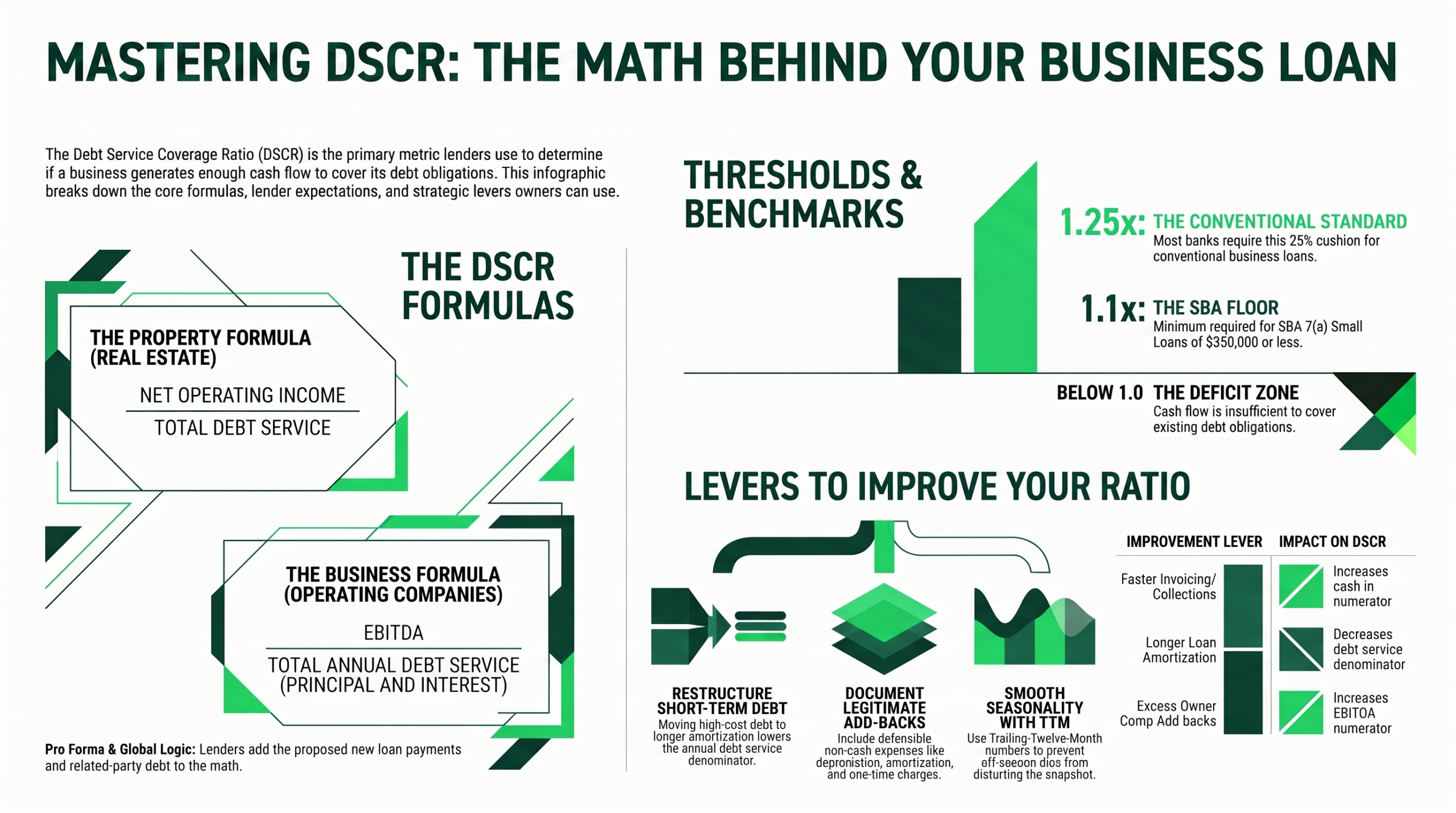
For commercial real estate, DSCR equals net operating income divided by total debt service, where net operating income is the property’s income after operating expenses but before loan payments and capital expenditures, per J.P. Morgan. If a property produces $150,000 in net operating income and owes $120,000 in annual debt service, its DSCR is 1.25. The cleaner the income picture, the more straightforward this calculation becomes.
Property DSCR = Net Operating Income / Total Debt Service. Net operating income excludes loan payments and capital expenditures. Source: J.P. Morgan, What is debt service coverage (DSCR) in real estate.
The business formula (operating companies)
For an operating company, DSCR equals EBITDA divided by total annual debt service (principal plus interest), as described by Commerce Bank. EBITDA stands for earnings before interest, taxes, depreciation, and amortization, and it stands in as a proxy for operating cash flow. A more precise version subtracts cash taxes from the numerator, because, as the Corporate Finance Institute notes, EBITDA is not the same as cash flow. The point of the refinement is the same in both cases: measure the cash genuinely available to make payments, then compare it to the payments themselves.
Business DSCR = EBITDA / Total Annual Debt Service (principal + interest). A more precise version uses (EBITDA minus cash taxes) in the numerator, because EBITDA is not cash flow. Sources: Commerce Bank; Corporate Finance Institute.
What is global or pro forma DSCR (and why your own math may not match the bank’s)?
Global, or pro forma, DSCR is the version lenders actually underwrite: it measures your cash flow against your existing debt service plus the payments on the new loan you are requesting. This is the single most important thing to understand about the ratio, and it is why the number you calculate at your desk often differs from the one the bank lands on. You may pass on your current debt and still fall short once the proposed payment is layered in.
Lenders compute DSCR on a pro forma basis, adding the new facility’s payments to the denominator, and a global DSCR goes further by blending the owner’s and related entities’ debt into the same picture, according to Commerce Bank and G-Squared CFO. So if you carry debt across two entities, or personally guarantee an obligation outside the operating company, that debt can be folded in. The lesson is to run the math the way the lender will: include every payment the business and its owner are responsible for, plus the loan you are asking for.
Add-backs: what legitimately raises the numerator
Add-backs are non-cash or non-recurring expenses that lenders permit you to add back to earnings to reflect true cash flow, which raises the numerator and the ratio. Common, defensible add-backs include depreciation, amortization, genuine one-time charges, and excess owner compensation, per the Corporate Finance Institute and Crestmont Capital. The key word is defensible. Documenting these with your accountant before you apply can legitimately improve the ratio, but a “one-time” charge that reappears every year will be added back into the expense base instead.
What DSCR do lenders want to see?
Most lenders want to see a DSCR comfortably above 1.0, with the exact floor depending on the program and the lender. Conventional banks commonly set a minimum around 1.25x, and covenants are often written as “not less than 1.25x,” according to the Corporate Finance Institute. Commerce Bank notes that most lenders prefer to go no lower than about 1.2, and may look for roughly 1.5 on unsecured lines of credit, where there is no collateral to fall back on. These are typical preferences, not universal rules, and any single lender may sit above or below them.
A DSCR below 1.0 means a business does not generate enough income to cover its debt; 1.0 means no cushion at all. The Corporate Finance Institute describes anything under 1x as “very weak,” and notes many lenders prefer a ratio closer to 2x. Sources: J.P. Morgan; Corporate Finance Institute.
SBA floors are different from a bank’s preference
It is worth separating two things owners often conflate: an SBA program’s required minimum and an individual bank’s internal preference. For SBA 7(a) Small Loans of $350,000 or less, underwriting requires a debt service coverage ratio of at least 1.1:1 on historical and/or projected cash flow, effective March 1, 2026, according to Starfield & Smith, citing an SBA Procedural Notice, under the framework of SBA SOP 50 10 8. SBA program floors set the minimum a lender must meet; a bank can, and frequently does, hold to a higher internal standard on top of that floor. Knowing which number you are being measured against changes how you prepare.
How do seasonality and timing distort your DSCR?
Seasonality and working-capital timing can make a healthy business look weak in a single-period snapshot, because DSCR is a ratio measured over a window, and the window you pick changes the answer. A seasonal operator can show a DSCR of 0.85 in the off-season and 1.65 in peak season, which means a lender sampling the wrong quarter sees a business that cannot cover its debt when, across the full year, it covers it comfortably, as G-Squared CFO illustrates. The remedy is to present trailing-twelve-month figures so the ratio reflects a full cycle rather than one slice of it.
Working-capital timing distorts the number in a quieter way. Slow invoicing and long receivables depress the cash that reaches the numerator, so a profitable business shows a weaker DSCR than its economics deserve, and Crestmont Capital points to faster invoicing, early-payment discounts, and receivables financing as direct fixes. This is the same pattern behind why profitable businesses still run out of cash: the money has been earned, but it has not arrived, and the ratio only sees what has arrived.
The denominator gets distorted too. Stacked short-term, high-cost debt with short amortization schedules inflates total debt service, pushing the ratio down even when the underlying business is sound, per Commerce Bank and the Corporate Finance Institute. And once you carry a loan with a DSCR covenant, a single weak reporting period can trip that covenant and trigger a technical default, even if every payment has been made, as G-Squared CFO warns. The ratio is not just a gate at application. It can follow you through the life of the loan.
How do you improve your DSCR before applying?
You improve your DSCR before applying by either raising the cash flow in the numerator or lowering the debt service in the denominator, and several of the most effective levers are within your control. None of these are tricks. They are legitimate ways to make the ratio reflect the business you actually run.
Where flexible capital fits when the bank’s cutoff does not fit your cycle
Some businesses fall short of a rigid DSCR cutoff not because the company is weak, but because the snapshot was taken at the wrong moment or the existing debt was structured against the business’s cash cycle. A seasonal dip, a stretch of long receivables, or a stack of short-term loans can pull the ratio below a bank’s line while the underlying business throws off plenty of cash across a full year. That is a structuring problem, and structuring is what we do.
At Capital Source, we design capital around the deal, which means we look at how your cash actually moves across the year rather than judging you on a single quarter. Financing is offered through our affiliate, Stretch Finance, and Capital Source’s Stretch Finance offering can structure around a cash cycle so that seasonal and receivables dips are addressed rather than penalized. If a rigid bank cutoff has capped your working capital, the same numbers can read differently inside a structure built for your cycle. You can explore the full range of financing solutions or bring us the specific deal.
Run the number with us before the bank runs it for you
If a DSCR cutoff has capped or declined you, that may be a structuring problem, not a verdict on your business. Tell us how your cash moves across the year and we will structure capital around it.
If your situation is more nuanced than a standard application, you can also submit a deal with your supporting documents and our Deal Desk will review the structure with you.
Key takeaways
- DSCR is the number behind the no. It measures cash flow against debt payments; below 1.0 means a business cannot cover the debt it already carries (J.P. Morgan).
- Know which formula applies. Property DSCR is net operating income over total debt service; business DSCR is EBITDA over total annual debt service, and EBITDA is not the same as cash flow (J.P. Morgan; Commerce Bank; Corporate Finance Institute).
- Lenders use global, pro forma DSCR. They include the new loan’s payments and often related-entity debt, which is why your math may not match theirs (Commerce Bank; G-Squared CFO).
- Thresholds vary, and SBA floors differ from bank preferences. Conventional banks commonly want around 1.25x; SBA 7(a) Small Loans of $350,000 or less require at least 1.1:1, effective March 1, 2026 (Corporate Finance Institute; Starfield & Smith).
- Timing distorts the ratio, and it is fixable. Seasonality and slow receivables can sink a snapshot; trailing-twelve-month figures, faster collections, and refinancing short-term debt move the number legitimately (G-Squared CFO; Crestmont Capital).
Frequently asked questions
What is a good debt service coverage ratio?
Most lenders want to see a DSCR comfortably above 1.0. Conventional banks commonly set a minimum around 1.25x, many prefer to go no lower than about 1.2, and unsecured lines of credit may call for roughly 1.5. These are typical preferences that vary by lender and program, not universal rules.
How do you calculate DSCR?
You divide the cash flow available to service debt by the total debt payments due over the same period. For commercial real estate, that is net operating income divided by total debt service. For an operating business, it is EBITDA divided by total annual principal and interest, sometimes refined by subtracting cash taxes from the numerator.
What is global or pro forma DSCR?
Global, or pro forma, DSCR measures your cash flow against your existing debt service plus the payments on the new loan you are requesting, and a global version blends in the owner’s and related entities’ debt. It is the version lenders actually underwrite, which is why your own calculation can differ from the bank’s. Including every payment the business and owner are responsible for gives you the lender’s view.
What DSCR does the SBA require?
For SBA 7(a) Small Loans of $350,000 or less, underwriting requires a debt service coverage ratio of at least 1.1:1 on historical and/or projected cash flow, effective March 1, 2026, per Starfield & Smith citing an SBA Procedural Notice. An SBA program floor sets the minimum a lender must meet, but an individual bank can hold to a higher internal standard on top of that floor.
How can I improve my DSCR before applying?
Raise the cash flow in the numerator or lower the debt service in the denominator. Practical levers include refinancing a short-term, high-cost loan into longer amortization, speeding up invoicing and collections, documenting legitimate add-backs with your accountant, and presenting trailing-twelve-month figures so seasonality does not define the ratio.
Sources
- J.P. Morgan, What is debt service coverage (DSCR) in real estate?
- Commerce Bank, What is the debt service coverage ratio?
- Corporate Finance Institute, Debt Service Coverage Ratio.
- G-Squared CFO, Calculating DSCR.
- Crestmont Capital, How to Improve Your DSCR for Loans.
- Starfield & Smith, SOP 50 10 8 Update: New 7(a) Small Loan Underwriting Requirements.
- U.S. Small Business Administration, SOP 50 10 Lender and Development Company Loan Programs.
This article is for informational purposes only and does not constitute financial or lending advice. The ratios and thresholds described are typical lender guidelines that vary by lender, program, and industry, and are not lending criteria or guarantees. SBA requirements are summarized from the cited sources and are current as of June 2026; confirm current program rules with the SBA or an SBA lender. External figures are drawn from the sources listed and are current as of their respective reporting periods. Capital Source provides commercial financing solutions through its affiliate, Stretch Finance, LLC; availability, amounts, structures, and terms depend on each business’s circumstances and are subject to review and approval.