
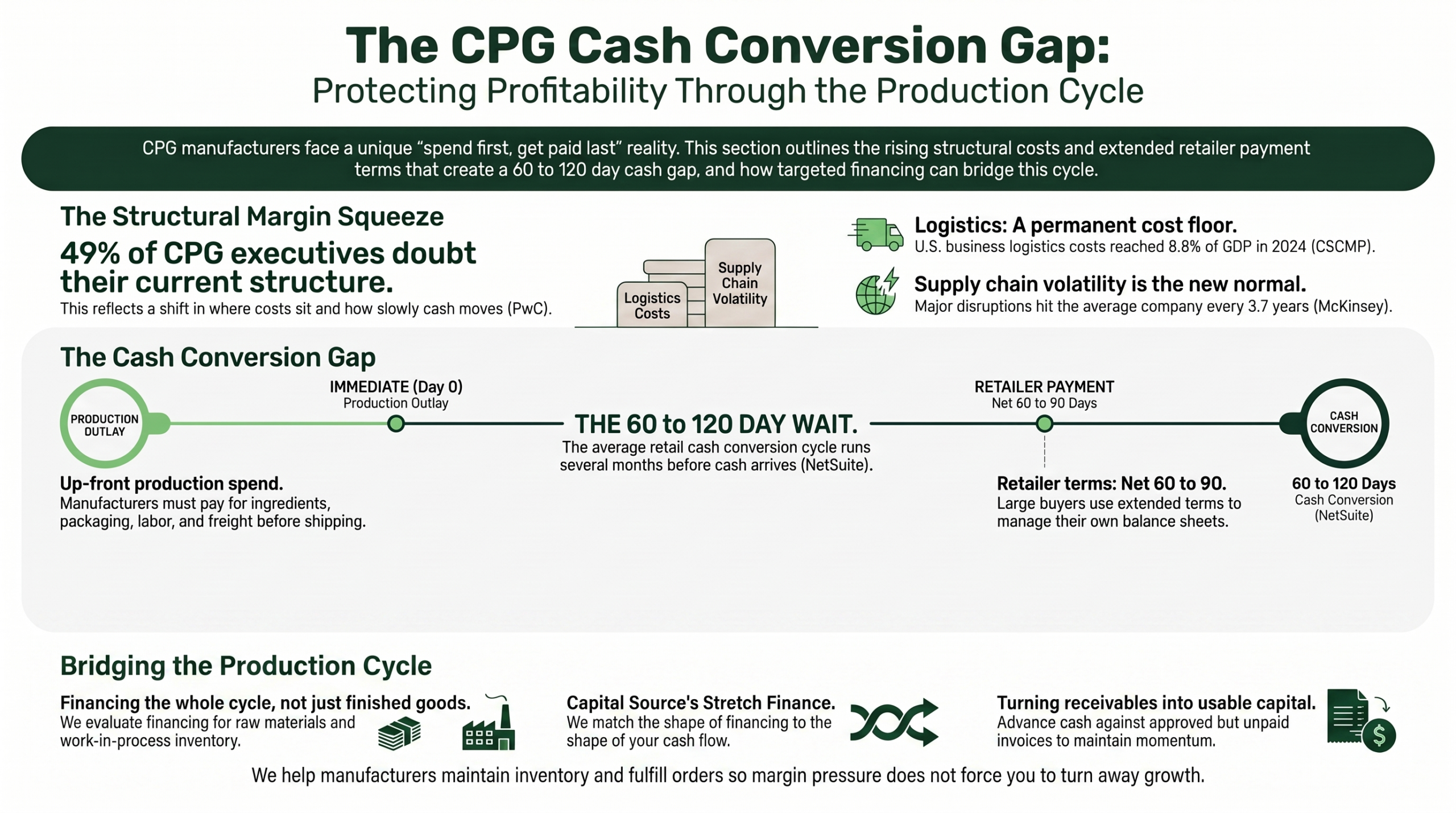
For consumer goods manufacturers, the squeeze rarely shows up as a single bad month. It builds quietly: input and freight costs climb, retailers push back on price, and the cash you spent making the product sits in inventory and receivables for months before it comes back. Here is what the current data says about CPG margin pressure, and how the right working capital structure helps you protect profitability without slowing production.
How much margin pressure are CPG manufacturers under in 2026?
Consumer packaged goods is one of the largest engines in the U.S. economy, and that scale is exactly why the margin math has become so unforgiving. The sector supports roughly 22.3 million jobs, about 10.5% of total U.S. employment, and contributes around $2.5 trillion to the economy, according to a Consumer Brands Association analysis built on PwC data. A market that large draws relentless competition for shelf space, and that competition lands on the manufacturer’s margin first.
Operators feel it. Nearly half of CPG executives, 49%, say their current business structure will not hold up for another decade, a figure 7 percentage points higher than the cross-industry average, per PwC research reported by FoodNavigator. That is not pessimism for its own sake. It reflects a real shift in where costs sit and how slowly cash moves through the business.
CPG supports about 22.3 million jobs and roughly $2.5 trillion in U.S. economic contribution, yet 49% of executives doubt their current structure will last another decade (Consumer Brands Association / PwC, via FoodNavigator).
Where does CPG margin pressure actually come from?
CPG margin pressure comes from several directions at once, which is what makes it so hard to manage with pricing alone. The cost to make and move a product has reset to a higher baseline, while the ability to raise prices has narrowed. For a $5M to $50M manufacturer, that combination turns a profitable product line into a thin one.
The biggest structural driver is the cost of moving goods. U.S. business logistics costs rose 5.4% in 2024 to $2.58 trillion, or 8.8% of GDP, according to the CSCMP State of Logistics Report. That share has settled well above its pre-pandemic level, which means freight is no longer a temporary spike to wait out. It is a permanently higher cost floor.
On top of that, supply chains remain volatile. A disruption lasting a month or longer now hits the average company roughly every 3.7 years, based on McKinsey research compiled by TradeVerifyd, and longer lead times push manufacturers to hold more safety stock. More inventory means more cash locked up before a single unit sells. Layer in retailer demands for lower prices and trade spend, rising labor costs, and the need to invest in technology, and the margin gets attacked from every side. The POI Institute 2026 CPG Industry Outlook frames the year around exactly this challenge: building a deliberate margin architecture across channels, packaging, and segments rather than defending profit reactively.
The CPG Cash Conversion Gap
Margin pressure meets the cash gap
You pay to make the product first. The retailer pays you last.
Costs land early and high; price relief comes slowly.
Logistics cost floor
U.S. business logistics costs reached 8.8% of GDP in 2024, a higher permanent baseline for freight (CSCMP).
Supply-chain volatility
A month-plus disruption hits the average company about every 3.7 years, pushing safety stock higher (McKinsey).
Retailer price pressure
Competition for shelf space lands on the manufacturer’s margin first, before any price increase can follow.
Inventory tie-up
Inventory is the largest asset on most CPG balance sheets, locking cash in raw materials and finished goods.
Capital sequenced to the cycle, not the calendar.
Production spend
Buy ingredients, packaging, labels, and components; pay labor, co-packing, and freight.
Inventory and shipment
Work-in-process becomes finished goods, then ships against a retailer purchase order.
The payment wait
Retailers commonly pay on Net 60 to 90 terms, and the retail cash conversion cycle runs 60 to 120 days before cash arrives (NetSuite).
Cash returns and resets
Working capital bridges the gap so production never stops waiting on receivables.
Illustrative cash conversion cycle for a CPG manufacturer. Figures reflect the cited sources; structures depend on each business and are subject to review and approval.
Why margin pressure turns into a cash flow problem
Margin pressure becomes a cash flow problem because CPG manufacturers spend first and get paid last. You buy raw materials, packaging, and freight, run production, and ship to a retailer, then wait. The retail cash conversion cycle commonly runs 60 to 120 days, and inventory is the largest asset on most CPG balance sheets, according to NetSuite’s analysis of CPG industry trends. For a growing brand, that means the better your sales, the more cash you have tied up at any given moment.
Retailer payment terms make the gap wider. Major retailers commonly pay consumer goods suppliers on Net 60 to Net 90 terms, and some stretch further. Extended terms have become a standard part of how large buyers manage their own balance sheets, which effectively turns suppliers into a source of financing. The manufacturer absorbs the timing, covering payroll, suppliers, and the next production run while a large, creditworthy receivable sits unpaid on the books.
This is the core working capital challenge in consumer goods manufacturing. It is not a sign of a weak business. It is the natural result of selling to big customers on long terms while input costs are paid up front.
How working capital helps CPG manufacturers protect margins
The most effective response to CPG margin pressure is to manage the cash cycle as deliberately as you manage production. Manufacturer working capital does not change your costs, but it changes their timing, so a slow-paying purchase order becomes a managed event instead of a payroll emergency. A few structures fit the consumer goods cycle particularly well.
Used together, these tools help manufacturers maintain inventory levels, fund production, prepare for peak season, and keep wholesale distributor funding aligned with how the business actually earns. The goal is not more debt for its own sake. It is matching the shape of your financing to the shape of your cash flow, so margin pressure does not force you to turn away good orders.
Financing the whole production cycle, not just finished goods
Here is where many manufacturers hit a wall, and where the right financing partner matters most. Most purchase order finance providers will only look at finished goods: inventory that is already manufactured, packaged, ready to ship, and tied to a confirmed customer order. That model can work for distributors and importers, but it often leaves CPG manufacturers with a financing gap earlier in the process, exactly when capital is needed for ingredients, packaging, labels, components, labor, co-packing, and freight.
At Capital Source, we understand that inventory value is created in stages. In select situations, we can evaluate financing opportunities tied to unfinished goods, work-in-process inventory, raw materials, and production-stage inventory, not only finished goods sitting in a warehouse. For manufacturers with credible customers, real orders, and a clear production plan, that flexibility can help bridge the cash gap between making the product and getting paid for it, so you can maintain inventory, fulfill orders, protect margins, and avoid turning away growth. Capital Source is the brand of Capital Source Group, LLC, a commercial finance firm headquartered in Chicago, funding businesses since 2015 with over $500 million in active funding programs. Financing is offered through our affiliate, Stretch Finance, LLC.
Protect your margins and keep production moving
If you have confirmed demand but cash tied up in raw materials, work-in-process, or receivables, let’s talk about working capital built around your production cycle. Tell us where your business is headed and we will work to structure capital around it.
Key takeaways
- The squeeze is structural, not cyclical:logistics costs have reset to 8.8% of GDP and supply chains stay volatile, so manufacturers cannot simply wait out the pressure (CSCMP, McKinsey).
- Margin pressure shows up as a cash gap:the retail cash conversion cycle commonly runs 60 to 120 days, and inventory is the largest asset on most CPG balance sheets (NetSuite).
- Retailer payment terms widen the gap:Net 60 to 90 terms turn suppliers into a financing source, leaving creditworthy receivables unpaid while production costs come due.
- Working capital changes timing, not costs:inventory financing, receivables financing, and an inventory line of credit keep production funded through the wait.
- Stage matters:financing tied to raw materials and work-in-process, not just finished goods, can close the gap earlier in the cycle where many providers will not look.
Frequently asked questions
What is CPG financing?
CPG financing is funding designed around the cash cycle of consumer goods manufacturers and distributors, who pay for raw materials, packaging, labor, and freight long before retailers pay them. It commonly includes inventory financing, receivables financing, and working capital lines structured around production and retailer payment terms rather than a single lump-sum loan.
How does inventory financing work for consumer goods manufacturers?
Inventory financing provides capital structured against the inventory a manufacturer holds or needs to produce, so the business can buy raw materials and build product ahead of demand without draining cash. It is useful in CPG because inventory is typically the largest asset on the balance sheet, and cash stays locked there until finished goods sell and retailers pay.
Why do retailer payment terms create a cash flow gap?
Retailers commonly pay consumer goods suppliers on Net 60 to Net 90 terms, and sometimes longer, while the manufacturer pays for ingredients, packaging, labor, and freight up front. That mismatch leaves a large, creditworthy receivable sitting unpaid for months while production costs and payroll come due, which is the gap working capital is designed to bridge.
Can a manufacturer finance work-in-process or raw materials, not just finished goods?
In select situations, yes. Many purchase order finance providers only fund finished goods, but Capital Source can evaluate financing tied to raw materials, work-in-process, and production-stage inventory for manufacturers with credible customers, real orders, and a clear production plan. This closes the financing gap earlier in the cycle, when capital is needed for ingredients, packaging, components, labor, and co-packing.
What is manufacturer working capital?
Manufacturer working capital is the cash a manufacturer needs on hand to cover production, inventory, and operating costs before customer payments arrive. In CPG it bridges the gap between spending on a production run and getting paid by retailers, which often runs 60 to 120 days, so the business can keep producing and fulfilling orders without interruption.
Sources
- Consumer Brands Association, CPG Industry Drives U.S. Economy with $2.5 Trillion Contribution and 22.3 Million Jobs (PwC analysis, 2022 data, released October 2024).
- FoodNavigator, CPG companies aim to self-disrupt to assuage decline (reporting PwC research, August 2025).
- CSCMP State of Logistics Report via FreightWaves, Logistics GDP share rose in 2024 ($2.58 trillion, 8.8% of GDP, 2024 data).
- NetSuite, 13 Key CPG Industry Trends in 2026 (retail cash conversion cycle, inventory as largest asset).
- POI Institute, 2026 CPG Industry Outlook (margin architecture and channel profitability).
- TradeVerifyd, Supply Chain Statistics (compiling McKinsey disruption research and related supply-chain data).
This article is for informational purposes only and does not constitute financial, legal, or tax advice. Figures are drawn from the sources listed and are current as of their respective reporting periods. Capital Source provides commercial financing solutions through its affiliate, Stretch Finance; availability, amounts, structures, and terms depend on each business’s qualifications, inventory, receivables, cash flow, and underwriting review and are subject to approval.
Leave a Reply