
Most subcontractors are not failing because the work dries up. They run tight because they fund labor, materials, and mobilization for weeks before the payment for that work ever shows up. Here is what the latest data says about the construction cash flow gap, and what you can do to manage it.
If you run a specialty or subcontracting business doing roughly $1 million to $15 million a year, you already know the feeling. The bid was good. The job is on schedule. The project is profitable on paper. And yet payroll is Friday, the lumber invoice is due, and the payment for work you finished last month is still somewhere between the general contractor, the architect, and the owner. That distance between when you spend and when you get paid is the real construction cash flow problem, and it is structural, not a sign of bad management.
How serious is the construction cash flow problem right now?
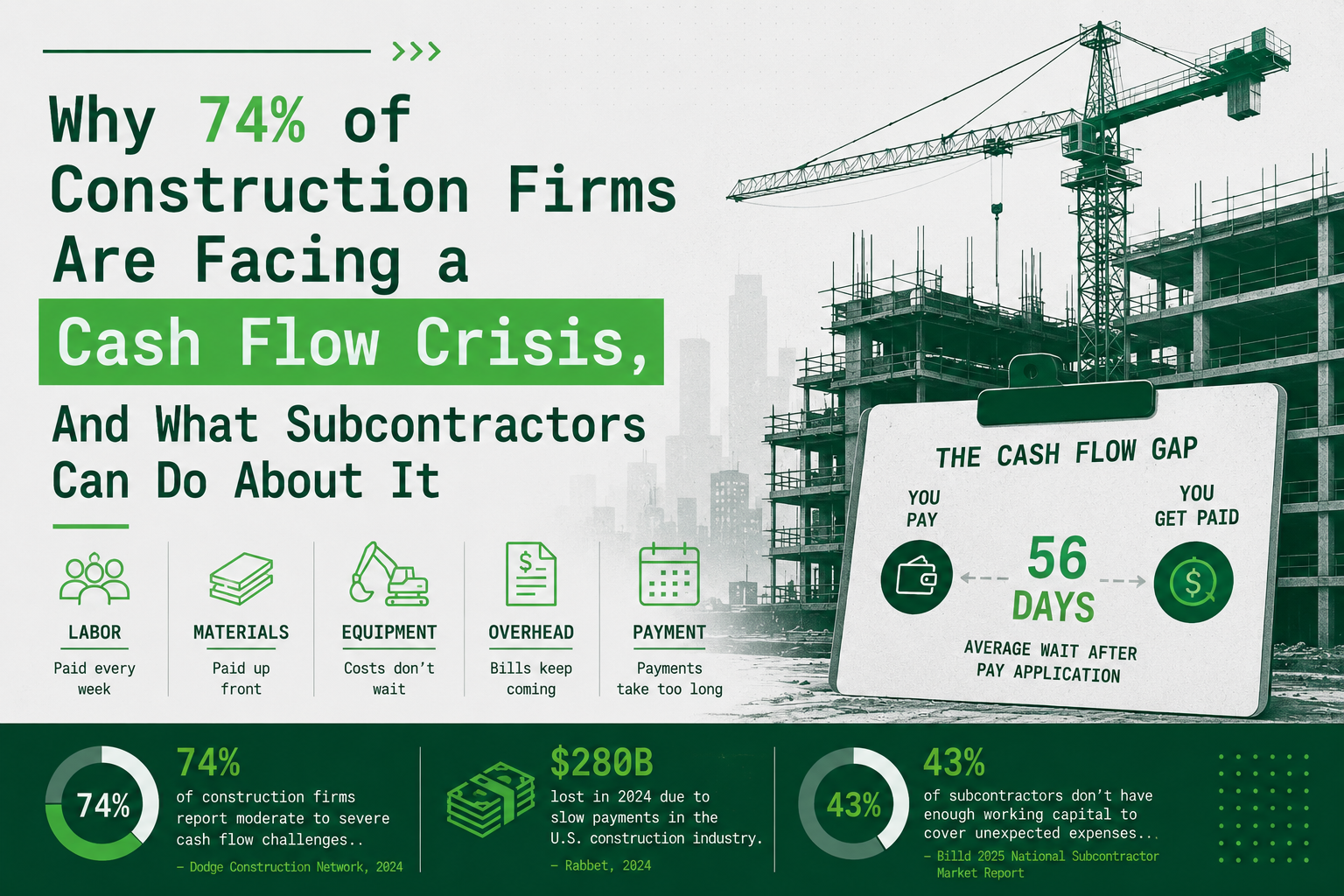
Cash flow pressure is now the norm across the industry, not the exception. In a 2024 Dodge Construction Network study, 74% of construction companies reported experiencing moderate to severe cash flow challenges, as reported by Imperial Training. The scale of the money in motion is just as telling: slow payments cost the U.S. construction industry an estimated $280 billion in 2024, according to Rabbet’s 2024 Construction Payments Report.
The reason is the way money moves through a project. Cash flows from the owner to the general contractor, then down to the subcontractor, and finally to suppliers. Each handoff adds time. Rabbet found the average construction payment cycle runs about 90 days, roughly double the 45-day window analysts consider healthy. The further down the chain you sit, the longer you wait, and subcontractors sit near the bottom while having already fronted the most cash.
What does the latest subcontractor data show?
The clearest read on the subcontractor side comes from Billd’s 2025 National Subcontractor Market Report, which surveyed more than 800 industry professionals and was summarized by Construction Dive. After submitting a pay application, subcontractors waited an average of 56 days to actually get paid.
Subcontractors wait an average of 56 days for payment after submitting a pay application, per the Billd 2025 National Subcontractor Market Report.
That wait collides with bills that do not wait. According to the same report via Construction Dive, 43% of subcontractors said they do not have enough working capital to cover unexpected expenses or project delays, and 29% said overdue invoices get in the way of progress or success on their projects. The squeeze is not abstract: 81% of subcontractors reported supplier terms shorter than the time it takes them to get paid, and roughly one in three said they pull from personal or retirement savings to bridge the gap.
Why do subcontractors feel the squeeze more than general contractors?
Subcontractors feel the squeeze more because they spend first and get paid last. A sub buys the material, schedules the crew, and performs the work, then submits a pay application that has to be reviewed, certified, and approved before the general contractor releases payment, as outlined in Procore’s overview of construction progress billing. By the time the money arrives, the sub has already carried labor and material costs for weeks.
That position also explains why expectations and reality drift so far apart. It is not that anyone is acting in bad faith. It is that the people higher in the chain do not feel the same gap, so they tend to underestimate how long the sub is actually waiting.
The 56-day reality versus the 30-day expectation
Here is the disconnect at the heart of the problem. In the Billd data reported by Construction Dive, general contractors believed payments reached subcontractors in about 30 days after a pay application. Subcontractors actually waited 56 days. That leaves a gap of roughly 26 days between what the people scheduling and managing the work assume, and what the people financing the work actually experience.
Twenty-six days does not sound dramatic until you map it against a real operating cycle. In that window you still have to make payroll once or twice, pay suppliers whose terms already came due, cover equipment and fuel, carry insurance and bonding, and keep the lights on at the office. The work is done. The profit is earned. The cash simply has not landed yet.
Why delayed payments create project risk, not just accounting stress
Delayed payments are not only a bookkeeping headache. When cash is tight, a subcontractor may slow down material orders, defer hiring, or stretch suppliers, and any of those can put the next milestone, and the relationship with the GC, at risk. Two features of construction make this worse than a generic late invoice.
The first is retainage. Retainage is a portion of each progress payment, commonly 5 to 10 percent, that an owner or general contractor withholds until the project reaches substantial or final completion, as explained by Levelset. On a profitable job, retainage can quietly hold back a meaningful slice of your margin for months after the work is finished.
The second is change orders. A change order is a written modification to the original contract that adds, removes, or alters scope, cost, or schedule, and that usually must be approved before the affected work can be billed, per Procore. When a sub performs changed work ahead of formal approval, the cost lands immediately while the payment waits on paperwork. Stack retainage, change orders, and a 56-day base cycle together and a healthy job can still drain the bank account.
Why working capital can become a competitive advantage
The subcontractors who handle this best treat working capital as part of pricing, not an afterthought. Construction working capital is the cash a contractor needs on hand to cover labor, materials, equipment, and mobilization before a project’s payments arrive. When you plan for that cost deliberately, it stops being a surprise and starts being a line you manage.
In 2024, subcontractors who accounted for the cost of working capital in their bids posted a 24% profit margin, compared with 17% for those who did not, according to the Billd 2025 report via Construction Dive.
That is the quiet edge. The firms that price in the cost of carrying a project, and have capital ready when the gap opens, are not just surviving the wait. They are bidding with confidence, taking on bigger or overlapping jobs, and protecting their margin instead of eroding it with rushed decisions made under cash pressure.
Practical steps subcontractors can take
You cannot single-handedly fix how the industry pays, but you can shorten and manage your own gap. A few moves consistently help.
Tighten your billing process
Submit complete, clean pay applications on time, every cycle, with the lien waivers, insurance certificates, and backup the GC requires. The fastest way to extend a 56-day wait is an application that gets kicked back for a missing document. Invoice promptly and follow up on a schedule rather than waiting for the phone to ring.
Monitor cash flow at the project level
Track cash job by job, not just company-wide. A profitable company can still run dry because two big projects hit their heaviest spend in the same week. Knowing each job’s spend-versus-collect timeline lets you see the squeeze before it arrives.
Negotiate clearer payment terms
Push for defined payment timelines, reasonable retainage, and pay-when-paid clarity before you sign. You will not win every point, but the conversation sets expectations and surfaces the GCs whose terms simply do not fit your cash cycle.
Track retainage and change orders deliberately
Treat retainage as money you are owed and schedule its release, do not let it disappear into project memory. Get change orders approved in writing before performing the work wherever possible, so the cost and the billing move together instead of weeks apart.
Use financing proactively, not reactively
The worst time to arrange capital is the week payroll is short. Line up working capital before you need it, so a slow-paying job becomes a timing event you planned for rather than an emergency. Used this way, financing supports growth instead of patching a hole.
Where Capital Source fits
This is the gap Capital Source is built to bridge. We are a commercial finance firm that understands the real construction payment cycle, where the money is earned long before it arrives, and we structure capital around your project timelines, receivables, and operating realities rather than rigid, one-size terms. Through our affiliate, Stretch Finance, we offer flexible working capital designed around how your cash actually moves on a job.
The goal is simple: keep a profitable business from being constrained by timing. Availability, amounts, and structure depend on your receivables, cash flow, and an underwriting review, and we will tell you plainly what fits your situation. For related background, see our overviews of working capital and inventory financing.
Build capital around your real project timelines
Before your next project strains your payroll, materials budget, or vendor relationships, talk with a Capital Source specialist about construction working capital built around how your cash actually moves on a job.
The construction cash flow gap, on one page
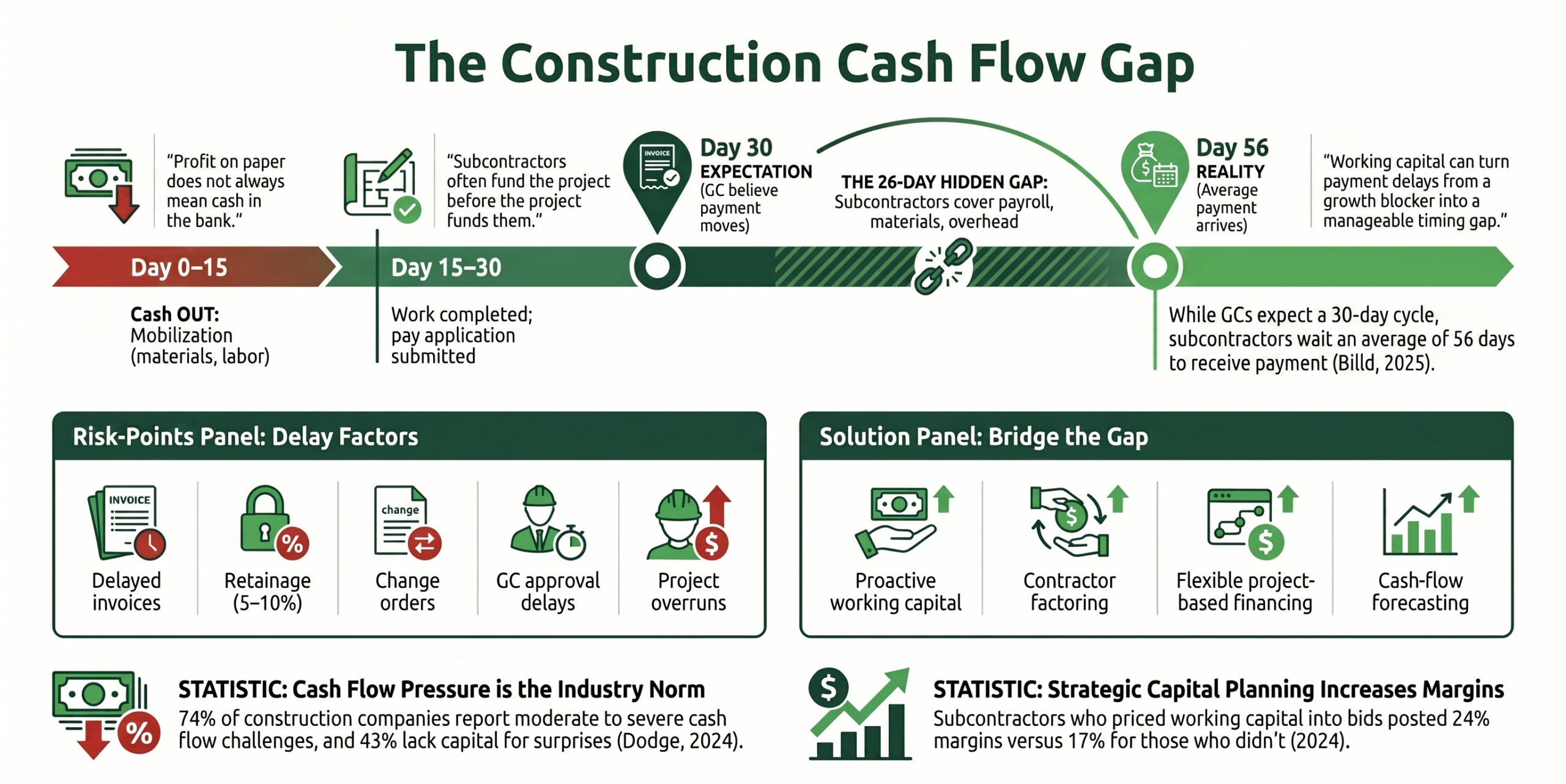
Click to view full size. This infographic was generated with AI from our article and is provided for general information only. It is not financial advice; availability, amounts, structures, and terms depend on each business’s circumstances and are subject to review and approval.
Key takeaways
- The crisis is structural, not personal:74% of construction companies reported moderate to severe cash flow challenges in 2024, driven by how slowly money moves down the payment chain.
- Subcontractors wait the longest:an average of 56 days for payment, while many general contractors assume it takes about 30, a roughly 26-day expectation gap.
- The cost lands before the cash:retainage and unapproved change orders can hold back margin on a job that is already profitable on paper.
- Working capital is a competitive edge:subcontractors who priced working capital into their bids posted 24% margins versus 17% for those who did not.
- Plan capital before you need it:proactive financing turns a slow-paying job into a managed timing event instead of a payroll emergency.
Frequently asked questions
Why do subcontractors have such persistent cash flow problems?
Subcontractors spend first and get paid last. They fund labor, materials, and mobilization, then submit a pay application that must be reviewed and approved before the general contractor releases payment. In Billd’s 2025 report, that wait averaged 56 days, while suppliers and payroll come due much sooner.
What is the difference between when GCs think subs get paid and reality?
In the Billd data reported by Construction Dive, general contractors believed subcontractors were paid in about 30 days after a pay application, but subcontractors actually waited 56 days. That leaves a gap of roughly 26 days during which the sub still has to cover payroll, suppliers, and overhead.
What is construction working capital?
Construction working capital is the cash a contractor needs on hand to cover labor, materials, equipment, and mobilization before a project’s payments arrive. It bridges the gap between spending on a job and getting paid for it, which in construction often runs weeks or months.
How does contractor factoring work?
Contractor factoring, also called invoice factoring or receivables financing, lets a contractor advance cash against approved but unpaid invoices instead of waiting out the full payment cycle. It converts a long collection window into usable capital now, structured around the receivables a business already holds.
How does retainage affect cash flow?
Retainage is a portion of each progress payment, commonly 5 to 10 percent, that an owner or general contractor withholds until the project reaches substantial or final completion. Because it is held back on every payment, it can keep a meaningful slice of a job’s margin out of reach for months after the work is done.
Sources
- Construction Dive, Cash flow problems continue to plague subcontractors (summarizing the Billd 2025 National Subcontractor Market Report).
- Billd, 2025 National Subcontractor Market Report.
- Imperial Training, Construction Firms Face Growing Cashflow Crisis (citing Dodge Construction Network, 2024).
- Rabbet / GlobeNewswire, Slow Payments Cost $280 Billion in 2024 (2024 Construction Payments Report).
- Levelset, Retainage in Construction.
- Procore, Construction Progress Billing.
- Procore, Accelerating Payments and Strengthening Vendor Relationships.
This article is for informational purposes only and does not constitute financial, legal, or tax advice. Figures are drawn from the sources listed and are current as of their respective reporting periods. Capital Source provides commercial financing solutions through its affiliate, Stretch Finance; availability, amounts, structures, and terms depend on each business’s qualifications, receivables, cash flow, and underwriting review and are subject to approval.
Leave a Reply