
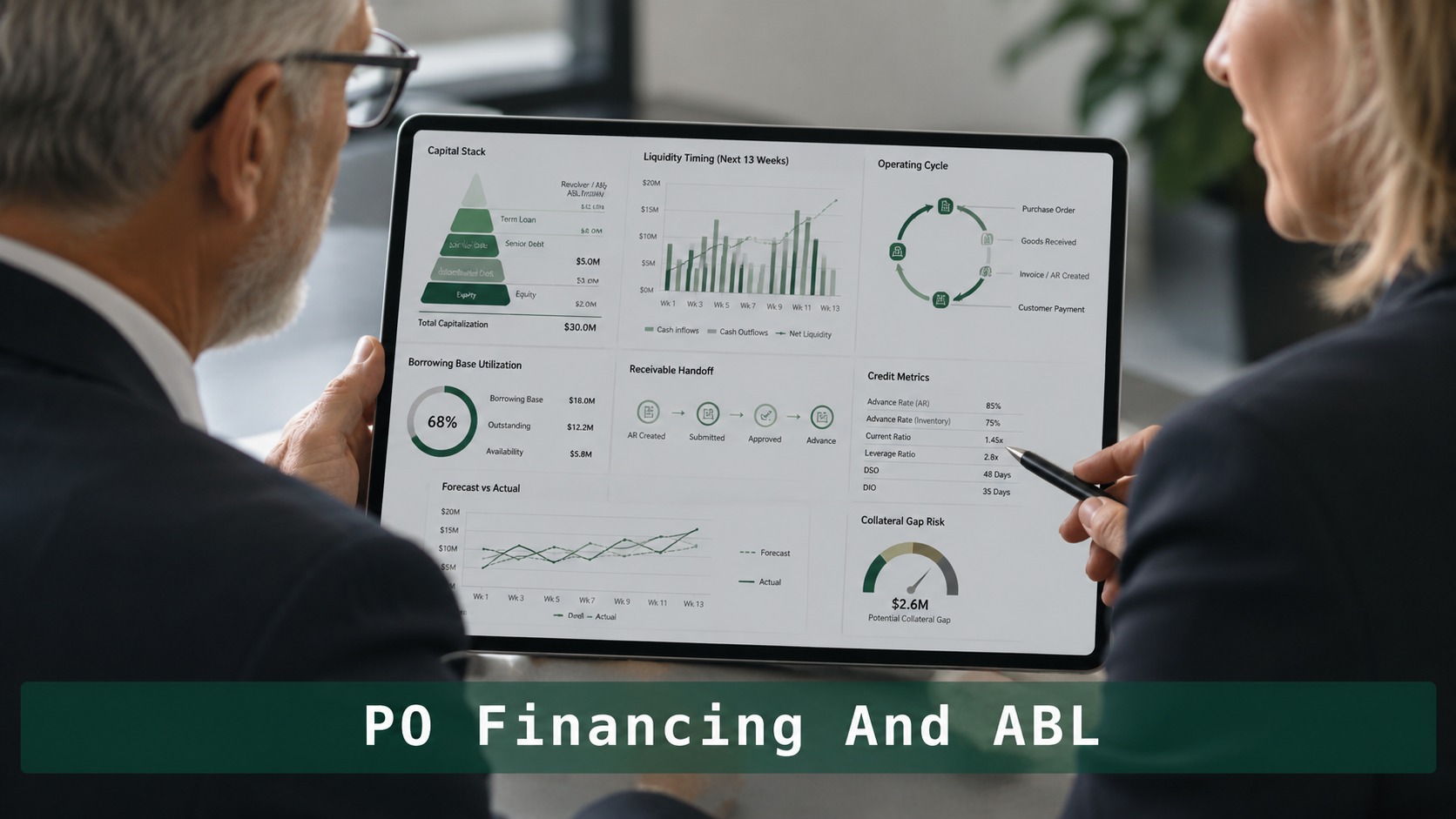
PO Financing and ABL: Where One Ends and the Other Begins
How the Phase One to Phase Two transition retires PO financing, activates the ABL borrowing base, and prevents collateral gaps across manufacturing, distribution, and government contracting.
Four-Instrument Capital Stack Series • Article Three
The Phase One to Phase Two transition is where most multi-instrument capital structures fail.
Not from using the wrong instruments.
From failing to govern the handoff between them.
A distributor funds a confirmed retailer order through PO financing. The goods arrive from the overseas supplier. The retailer takes delivery. The invoice is raised. The PO financing lender expects its advance to be retired from the invoice proceeds.
The problem is timing.
The retailer’s payment terms are net 60. The invoice proceeds will not arrive for 60 days. The PO financing advance cannot wait 60 days without rolling into a period it was not built to cover.
The correctly governed transition retires the PO financing advance from the ABL borrowing base, not from the eventual receivable collection. The receivable generated by the invoice enters the ABL facility as eligible collateral. The ABL advance against that receivable retires the PO financing advance at the transition point. The retailer’s 60-day payment cycle is then governed by the ABL receivables structure, not by the PO financing timeline.
That is the transition discipline. Without it, the stack has a structural gap at its most sensitive point.
This article is the third in the Four-Instrument Capital Stack Series. Article One established the Four-Instrument Capital Stack and Instrument Phase Discipline. Article Two developed the Stack True Cost Assessment and the Stack Erosion Threshold. This article develops the Phase One to Phase Two transition in depth: how PO financing and ABL work together as the first two instruments in the stack, where PO financing ends, where ABL begins, and why the handoff point is a governance decision, not a lender preference.
Readers arriving here directly will find this article stands alone as a complete diagnostic.
Key Points
PO financing and ABL serve sequential phases of the same operating cycle. PO financing governs the pre-production phase by advancing against the confirmed buyer obligation before inventory exists. ABL governs the conversion phase by advancing against the asset base the production or sourcing cycle generates. The handoff from PO financing to ABL is not a refinancing event. It is a phase transition governed by the operating cycle’s progression from buyer obligation to physical asset.
The Phase One to Phase Two transition occurs when the goods are delivered, the invoice is raised, and the receivable is created. At that moment, the PO financing advance retires against the ABL borrowing base, and the receivable enters the ABL facility as eligible collateral. The transition is the structural mechanism that makes PO financing a clean, self-retiring instrument rather than a rolling credit facility.
For manufacturers, the transition is more complex. The production cycle generates WIP before it generates finished goods and receivables. The Phase One to Phase Two transition in manufacturing is not a single event. It is a progression: raw materials enter the ABL borrowing base as purchased, WIP enters under Cost to Complete Discipline as it accumulates, and finished goods replace WIP as the production cycle closes. PO financing retires only when finished goods are delivered and the receivable is created.
The ABL facility that receives the Phase Two transition must be sized against the Integrated Inventory Borrowing Base. That means forensic advance rates on inventory calibrated to current forced liquidation value and forensic advance rates on receivables calibrated to the actual current CCC. A Phase Two ABL facility that was not built to integrate with the Phase One PO financing structure will produce a collateral gap at the transition point.
Across all industries, the Phase One to Phase Two transition is the most governance-sensitive moment in the Four-Instrument Capital Stack. Getting the transition wrong produces either an over-advance condition, where the PO financing advance has not fully retired before the ABL advance activates against the same underlying obligation, or an availability gap, where the PO financing retires before the ABL borrowing base has been established against the assets the transition generates.
Core Terms
Phase One to Phase Two Transition — the operating cycle event that retires the PO financing advance and activates the ABL borrowing base against the assets the production or sourcing cycle has generated. The transition occurs when goods are delivered, the invoice is raised, and the receivable is created, converting the confirmed buyer obligation that supported the PO financing advance into the receivable that enters the ABL borrowing base.
Collateral Gap — the availability shortfall that occurs when the PO financing advance retires before the ABL borrowing base has been established against the assets the Phase One to Phase Two transition generates, or when the ABL facility’s advance rates produce insufficient availability against the transition assets to cover the operating cycle’s Phase Two capital requirement.
Within the Four-Instrument Capital Stack, Phase One is the buyer-obligation phase and Phase Two is the asset-base phase. PO financing belongs to Phase One because it advances against the confirmed buyer obligation before inventory or receivables exist. ABL belongs to Phase Two because it advances against the inventory and receivables created by the operating cycle. The Phase One to Phase Two transition is the governed handoff between those two collateral states.
The Transition Across Business Types
Distribution
For distributors, the Phase One to Phase Two transition is the cleanest of the three business types.
The confirmed buyer order is received. PO financing advances against the order to fund sourcing or procurement. Goods arrive and are inspected. The invoice is raised against the buyer. The receivable is created and enters the ABL borrowing base. The ABL advance against the receivable retires the PO financing. The buyer’s payment collection is governed by the ABL receivables structure through the CCC-Adjusted Advance Rate calibrated to the actual collection period.
The collateral gap risk in distribution occurs when the ABL advance rate on the transition receivable is insufficient to fully retire the PO financing advance. If PO financing advanced 90 percent of the confirmed order value and the ABL receivables advance rate is 80 percent of eligible receivables, the transition produces a 10 percent gap against the order value that the borrower must fund from operating cash at the transition point.
The Stack True Cost Assessment from Article Two identifies this gap before it occurs.
Manufacturing
For manufacturers, the Phase One to Phase Two transition is a progression rather than a single event. The production cycle generates multiple asset classes sequentially.
Raw materials enter the ABL borrowing base as they are purchased, at forensic advance rates against current commodity pricing. WIP accumulates and enters the borrowing base under the WIP Cost to Complete Discipline, at the advance rate established by cost invested minus cost to complete against the forced liquidation floor. Finished goods replace WIP as the production cycle closes, at the finished goods advance rate against current forced liquidation value.
The PO financing advance retires only when finished goods are delivered against the confirmed buyer order and the invoice is raised. For a production cycle that takes 90 days from raw material receipt to finished goods delivery, the PO financing advance is outstanding for 90 days before the transition event.
The ABL facility is simultaneously advancing against raw materials and WIP throughout that 90-day period, which means both instruments are outstanding at the same time through the production cycle.
That simultaneous deployment is not a Phase Boundary Violation. It is the correct structure for a manufacturing operating cycle where the pre-production buyer obligation and the in-process inventory exist at the same time.
Government Contracting
For government contractors, the Phase One to Phase Two transition has a specific characteristic that distinguishes it from distribution and manufacturing.
The confirmed government contract is both the Phase One buyer obligation that supports PO financing and the ongoing performance obligation that generates the Phase Two receivables the ABL facility advances against. The contract does not retire at a single delivery event. It generates receivables periodically as contract milestones are achieved and invoices are raised.
The transition discipline for government contracting is not a single handoff from PO financing to ABL. It is a governed overlap.
PO financing covers mobilization costs before the first milestone invoice. The first milestone receivable enters the ABL borrowing base and retires the PO financing advance proportionally. Subsequent milestone receivables are governed entirely by the ABL facility.
The Stack True Cost Assessment must account for the mobilization period when PO financing and ABL carry cost simultaneously against the same underlying contract obligation.
The Phase One to Phase Two transition is not a lender preference. It is an operating cycle event governed by the progression from confirmed buyer obligation to physical asset to receivable. The lender’s job is to build the transition mechanism so the PO financing retires cleanly against the ABL advance at the transition point rather than forcing the borrower to fund the gap from operating cash.
That design discipline is what makes the two-instrument PO-to-ABL sequence a governed structure rather than two sequential loans with an unmanaged gap between them.
The strategic consequence is direct: a capital structure with a correctly governed transition mechanism carries no collateral gap at the handoff point, no over-advance condition from overlapping instrument coverage, and no availability shortfall from transition assets that the ABL facility’s advance rates cannot support. A capital structure with an ungoverned transition carries at least one of those three conditions at every transition event.
Most businesses cycle through that transition multiple times per year.
Cross-Industry Transition Governance
The transition governance discipline applies across every industry whose operating cycle moves from confirmed buyer obligation to physical asset to receivable.
The mechanism is consistent. The timing and asset progression vary by industry.
Food and Beverage
For food and beverage businesses, the Phase One to Phase Two transition reflects the seasonal procurement cycle.
PO financing covers ingredient procurement against confirmed production commitments from distributors or retailers. Ingredients enter the ABL borrowing base as raw materials at current commodity pricing. Production converts raw materials to finished goods, with packaged product entering the borrowing base at finished goods advance rates. Finished goods ship against the confirmed orders, and the invoice generates the receivable that retires the PO financing advance.
The ABL facility governs the receivables through the collection cycle.
Staffing
Staffing does not use PO financing in the traditional sense, since confirmed staffing engagements are not purchase orders for physical goods.
The Phase One equivalent in staffing is the signed client engagement agreement: a contractual commitment from a creditworthy client to pay for defined labor services. Some staffing companies access specialized staffing-specific financing against signed client agreements before labor is deployed, functioning analogously to PO financing for the pre-deployment period.
Phase Two is the ABL receivables facility that governs the invoiced labor as the engagement generates receivables through the deployment cycle.
Retail
For retailers, Phase One activates for seasonal merchandise procurement against confirmed buyer programs from brand suppliers. The retailer commits to a seasonal buy before the merchandise has been sourced. PO financing covers the sourcing commitment.
Merchandise arrives and enters the ABL borrowing base under the seasonal time-decay obsolescence mechanism, with the advance rate declining through the demand window as the Inventory Financing Series established. The transition from PO financing to ABL inventory advance occurs when the merchandise enters the distribution center and is available for sale.
The ABL facility then governs the merchandise through the seasonal sell-through cycle and the receivables that corporate account sales generate.
Every industry’s Phase One to Phase Two transition follows the same governance logic, even when the specific assets and timing differ. The confirmed buyer obligation that supports the PO financing advance must convert to a physical asset or receivable before the PO financing retires and ABL takes over.
The transition mechanism must be built before the instruments are deployed, not discovered at the moment the PO financing expects retirement and the ABL borrowing base has not yet been established.
Forensic Stress Test: Is Your Phase One to Phase Two Transition Governed?
Use these questions to test whether your PO financing and ABL structure has a governed transition mechanism or an unmanaged gap.
- Has the Phase One to Phase Two transition mechanism been explicitly built, including how the PO financing advance retires against the ABL borrowing base at the transition event rather than waiting for eventual receivable collection?
- Has the ABL advance rate on the transition receivables or inventory been confirmed as sufficient to fully retire the PO financing advance without requiring the borrower to fund a collateral gap from operating cash?
- For manufacturers, has the simultaneous deployment of PO financing and ABL through the production cycle been structured correctly, with PO financing covering the confirmed order obligation and ABL advancing against raw materials and WIP at the same time without producing an over-advance condition against the same underlying obligation?
- Has the Stack True Cost Assessment been run against the transition period when both PO financing and ABL carry cost at the same time to confirm the blended cost during the overlap period is below the Deployment Return Threshold?
Frequently Asked Questions
Why does PO financing need to retire against the ABL advance rather than against the eventual receivable collection?
PO financing is a pre-production instrument built to serve Phase One, the period before the asset base exists. Once the invoice is raised and the receivable is created, the operating cycle has entered Phase Two, and the correct instrument is ABL.
Extending PO financing through the receivable collection period is a Phase Boundary Violation. It carries PO financing cost, typically 18 to 24 percent annualized, against a period when the ABL facility would govern the same receivable at 10 to 14 percent annualized.
The transition mechanism that retires PO financing against the ABL advance at the invoice date keeps each instrument inside its designed phase.
What creates a collateral gap at the Phase One to Phase Two transition?
A collateral gap occurs when the ABL advance rate against the transition assets — the receivables or inventory the Phase One to Phase Two event generates — is insufficient to fully retire the PO financing advance at the transition point.
If PO financing advanced 85 percent against the confirmed order value and the ABL receivables advance rate is 80 percent of eligible receivables, the transition produces a five percent gap that the borrower must fund from operating cash.
The gap is the difference between what the PO financing deployed and what the ABL can advance against the assets the transition generates. Designing the ABL facility’s advance rates against the expected transition assets before the instruments are deployed eliminates the collateral gap before it occurs.
How does the manufacturing transition differ from the distribution transition?
Distribution transitions at a single event: goods delivered, invoice raised, receivable created, PO financing retired against the ABL advance.
Manufacturing transitions progressively as the production cycle converts raw materials to WIP to finished goods, with each stage entering the ABL borrowing base at the appropriate advance rate under the Integrated Inventory Borrowing Base.
The PO financing advance against the confirmed production order remains outstanding throughout the production cycle and retires only at the finished goods delivery event. Both instruments are outstanding at the same time through the production cycle. That is a correctly governed overlap rather than a Phase Boundary Violation.
What does Capital Source do at the Phase One to Phase Two transition that other lenders do not?
Most lenders manage one instrument and are indifferent to how the borrower transitions from another.
Capital Source designs the transition mechanism as part of the capital stack structure. That means establishing the ABL borrowing base in advance of the transition event, confirming the advance rates against the expected transition assets, and structuring the retirement of the PO financing advance against the ABL borrowing base at the transition point.
That design discipline eliminates the collateral gap, prevents the Phase Boundary Violation of extended PO financing, and keeps the blended stack cost during the transition period below the Deployment Return Threshold.
How does the Phase One to Phase Two transition connect to the Stack True Cost Assessment?
The transition period is typically when both PO financing and ABL carry cost at the same time, making it the highest blended cost period in the operating cycle.
The Stack True Cost Assessment from Article Two calculates the blended cost during the overlap period and tests it against the Deployment Return Threshold. If the overlap is correctly structured and brief, the blended cost during the transition is manageable. If the transition is ungoverned and PO financing extends beyond its designed phase, the blended cost during the extension period can exceed the Deployment Return Threshold, even when each instrument appears affordable individually.
Conclusion
PO financing and ABL are not two separate lending relationships that happen to serve the same operating cycle. They are two sequential instruments in a governed capital stack whose transition from one to the other is the most governance-sensitive moment in the Phase One and Phase Two sequence.
The transition discipline — retiring the PO financing advance against the ABL borrowing base at the transition event, designing the ABL advance rates against the expected transition assets, and confirming the blended cost during the overlap period is below the Deployment Return Threshold — is what makes the two-instrument PO-to-ABL sequence a governed structure rather than two loans with an unmanaged gap between them.
Article Four develops inventory governance within the ABL facility: how the Integrated Inventory Borrowing Base governs the stack’s core Phase Two asset class across manufacturing, distribution, and retail.
If the transition between PO financing and ABL has never been governed against the actual timing of delivery, invoicing, receivable creation, and borrowing-base activation, the stack may carry a collateral gap at its most sensitive handoff point.
Request a Phase One to Phase Two Transition Review
Capital Source maps the PO financing retirement point and ABL activation point across the operating cycle, identifying collateral gaps, over-advance risk, and availability shortfalls before the instruments are deployed.
Series Articles
Article Two: The True Cost of the Capital Stack
Article Four: Inventory Governance Within the Stack
Article Five: Stack Governance and the Deployment Return Threshold
Strategic Disclosure
Capital Source is a commercial capital advisory firm. This article is produced for informational purposes and represents the firm’s analytical perspective on current credit market conditions. It does not constitute financial, legal, or investment advice. Businesses evaluating capital structure decisions should engage qualified advisors with direct knowledge of their specific operating circumstances.
Proud to be ranked on the 2024 and 2025 Inc. 5000 list of America’s fastest-growing private companies.