
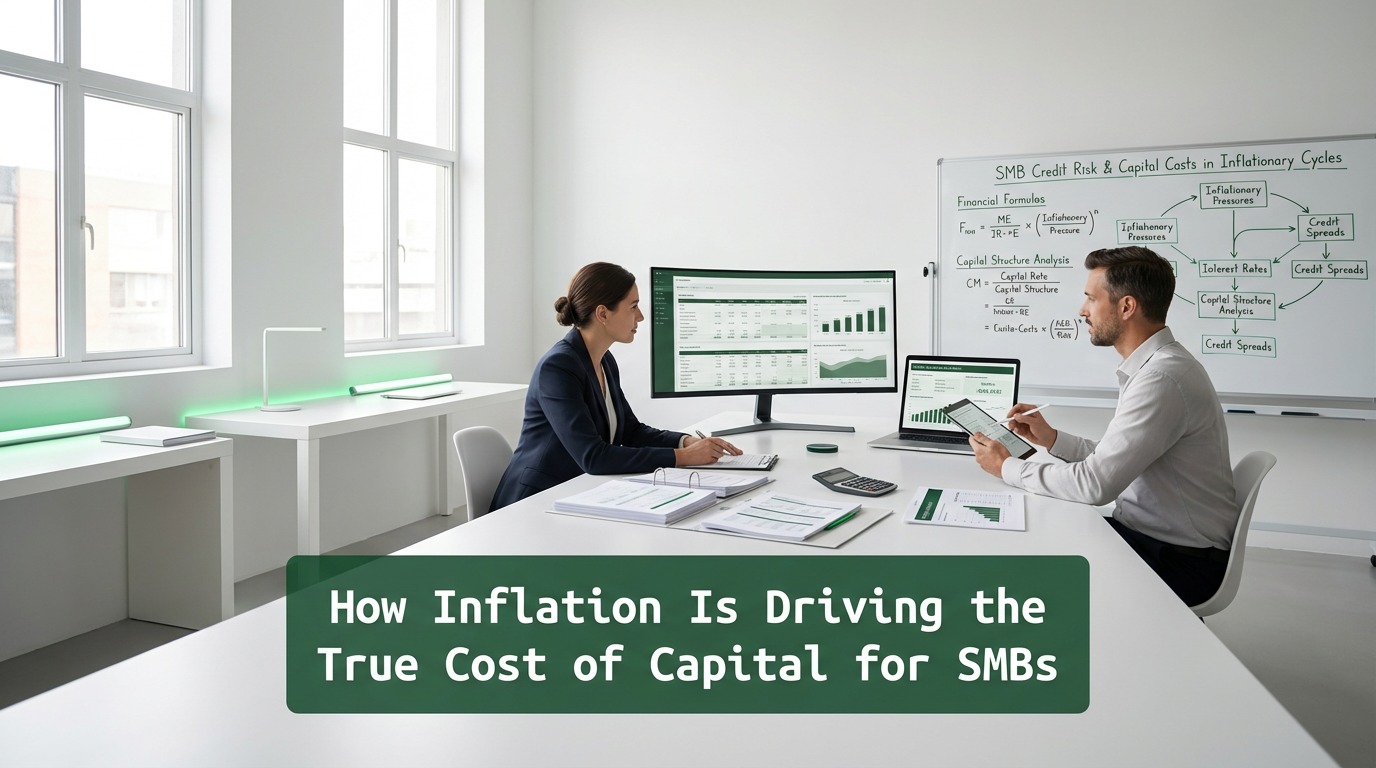
What Inflation Is — And What It Is Actually Doing to Your Cost of Capital
The Macroeconomic Pressure System Every SMB Operator Needs to Understand Before the Next Facility Conversation
SERIES CONTEXT
This article is the first in a three-part series examining how inflation reshapes capital access and deployment for SMB operators.
It builds on Capital Source’s:
- True Cost of Money framework
- Capital Governance Stack
- SMB Credit Tightening Series
- TLAC institutional analysis
If you’re familiar with those frameworks, this article extends them. If not, it stands independently and introduces the core mechanics you need to understand what’s happening in today’s credit environment.
KEY POINTS
- Inflation is not a single cause event. It is the combined effect of supply constraints, demand expansion, monetary conditions, and expectation dynamics acting together.
- The most immediate impact on SMBs is not rising input costs—it is the transmission of inflation into borrowing costs, making capital both more expensive and less available.
- Regulatory capital research and Federal Reserve reporting show that TLAC-driven balance sheet pressure and inflationary rate conditions compound: less credit, higher cost, fewer competing lenders.
- The Inflation Transmission Mechanism explains how macro conditions convert into borrowing cost increases, working capital strain, and operating cycle disruption.
- The True Cost of Money is no longer a strategic advantage—it is the minimum operating standard in this environment.
DEFINITION
Inflation Transmission Mechanism
The pathway through which inflation converts into higher borrowing costs, increased operating expenses, and pressure on the working capital cycle. It operates through three channels:
- Rate-channel
- Cost-channel
- Demand-channel
THE INSTITUTIONAL CONTEXT
This environment cannot be understood without recognizing the institutional constraints shaping it.
Research from the Bank for International Settlements and Federal Reserve analysis of post-Basel III capital frameworks shows that:
- TLAC requirements
- G-SIB surcharges
- Enhanced leverage ratio rules
have increased the structural cost of maintaining large commercial loan books.
The result is not a shutdown in lending. It is:
- tighter credit selection
- higher pricing
- more constrained deployment
At the same time, the SMB Credit Tightening framework identifies the Credit Availability Gap:
the widening separation between a business’s actual credit quality and its access to conventional financing.
Inflation does not create this gap. It intensifies it.
When regulatory pressure and inflation-driven rate increases hit at the same time, the outcome is a credit market that is:
- tighter
- more expensive
- less competitive
That combination is what SMB operators are now facing.
SECTION ONE: WHAT INFLATION ACTUALLY IS
Inflation is the sustained increase in the general price level across an economy.
That definition alone isn’t useful operationally.
What matters is what is driving inflation, since the cause determines how it affects your business.
Three pressure systems drive inflation:
Supply-Side Pressure
Supply-side inflation occurs when production capacity falls behind demand.
Drivers include:
- supply chain disruption
- rising input costs
- labor shortages
- material constraints
For SMBs, this shows up immediately in:
- inventory costs
- procurement pricing
- margin compression
This is most severe for businesses that rely heavily on inventory or physical inputs.
Demand-Side Pressure
Demand-side inflation occurs when spending increases faster than supply can respond.
This can initially look positive:
- higher sales
- stronger revenue
But it creates hidden pressure:
- inventory becomes more expensive to maintain
- receivables take longer to collect
- working capital cycles extend
Revenue may rise, but cash becomes harder to access.
Monetary Conditions
Monetary policy interacts with both supply and demand.
When money supply expands faster than output:
- purchasing power declines
- inflation rises
When central banks respond:
- rates increase
- borrowing costs rise
Federal Reserve tightening cycles and commercial lending data show that SMB borrowing costs adjust quickly under these conditions.
This effect becomes stronger when combined with regulatory capital pressure, since both forces push borrowing costs in the same direction.
SECTION TWO: THE INFLATION TRANSMISSION MECHANISM
Understanding inflation is not enough. You need to understand how it reaches your business.
The transmission occurs through three channels:
Rate-Channel Transmission
This is the most visible channel.
When rates rise:
- variable-rate facilities reprice immediately
- new loans come at higher rates
- refinancings occur in a more expensive environment
Even fixed-rate debt is affected when:
- it matures
- it needs renewal
This means your capital structure is constantly being repriced against current conditions.
Cost-Channel Transmission
This channel operates through your operating cycle.
When input costs rise:
- more capital is required to run the same business
- inventory costs increase
- labor and logistics costs rise
Research on working capital in inflationary environments shows that:
capital requirements often rise proportionally—or more—relative to input cost increases
If your facilities were sized for a lower-cost environment, you are now undercapitalized relative to your operating needs.
Demand-Channel Transmission
This is the least visible but often the most damaging.
In a demand-driven inflation environment:
- revenue may increase
- but cash conversion slows
What happens:
- customers delay payments
- receivables extend
- inventory holding periods increase
This lengthens your cash conversion cycle (CCC) at the same time that carrying that cycle becomes more expensive.
This is where the EBITDA Illusion becomes dangerous:
- income statements show growth
- actual cash availability declines
SECTION THREE: THE TLAC–INFLATION COMPOUNDING EFFECT
These pressures do not act independently.
They reinforce each other.
BIS and Federal Reserve analysis shows:
- TLAC increases the cost of balance sheet deployment
- inflation increases the cost of funding
Academic and regulatory research on constrained credit environments shows that:
lenders respond by concentrating capital in higher-return relationships
This produces:
- reduced credit availability
- higher borrowing costs
- fewer competitive lending options
Federal Reserve senior loan officer surveys consistently reflect:
- tighter standards
- fewer active lenders
- reduced competition
For SMBs, this creates a three-part reality:
- Less credit available
- Higher cost of that credit
- Less leverage in negotiating terms
This is not just expensive capital.
It is expensive capital with fewer alternatives.
WHAT THIS MEANS OPERATIONALLY
- Rate is not cost—but rising rates increase total cost exposure
- Delays in capital access become more expensive
- Inefficient deployment compounds faster
- Weak working capital cycles become critical failures
The True Cost of Money becomes the operating constraint.
The businesses that perform well here are not those with the lowest rate.
They are those that:
- deploy capital efficiently
- convert revenue into cash quickly
- maintain control over their operating cycle
FORENSIC STRESS TEST
Use this to identify where inflation is hitting your business.
Rate-Channel Exposure
- Do you have variable-rate facilities or upcoming renewals?
- Was your capital structured in a lower-rate environment?
- Has your debt service burden increased relative to cash flow?
Cost-Channel Exposure
- Have input costs increased materially?
- Is your working capital facility sized for prior conditions?
- Has your required working capital base increased?
Demand-Channel Exposure
- Has your cash conversion cycle extended?
- Are customers paying more slowly?
- Is your income statement stronger than your actual cash position?
If you are exposed in multiple channels, you are operating in a compounding inflation environment.
FREQUENTLY ASKED QUESTIONS
What is the Inflation Transmission Mechanism?
It is how inflation moves from macro conditions into your business through borrowing costs, operating expenses, and working capital strain. Different businesses are affected through different channels.
How does TLAC increase borrowing costs?
TLAC raises the cost of capital for large institutions. When combined with inflation-driven rate increases, this raises borrowing costs and reduces competition among lenders.
Why does the True Cost of Money matter more now?
Because margin for error is smaller. Inefficient deployment or slow cash conversion can make capital unserviceable in a higher-rate environment.
Supply-side vs demand-side inflation — what’s the difference?
Supply-side: raises input costs
Demand-side: increases revenue but stretches cash cycles
Each creates different risks and requires different responses.
How does inflation affect working capital?
It:
- increases required capital
- extends receivables
- raises cost of carrying the cycle
This can create a structural deficit even when revenue grows.
CONCLUSION
Inflation is not abstract for SMB operators.
It determines:
- what capital costs
- how fast those costs compound
- whether your operating cycle can support debt
The Inflation Transmission Mechanism shows that:
- rate, cost, and demand pressures interact
- income statements do not fully reflect risk
- working capital becomes the critical constraint
The next article will focus on how rising rates specifically reprice facilities and reshape working capital economics.
Understanding how inflation affects your operating cycle is the first step.
Capital Source provides forensic capital structure assessments to evaluate:
- borrowing base
- working capital cycle
- deployment efficiency
If you’re new to the Capital Governance Stack, start with the series overview before continuing.
STRATEGIC DISCLOSURE
Capital Source is a commercial capital advisory firm. This article is produced for informational purposes and represents the firm’s analytical perspective on current macroeconomic and credit market conditions. It does not constitute financial, legal, or investment advice. Businesses evaluating capital structure decisions should engage qualified advisors with direct knowledge of their specific operating circumstances.
Proud to be ranked on the 2024 and 2025 Inc. 5000 list of America’s fastest-growing private companies.